
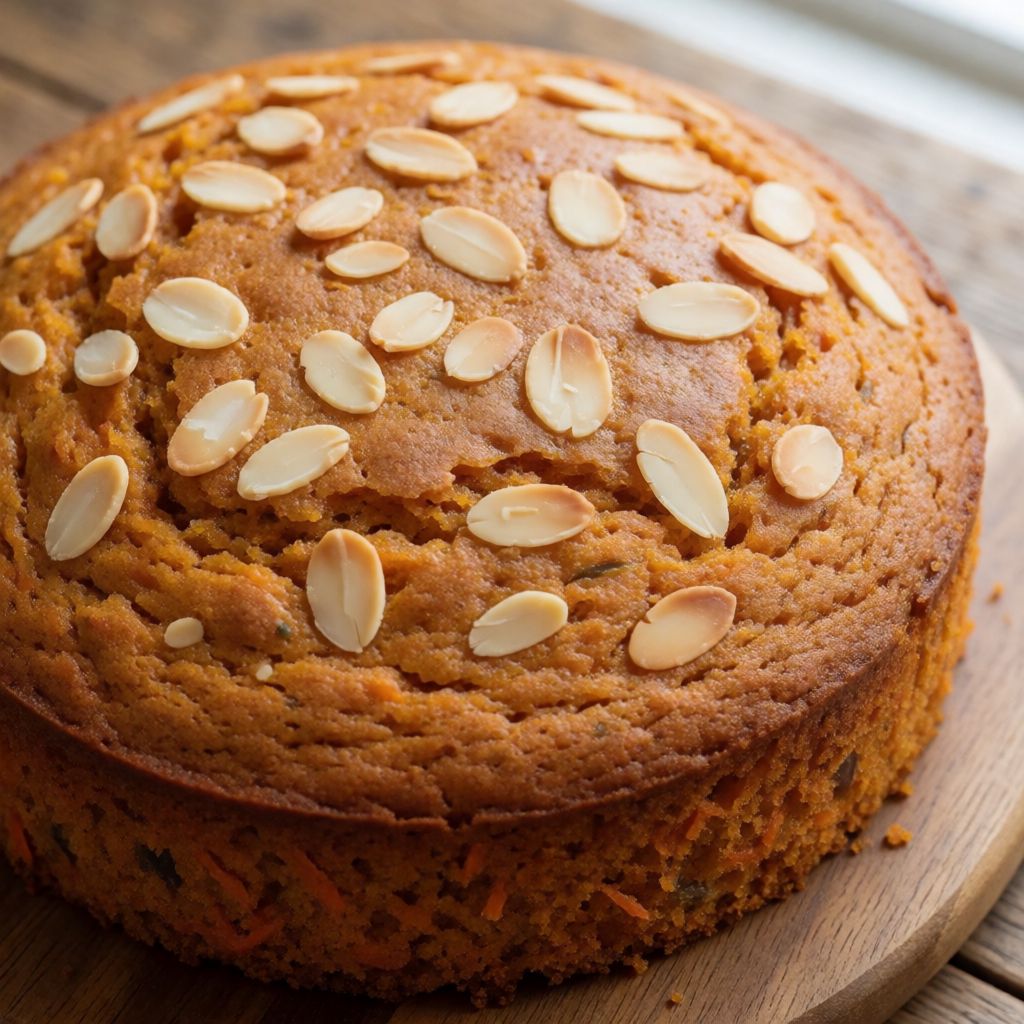
 AI photo
Vegan Carrot Cake
A simple vegan carrot cake made with almonds and rice flour.
Labels are worked out automatically from the ingredients and can be wrong. Check the packaging if it matters to you.
Ingredients
- 250 g Carrot
- 150 g Plain flour
- 50 g Rice flour
- 80 g Brown sugar
- 75 ml Vegetable oil
- 50 g Almonds
- 75 ml Soy milk
- 16 g Baking powder
- Icing sugar to taste






Steps
Toast the almonds in a heavy-bottomed pan, then grind them in a blender.
Wash and peel the carrots, add the vegetable oil and blend until smooth.
Transfer the carrot mixture to a bowl and add the ground almonds.
Add the brown sugar and mix well.
Sift the flour, add it with the baking powder and mix.
Add the soy milk and rice flour, and mix well.
Grease a 20 cm tin with oil, dust with flour and pour in the batter.
Bake in a preheated oven at 180°C for about 30 minutes.
30 minLet the cake cool before serving.
Dust with icing sugar before serving.
What was changed
The rice oil in the original is replaced with vegetable oil Vegetable oil, a neutral oil easy to find in British shops.
A carrot cake without eggs, without butter, and without dairy milk — which sounds like a dare but is actually just honest engineering. Eggs in a normal cake do two jobs: they bind and they lift. Here the lift comes from baking powder, and the bind comes from the carrot itself, pureed to a wet paste, plus the oil. You're not missing an ingredient so much as trading one mechanism for another.
What decides whether this works is the moisture balance. Carrot is mostly water held inside cell walls. Blend it to a puree and you release that water into the batter — more than grated carrot ever would, because you've broken the cells open rather than just torn them. That extra liquid is why the recipe leans on two flours instead of one: plain flour gives structure, rice flour (no gluten) keeps the crumb from going gummy under all that wet carrot. Some say rice flour is there "for texture" — no, it's there because it can't form gluten strands, and a cake this wet needs something in it that won't turn to glue.
The baking powder is doing heavier lifting than usual — 16 g is a real dose, not a pinch — because there's no egg foam to carry air into the oven. It has to do all the rising on its own, chemically, the moment it meets liquid and heat. That's also why you move fast once the wet and dry are combined: baking powder starts working the second it's wet, and every minute you dawdle before the oven is a minute of lift wasted in the bowl instead of in the tin.
Carrot: 250 g, washed and peeled — peeling matters more here than in a stew, because the skin has a bitter, slightly soapy edge that a chunky carrot cake can hide but a blended one cannot. You're pureeing it smooth, so every off-flavour in the peel ends up smooth too, evenly distributed instead of chewed out and left on the side of the plate. Choose carrots that feel heavy and firm — a carrot that bends before it blends has already lost moisture to storage, and you need that moisture.
Plain flour and rice flour: the plain flour (150 g) is where your structure comes from — it's the only flour here with gluten to speak of, and gluten is what holds the risen crumb up once the baking powder has done its job. Rice flour (50 g) is the counterweight: no gluten, so it can't toughen, and it absorbs the carrot's released water without turning gummy. If you don't keep rice flour in the cupboard, cornflour will do roughly the same job in roughly the same amount — it's there for absence of gluten, not for any flavour of its own.
Brown sugar over white isn't a style choice, it's a flavour one: brown sugar carries molasses, which brings a faint bitterness and depth that plays well against raw carrot's sweetness. White sugar would make the cake sweeter and flatter at the same time. 80 g is a modest hand — this isn't meant to read as dessert-sweet, more as a tea-time cake, which suits it well for a British table where it'll sit next to a cup with milk in it rather than against ice cream.
Vegetable oil, 75 ml: any oil with no smell of its own — sunflower, light rapeseed, the bland end of the vegetable oil shelf. Not olive oil, which has its own opinion about flavour and will argue with the carrot. Oil here replaces butter's fat function but not its structure function — butter, when creamed, traps air; oil can't trap anything, it just coats flour particles and keeps the crumb tender. That's fine, because your air this time comes from the baking powder, not from fat.
Soy milk, 75 ml: it's not pretending to be dairy, it's providing the liquid a normal recipe would get from milk and eggs combined, which is why the quantity looks modest — the carrot puree is already supplying most of your moisture. Any plant milk with no strong flavour of its own will substitute — oat is close, almond doubles down on the almond note already in the cake, which isn't a bad accident if that's what's in your fridge.
Almonds, 50 g, toasted then ground: toasting is non-negotiable if you want flavour rather than filler. A heavy-bottomed pan matters here too — thin pans scorch almonds unevenly before the centre has coloured, so you get bitter spots next to pale ones. Keep them moving, judge by smell and colour, not a clock — they go from pale to golden to burnt faster than you expect once they start, because the sugars inside them are catching all at once.
On the oven: 180°C is where this recipe lives or dies, but a domestic oven rarely tells the truth about its own dial — fan ovens run hotter than they claim, old ovens run cooler in the corners. Thirty minutes is your lower bound, not your answer. The real test is the one every baker uses and no thermometer replaces: a skewer or knife into the centre should come out without wet batter clinging to it. Some say you should open the oven door to check — no, not in the first twenty minutes, because every time you let the heat out before the structure's set, the rise collapses and you're left with a cake that's dense in the middle and done at the edges.
Let it cool before you dust with icing sugar — not for looks, though it does help there, but because a warm cake sweats, and that sweat will dissolve icing sugar into a wet patch rather than leaving it sitting pretty on top. Patience here isn't optional, it's the difference between a dusted top and a soggy one.