
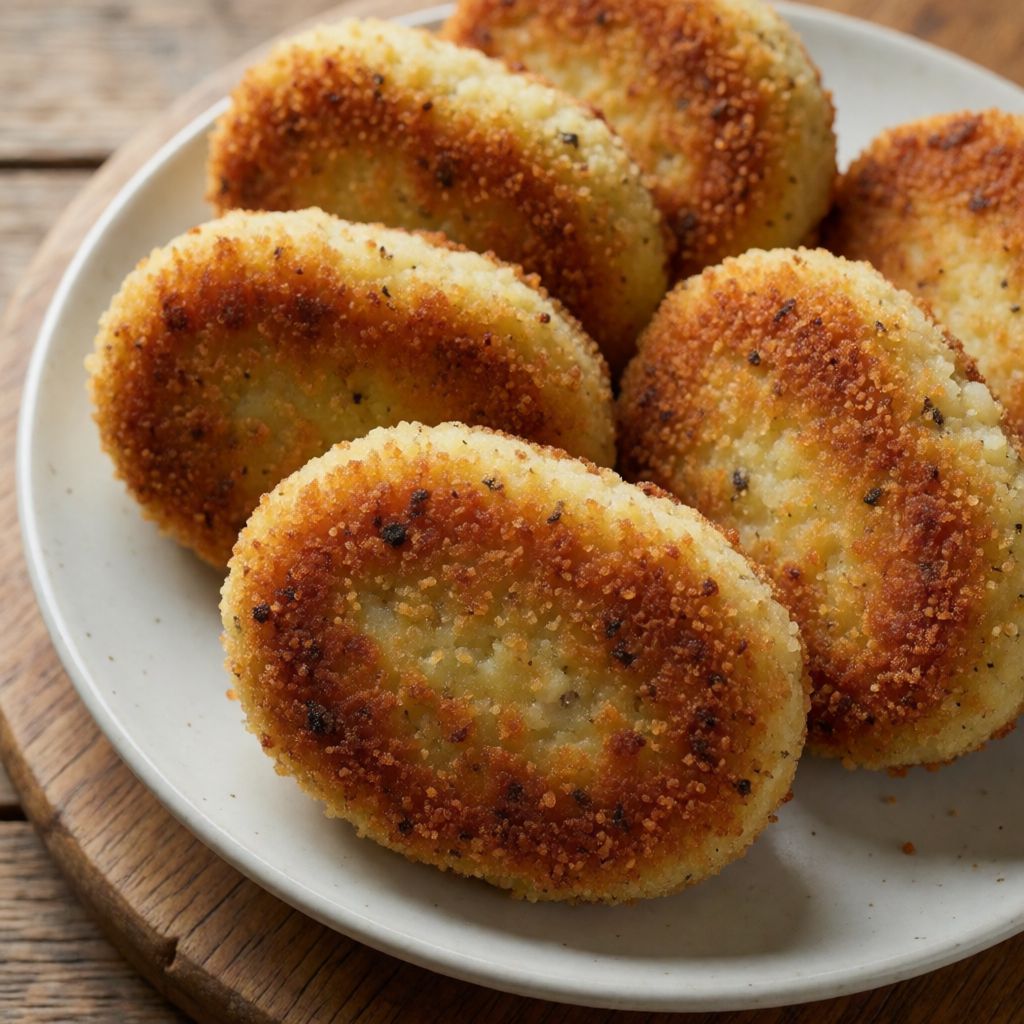
 AI photo
Cauliflower and Potato Cutlets
A simple side of cauliflower and potato cutlets, pan-fried until golden and finished in the oven if you like.
Labels are worked out automatically from the ingredients and can be wrong. Check the packaging if it matters to you.
Ingredients
- 600 g Cauliflower
- 250 g Potato
- 50 g Parmesan
- 1 pcs Egg
- 2 tbsp Breadcrumbs dried
- 80 g Smoked scamorza
- Parsley to taste
- Salt to taste
- Black pepper to taste
- Crushed cornflakes to taste, or breadcrumbs, for coating
- 1 l Vegetable oil









Steps
Break the cauliflower into florets and boil in salted water for about 10 minutes, until al dente
10 minBoil the potatoes for about 35 minutes, depending on size, then cool slightly and peel
35 minMash the potatoes and cauliflower with a potato masher and transfer everything to one bowl
Add the egg, Parmesan, parsley, salt, black pepper and breadcrumbs, and mix well
Shape into 40 g cutlets, place a piece of smoked scamorza in the centre, roll into balls and coat in crushed cornflakes or breadcrumbs
Fry the cutlets in small batches in hot oil for about 5 minutes, until golden
5 minIf you like, bake in the oven for 30 minutes at 200°C, or 180°C on fan
30 minArrange on a plate and serve immediately with mayonnaise or a yoghurt sauce
What was changed
Peanut oil was replaced with Vegetable oil, and the crunchy corn coating was replaced with Crushed cornflakes, both more familiar to British shoppers.
This is a croquette dressed up as a cutlet — mashed cauliflower and potato, bound into a ball, with a core of smoked cheese waiting to run once you bite through the crust. What decides whether it holds together, and whether the inside stays molten instead of weeping into the oil, is how dry your mash is before you add the egg and how cold it is when you fry it.
Cauliflower carries a lot of water even after boiling — it just doesn't look wet, it's wet in the way a sponge is wet. If you mash it straight from the pot without letting it sit and steam off, that water goes into the mixture, and the mixture goes limp in the pan: the coating won't crisp, it'll just slide off into the oil like a flake of old paint. So the forty-five minutes of prep isn't padding. Some of it is you standing there doing nothing, letting the vegetables give up their water to the air instead of to your cutlet.
The scamorza in the middle is the whole point, not a garnish. You're building a shell around a piece of cheese and asking it to hold its shape in hot oil long enough for the outside to brown before the inside blows out. That only happens if the cheese is cold and the ball is sealed properly — no cracks, no thin spots — because a crack is where the fat gets in and the filling gets out. Chill the shaped balls if your kitchen is warm; a cold core buys you the seconds you need.
Cauliflower, 600 g: buy it heavy for its size, white to cream, with the leaves still tight and green — a cauliflower with yellowing patches has been sitting under supermarket lights too long and will taste of nothing but water. Boil it in salted water only until a knife meets a little resistance, not until it collapses; it's getting mashed anyway, but a cauliflower boiled to mush has taken on more water than one boiled to al dente, and that water is the enemy here, not the texture.
Potato, 250 g: a floury variety — Maris Piper or King Edward, since you're in the UK — breaks down dry and fluffy when mashed. A waxy salad potato stays gluey and won't bind the way you need. Boil it whole, skin on, so it doesn't drink the cooking water; peel after, while it's still warm enough to handle but not so hot it burns you. This is standard roast-dinner potato sense — the same reason you don't boil your Sunday roast spuds peeled and chopped into tiny bits if you want them to fluff up properly.
Parmesan, 50 g: this is seasoning, not bulk — it adds salt and a savoury backbone the vegetables don't have on their own. Any hard, dry grating cheese works on the same logic: it has to be dry enough not to add more moisture to a mixture that's already fighting moisture. A soft cheese here would undo the point of letting everything cool and dry out first.
Egg, 1: the glue. It's what turns a bowl of mashed vegetable and cheese into something that holds a shape instead of falling apart the moment it meets hot oil. Don't skip it thinking the breadcrumbs will do that job — breadcrumbs absorb, they don't bind.
Smoked scamorza, 80 g: the molten centre. Its job is to melt without immediately turning to liquid and running everywhere — a firm, stretched-curd cheese like this (or a smoked mozzarella, or provolone in a pinch) holds its shape just long enough. A soft, wet cheese like a fresh mozzarella ball will simply flood the moment it's warm, and you'll get an empty shell and an oily puddle instead of a cutlet with a secret inside.
Breadcrumbs (dried, 2 tbsp in the mix, more for coating), and cornflakes as the coating option: in the mixture, breadcrumbs are there to take up the last of the moisture and give the egg something to grip. On the outside, your job is to build a barrier between the oil and the filling — a barrier that crisps fast, because the faster it crisps, the less time the oil has to seep in and the less time the cheese has to escape. Panko, if you have it, crisps even more aggressively than ordinary breadcrumbs for the same reason cornflakes do: it's already dried hard.
Vegetable oil, the full litre: you need enough depth that the cutlets float rather than sit on the bottom of the pan scorching on one side. Any oil with no flavour of its own and a smoke point well above a gentle fry will do — sunflower, rapeseed, groundnut. Olive oil has too much personality and too low a smoke point for this; save it for the yoghurt sauce on the side instead.
On the stove the "medium heat" instruction some recipes give you is useless without a cue: what you're watching for is a cutlet that sizzles the instant it goes in — a lazy ripple, no violent spitting — and turns an even gold, not a patchy brown that means the oil was cold when you started and then crept up. Some say you can skip the fry and just bake these — no, not quite the same thing: the oven at 200°C (180°C fan) will dry and set them nicely if you've already fried them first for colour and a sealed crust, but baking from raw won't give you that crust at all, just a pale, steamed-looking cutlet with a less convincing bite. If your hob is a single small ring and a pan rather than a proper fryer, fry in small batches as the recipe says — crowd the pan and the oil temperature drops with every cutlet you add, and you're back to the pale, soggy problem you were trying to avoid.