
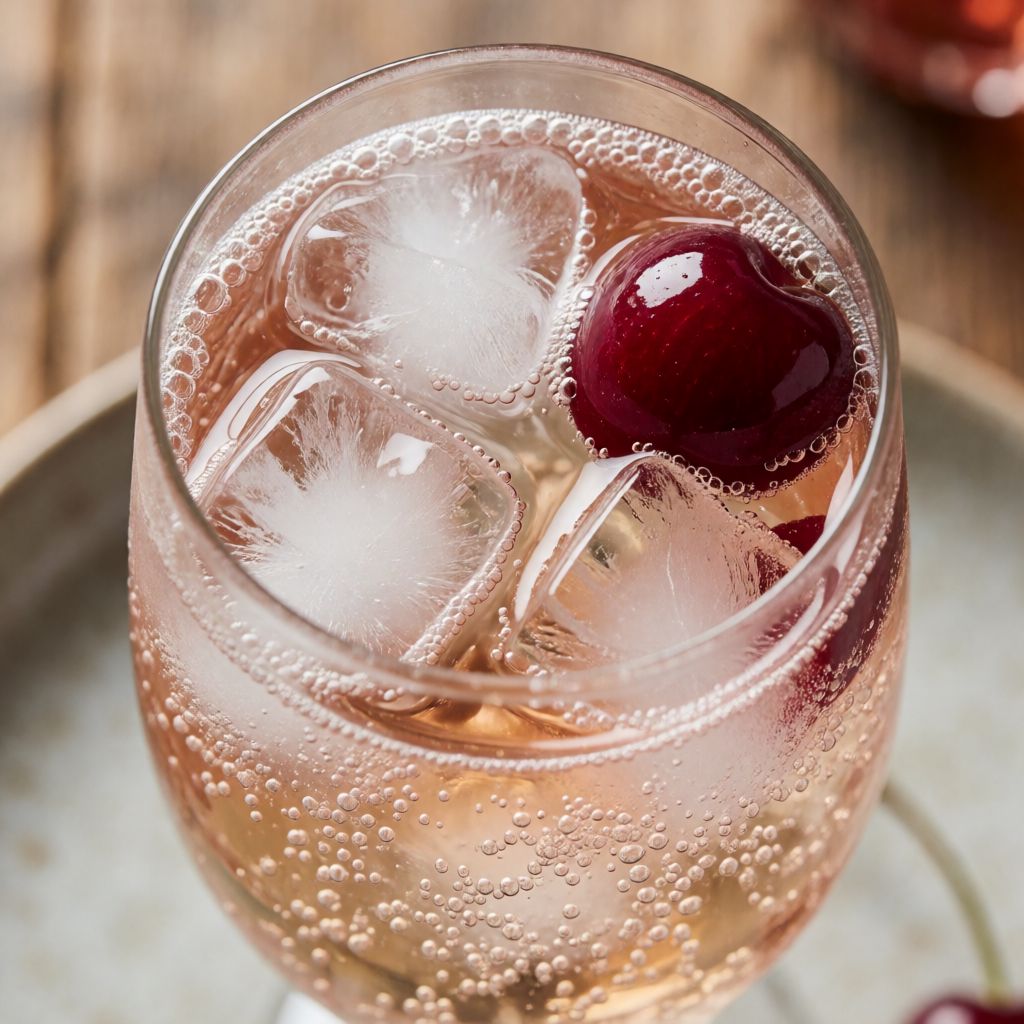
 AI photo
Cherry Cocktail
A quick cherry cocktail with a ginger kick, topped with sparkling wine and garnished with cherries and rosemary.
Labels are worked out automatically from the ingredients and can be wrong. Check the packaging if it matters to you.
Ingredients
- 40 ml Cherry wine or cherry liqueur
- 30 ml Grand Marnier orange liqueur
- 2 pcs Fresh ginger slices
- 100 ml Prosecco or another dry sparkling wine
- pcs Ice cubes
- 2 pcs Cherries for garnish, on a small skewer
- 1 pcs Fresh rosemary sprig






Steps
Put the cherry wine (or liqueur), Grand Marnier and ginger in a shaker with ice and shake until the drink is ice-cold.
Strain through a sieve into a glass and top up with the sparkling wine.
Thread two cherries onto a cocktail stick and garnish the drink with the cherries and rosemary.
What was changed
Cointreau isn't in our ingredient catalogue, so it's been replaced with Grand Marnier, another orange liqueur.
This isn't really a cooked thing — it's an assembly of three liquids and one piece of root, and what makes or breaks it is temperature and order, nothing else. You shake the cherry wine, Grand Marnier and ginger hard with ice until the shaker itself goes cold enough to sting your hand — that's your doneness cue, not a stopwatch count. Only once that's properly cold do you strain it and add the fizz. Reverse that order — pour the Prosecco in first, or shake the whole lot together — and you get a glass of warm, flat sweetness with no lift to it.
The mechanism worth understanding is this: shaking does two jobs at once. The ice chills the liquid, and the agitation pulls the sharp, peppery oils out of the ginger slices faster than steeping ever could — cold mechanical force instead of heat. That's why fresh ginger, sliced thin, not grated: slices give you controlled release and nothing fibrous floating in your glass; grated ginger over-extracts and turns the drink muddy and raw.
The Prosecco is the part people get wrong without knowing it. Some say you can shake a sparkling wine cocktail the same way you shake anything else — no, because shaking doesn't just chill, it also smashes the bubbles against metal and ice, knocking the gas out before it ever reaches your mouth. Prosecco goes in last, poured gently into an already-cold glass, so the bubbles survive the trip from bottle to lip. That fizz is the whole point of the drink; lose it and you've built a sweet, boozy, flat cordial.
Cherry wine or cherry liqueur is the backbone — it needs to taste of actual cherry, not of cherry-flavoured sugar syrup with a shadow of fruit in it. If you can't get a dedicated cherry wine, a cherry liqueur such as cherry brandy works the same job: fruit concentrated and stabilised by alcohol, not thinned out. The criterion is simple — does it smell of cherries when you open the bottle, or just of sweetness? If it's the second, you're better off with a small splash of cherry juice stirred into a neutral spirit than with a bad commercial liqueur.
Grand Marnier is there to do one specific thing: bitter orange peel against all that cherry sweetness. It's a cognac-based orange liqueur, and its job is to stop the drink collapsing into one-note syrup. Any orange liqueur with real peel bitterness in it — Cointreau, triple sec, even a decent orange curaçao — will do the same work. Don't reach for orange juice as a substitute; juice brings sugar and water, not the bitter edge that's actually doing the balancing here.
Ginger has to be fresh, sliced, not powdered and not grated — powder has none of the volatile oil left in it (it's long gone by the time it's dried and ground), and grated ginger shreds into the glass and over-extracts under shaking, turning sharp instead of aromatic. Two thin slices, bruised a little by the ice knocking around them in the shaker, is enough.
Prosecco needs to be dry — the sweetness in this drink already comes from the cherry wine and Grand Marnier, so a dry sparkling wine is doing the balancing act, not adding to the sugar pile. You're in the UK, so don't feel obliged to reach for Italy specifically: a dry English sparkling wine from Kent or Sussex does the same structural job, and arguably it's the more honest choice given where you're drinking it — Prosecco became the house pour across Europe mostly because it's cheaper to make than proper method traditionnelle fizz, not because it's uniquely suited to cocktails. Cava works too. What matters is dryness and a working fizz, not the label.
The ice cubes aren't just there to make it cold — the water they release as they melt during shaking is part of the recipe's dilution, softening the alcohol's edge. Don't skip the shake-with-ice step and just pour everything over ice in the glass; you'll get a sharper, less rounded drink because that dilution never happens properly.
Cherries and rosemary on a stick are not decoration you can skip without consequence. The stick matters because nobody wants to fish two cherries out of a full glass with their fingers — that's the defect it prevents, not vanity. The rosemary sits close to your nose as you drink, so its sharp, resiny smell reaches you before the liquid does; that's deliberate, and it's worth bruising the sprig gently between your fingers before you drop it in, to wake the oil up a bit.