
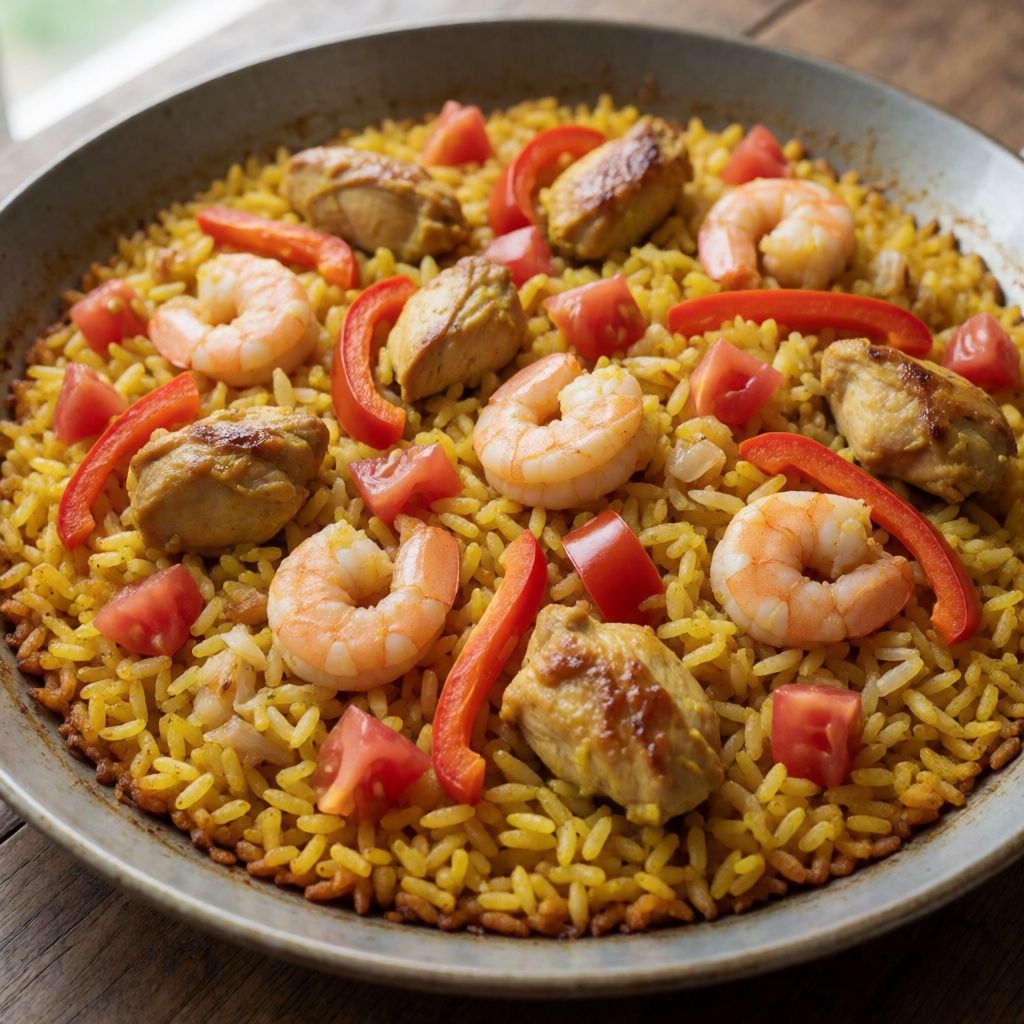
 AI photo
Paella with Chicken and Prawns
A paella with chicken, prawns, peppers and saffron rice, finished with lemon and orange.
Labels are worked out automatically from the ingredients and can be wrong. Check the packaging if it matters to you.
Ingredients
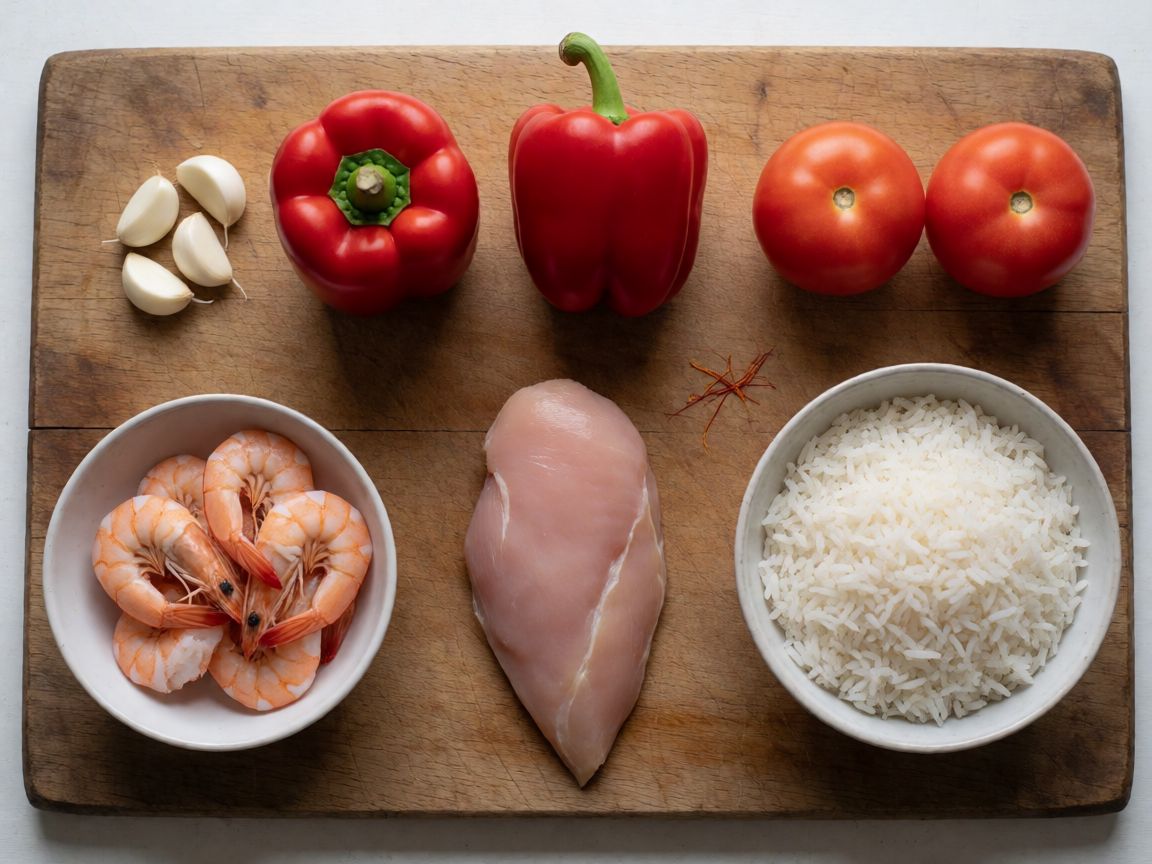
- 3 clove Garlic
- 1 pcs red bell pepper
- 1 pcs Bell pepper
- 2 pcs Tomato
- 1 pcs Chicken breast
- 200 g Prawns
- 2 pcs Saffron
- 950 ml Water hot
- 300 g Parboiled rice
- 1 package Peas well drained
- Olive oil to taste
- Oranges to taste
- Lemons to taste








Steps
Slice the pepper thinly, slice the garlic, and cube the tomatoes. Put everything in a pan with plenty of olive oil and fry.
Add the diced chicken breast and cook until the chicken reaches a safe internal temperature of 74°C.
10 minSet the vegetables and chicken aside.
In a paella pan or large frying pan, toast the rice with the saffron without oil.
Add the vegetables and chicken, stir, then pour in 950 ml of hot water and a stock cube. Cook.
Add the prawns and keep cooking.
10 minTip in the well-drained peas and cook through, stirring as little as possible.
Garnish the paella with lemon slices and orange rounds with the peel on.
Let's be honest about what this is: not paella, but a very good socarrat-less rice dish cooked in the spirit of one, in a flat with an electric hob instead of a gas ring and a kazan-wide pan over an open flame. Real paella is cooked over fire spread wide under a shallow pan, so the heat hits every grain evenly and the bottom catches that crust — socarrat — that Spaniards fight over with forks. Your frying pan on a British hob heats mostly in the centre. That's not a flaw in you or the recipe, it's physics, and once you accept it, you stop chasing a crust that was never going to form and start chasing something you can actually get: rice that's swollen, separate, each grain carrying stock and saffron rather than drowning in it.
What decides whether this works is not timing, it's the ratio of rice to liquid and the discipline not to stir. Rice absorbs water until it can't anymore, and parboiled rice especially has a window — past it, you get porridge, short of it, you get grit in the middle of a soft grain. 950ml to 300g is close to the standard 3:1 that bomba or paella rices expect, parboiled behaves a little differently because it's already been part-cooked and dried industrially, so it drinks slower and more evenly. That's actually an advantage for you here: it forgives a slightly uneven hob.
Saffron is the one ingredient here with no honest substitute — turmeric gives you the colour and none of the aroma, and the aroma is the entire point of putting it in. Two strands sound stingy, but saffron is sold by the thread for a reason: a gram of it costs more than a gram of silver some years, because each flower gives three stigmas and someone picked them by hand. Toast it dry with the rice rather than steeping it in water first — the dry heat opens it faster, you get the colour and the scent released straight into the grain that's about to drink it.
The chicken breast: cubed, cooked till it's done through rather than by the clock, 10 minutes is the lower bound your hob happens to need today, not a law. Breast is lean, no fat to protect it, so it goes from done to dry fast — pull it the moment it's cooked rather than leaving it in while you fuss with vegetables. If you'd rather not dice raw breast ahead of frying, thighs forgive overcooking better and won't punish you for five extra minutes; that's a real trade, not a downgrade.
Prawns go in late and briefly — raw prawns turn from grey-pink translucent to opaque and curl tight when they're done, and beyond that point they toughen, because their protein structure is thin and seizes up fast under heat, unlike chicken's denser muscle. If yours are the ready-cooked British supermarket kind (pink already), they only need warming through, not cooking — watch for that, it changes your last stage considerably.
Peas go in drained and late for a reason that has nothing to do with taste: they're already cooked, frozen or tinned, and all they'd do simmering longer is bleed starch and go grey-green and soft. Drain them properly — wet peas dilute the stock you've just spent an hour building saffron and chicken flavour into.
Bell peppers and tomato, fried first in "plenty" of olive oil — plenty matters because this is your sofrito, the base flavour the whole dish rests on, and it needs enough fat to actually fry rather than steam in its own juice. Olive oil here isn't negotiable for tradition's sake so much as for flavour continuity — any oil with no smell of its own, sunflower or a mild rapeseed, would carry the frying fine, but olive oil's own slight bitterness and fruitiness is doing real work in a dish this simply seasoned. Garlic sliced, not crushed, so it fries rather than burns to bitterness — crushed garlic has more surface area and catches first.
The stock cube mentioned in the method but missing from your ingredients list is doing the heavy lifting that chicken bones would do in a stock made from scratch — it's the shortcut version of what a Sunday roast carcass gives you for free the next day. If you happen to have roast chicken stock sitting in the fridge from the weekend, use it instead of water and cube both, it's exactly the same economic logic the dish runs on: use what you already paid for.
Orange and lemon on top, peel and all, aren't decoration you can skip without consequence — the bitter oil in citrus peel, released as you eat past it, cuts the saffron and oil's richness. It's a Valencian habit from a place where orange groves border the rice paddies, not a garnish invented by a food stylist. Leave it off if you must, but know what you're leaving off.
Patience, finally, is the ingredient with no gram weight. The rice needs its full drink of liquid without you rushing it along with extra stirring or extra heat, and the chicken needs you to actually check it rather than trust a clock that was written for someone else's hob.