
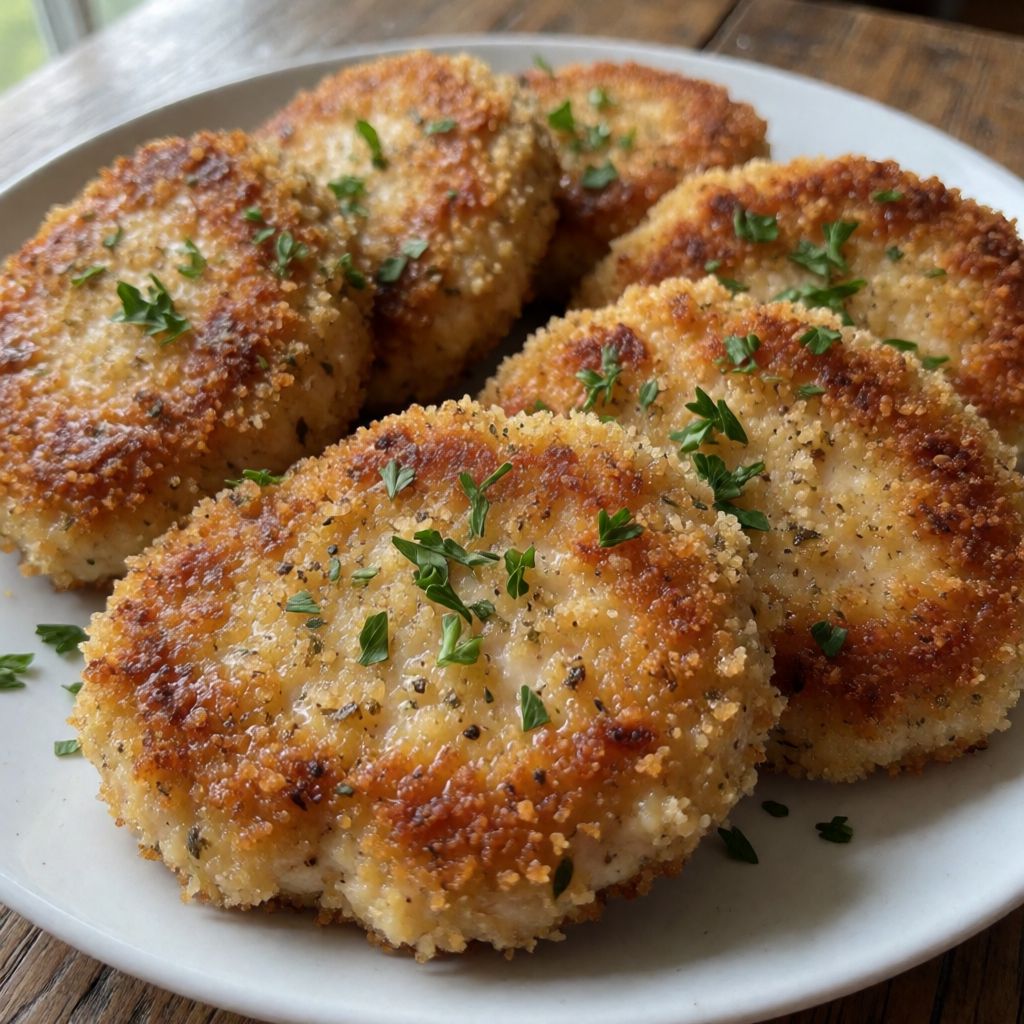
 AI photo
Chicken Breast Cutlets
Tender breaded chicken breast cutlets, pan-fried until golden and crisp.
Labels are worked out automatically from the ingredients and can be wrong. Check the packaging if it matters to you.
Ingredients
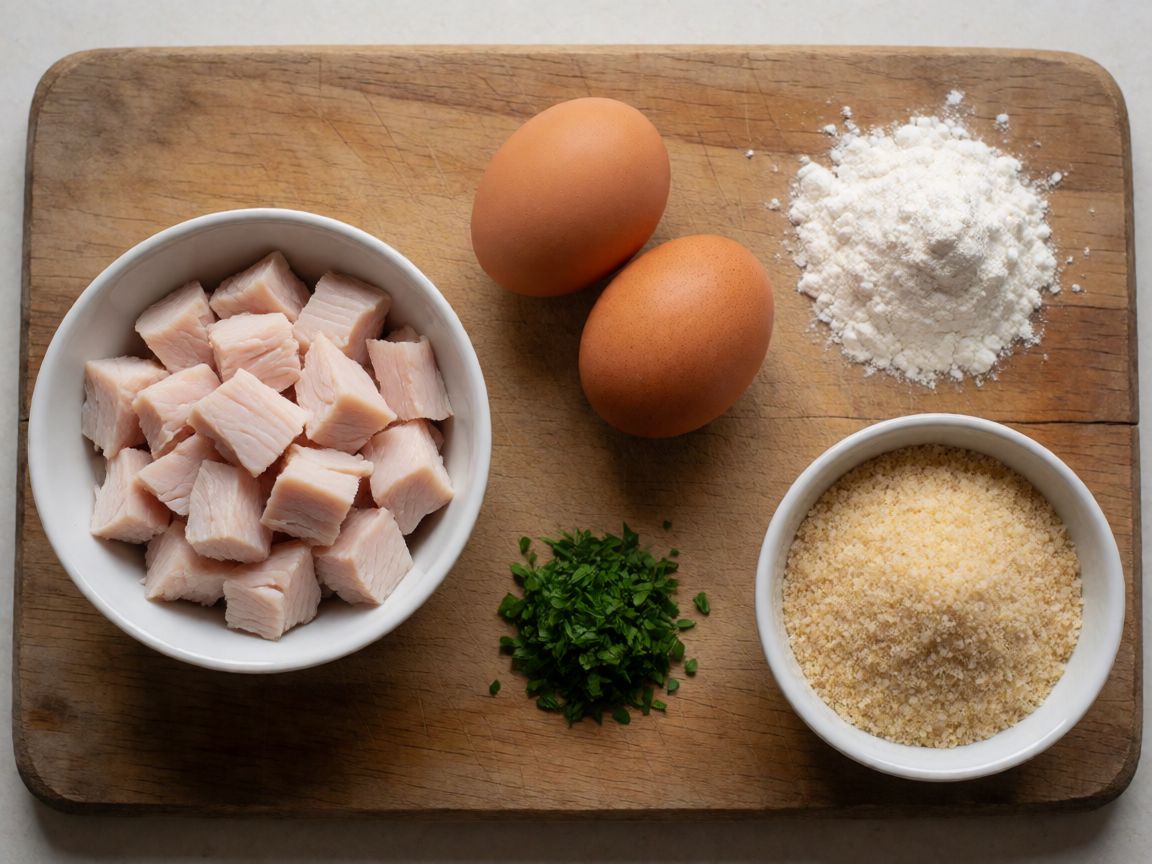
- 500 g Chicken Breast
- 2 pcs Eggs
- Plain Flour for dusting
- 200 g Breadcrumbs
- Parsley to taste
- Salt to taste
- Vegetable Oil for frying







Steps
Cut the chicken breast into thin slices or flatten with a meat mallet to an even thickness.
In a bowl, mix the breadcrumbs with the parsley.
In another bowl, beat the eggs with a pinch of salt.
Coat the chicken slices in flour, dip in the egg, then coat in the breadcrumbs on both sides.
Heat the oil in a frying pan to the right temperature — dip the tip of a wooden skewer into the oil to test it.
Place the cutlets in the hot oil and fry for about 2 minutes on each side until golden brown, making sure the inside reaches 74°C.
Transfer the cooked cutlets to a plate lined with kitchen paper to remove excess oil.
Alternatively, bake the cutlets for about 10 minutes at 180°C in the oven.
10 min
This is a schnitzel by another name — chicken breast flattened, armoured in crumb, fried hot and fast. The whole trick of the dish is solving one problem: breast meat has almost no fat and not much flavour of its own. Left alone it dries out the moment it overcooks, and it overcooks easily because it's lean. The crumb crust is armour against that — it seals the surface so the inside steams in its own juice while the outside goes brown and crisp.
What decides whether it works is evenness, not time. A breast is thick at one end, thin at the other. Fry it as it comes and the thin end is leather before the thick end is even warm through. That's the real reason for flattening it — not to "tenderise" (some say pounding breaks the meat down and makes it softer — no, because breast has no tough connective tissue to break, it's not shin or neck). Flattening just makes one thickness out of two, so the whole piece reaches doneness at the same moment.
The other thing that decides it is oil temperature, and here "medium heat" tells you nothing. Oil too cool and the crumb behaves like a sponge — it drinks oil instead of crisping in it, and you get a pale, greasy, soggy coat no matter how long you leave it in the pan. Oil too hot and the crumb scorches dark before the inside is even near safe. The skewer test — dip the tip in, watch for a steady lace of bubbles rising off it — is the sense cue you use when you don't have a thermometer to read the oil itself.
Chicken breast: buy it as it comes and slice it yourself rather than relying only on the mallet if it's a thick piece — cutting it open like a book and then flattening gives you an even slab without battering the fibres into shreds. You're aiming for one thickness across the whole piece, roughly the width of your little finger flattened, not a specific millimetre count.
Flour: this layer is not there to thicken anything, it's there to give the egg something dry to grip. A raw chicken surface is slick with its own moisture, and egg dropped straight onto wet meat slides off in the pan and ends up in the oil, not on the cutlet. A thin, even dusting of plain flour fixes that — any flour that absorbs a bit of surface moisture does the job, nothing special needed here.
Egg: this is the glue. Beaten with a pinch of salt, it loosens and spreads thin, and the moment it meets heat the proteins set fast, locking the crumb to the floured surface before it has a chance to fall off in the oil. If you ever run short of eggs, a thick flour-and-milk paste can stand in, but it won't set as quickly or as cleanly — egg is simply the better glue because it coagulates on contact with heat rather than needing to dry out first.
Breadcrumbs: this is the crust itself, and it has two jobs — colour and crunch on the outside, a moisture seal on the inside. For that it needs to be dry and fine; damp, fresh breadcrumb won't toast, it steams and goes soft instead of crisping. Panko gives you a lighter, airier crust if you want that; crushed crackers or your own dried, grated stale bread work just as well — the old reason breadcrumbs exist in kitchens at all is thrift, using up bread that's gone past fresh rather than throwing it out. The parsley mixed through is flavour and colour only, not mechanism — dried parsley in a smaller pinch does the same job if fresh isn't in the house.
Oil for frying: the rule is any oil with no smell of its own and a smoke point comfortably above frying heat — sunflower or rapeseed, both easy to find on a British shelf, do this well. Olive oil is the wrong choice here, not from snobbery but from physics: its smoke point sits close to the temperature you need for the crumb to crisp, so it starts burning and tasting bitter right when you need it steady.
One thing from my own kitchen, not written anywhere on the ingredient list: once the pieces are coated, let them sit on a board for a few minutes before they meet the oil. The crumb dries slightly and sets to the surface, and far less of it ends up loose in the pan. It costs you nothing but a little patience, and patience here is doing real work — it's the difference between a crust that stays put and one that sheds into the oil in flakes.
The oven route is a genuinely different mechanism, worth knowing rather than treating as a lesser version of frying. In the pan the crumb crisps because it's sitting in hot fat on all sides; in the oven it's dry convection heat from one direction, so you need to brush oil onto the crumb yourself or it will bake pale and dusty rather than golden. At 180°C ten minutes is the floor, not the answer — check the same way, by colour on the outside and by pressing the centre, which should feel springy and resistant rather than soft and yielding. Either way, with pan or oven, 500g of breast gives you four cutlets, enough for four people alongside something plain — chips, a green salad, nothing that competes with the crust for attention. This is a weekday dish built for speed, the opposite temperament to a Sunday roast's slow hours in the oven — frying was always the fast, cheap route to a cooked protein, and that's the whole of its history, no more mystery in it than that.