
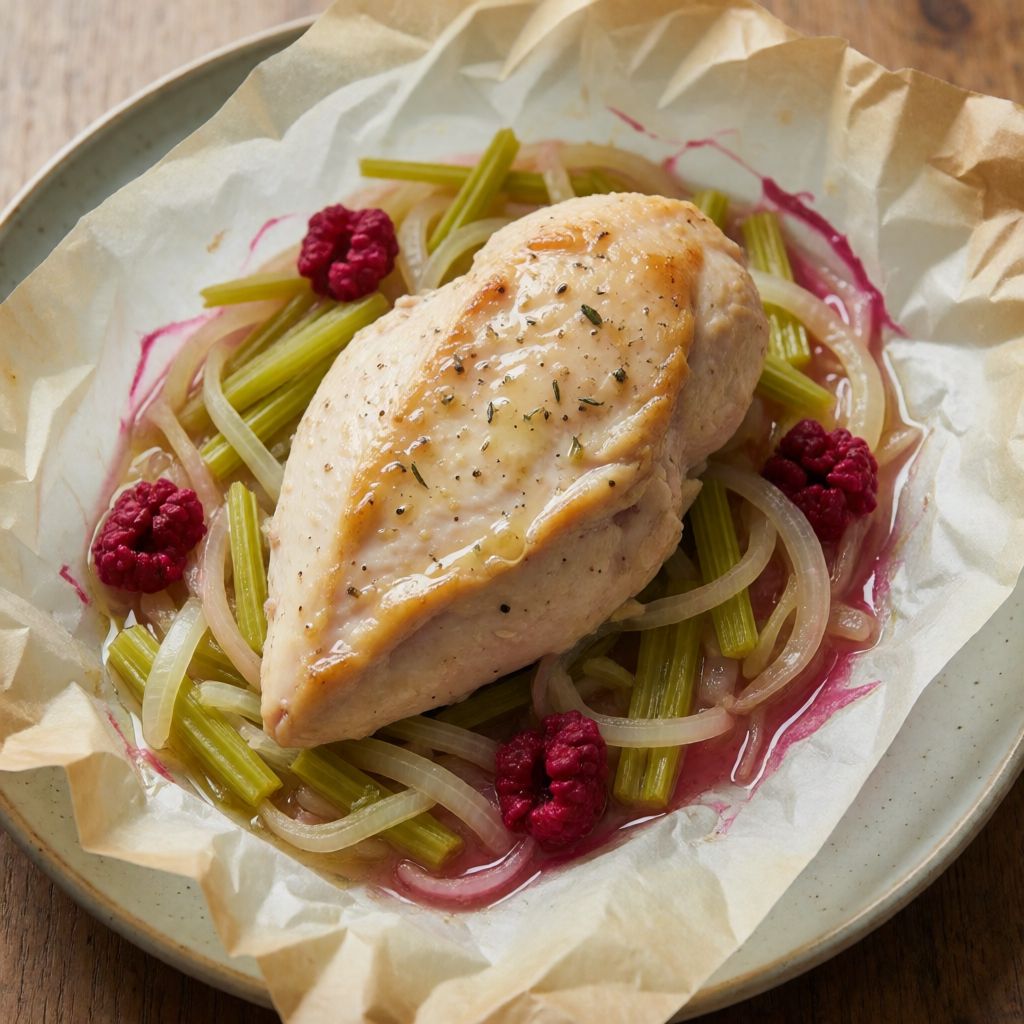
 AI photo
Chicken Breasts in Parchment
Tender chicken breast cubes baked in a parchment parcel with celery, onion, raspberries and pink peppercorns.
Ingredients
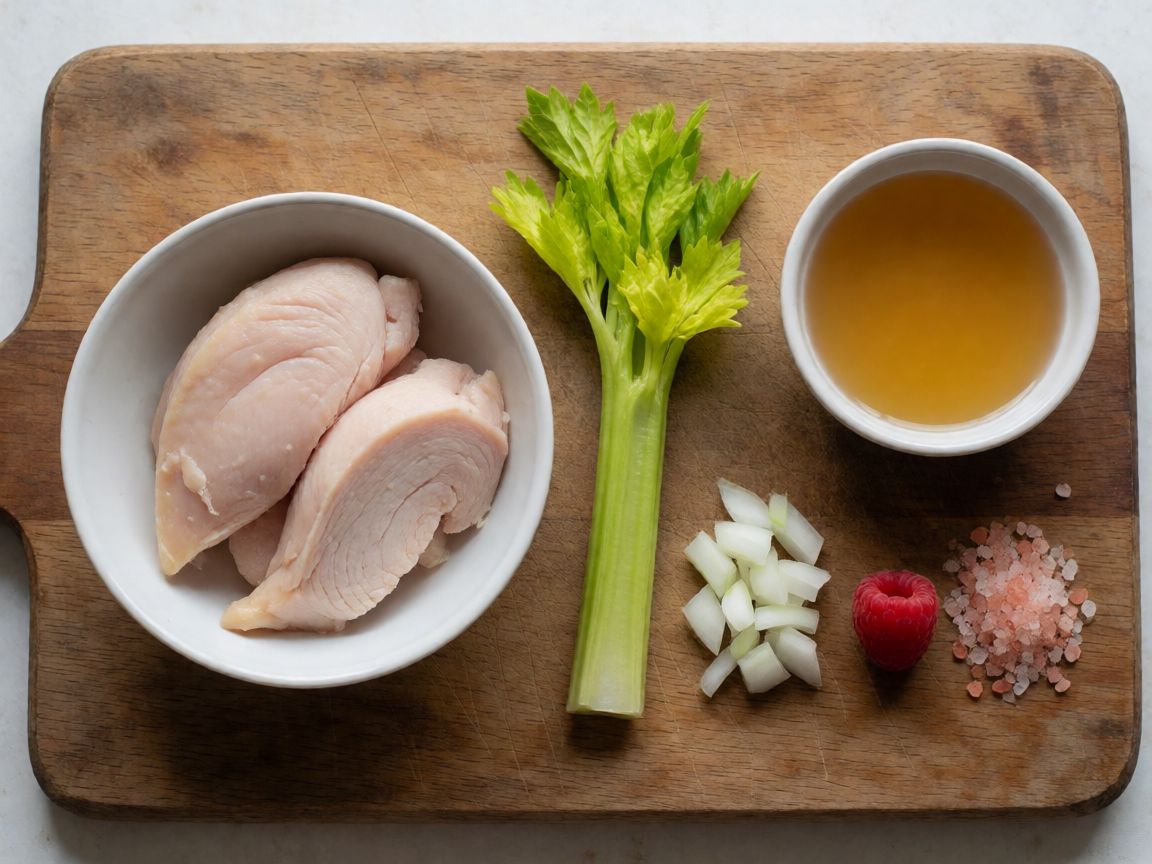
- 500 g Chicken Breast
- Apple Cider Vinegar to taste
- 1 pcs Celery stalk, diced
- 2 tbsp Onion diced
- 1 pcs Raspberries a few
- Olive Oil to taste
- Salt to taste
- Pink Peppercorns to taste








Steps
Dice the chicken breast, season with salt and brush with an emulsion of olive oil and apple cider vinegar.
Brush a sheet of baking parchment with egg white and place it in a baking dish.
Layer the chicken, diced celery and onion on top.
Scatter over the raspberries and a few pink peppercorns.
Cover with a second sheet of baking parchment to form a parcel — the egg white will help seal it.
Bake at 200°C for 20 minutes, until the chicken is fully cooked (internal temperature 74°C).
20 minUnwrap the parcel and serve the chicken with the vegetables and raspberries.
This is chicken breast diced small, salted, brushed with an oil-and-vinegar emulsion, then shut inside two sheets of baking parchment with celery, onion, raspberries and pink pepper, and put in a hot oven. Nothing here is really "roasted" — it's steamed and lightly poached inside its own little tent. The oven just supplies the heat from outside; the real cooking medium is the moisture trapped with the chicken.
What decides whether this works is the seal, not the oven dial. Chicken breast has almost no fat of its own — it's the leanest cut on the bird, which is exactly why it dries out so fast in an open pan. Wrap it and let no steam escape, and it cooks in a cloud of its own juice, the onion's sweetness, the vinegar's bite and the raspberries breaking down into something close to a thin sauce. Let the parcel split or gape, even a little, and you've built yourself a dry, pale disappointment that tastes of nothing but salt.
The egg white brushed on the parchment is the actual mechanism, not a decoration. Egg white is protein in water; heat and moisture make that protein set, the way it does in an omelette, and that set layer glues the two parchment sheets to each other along the fold. That's your "lid" — you have no domestic lid that fits a flat parcel, so you make one out of cooked protein instead.
Some people assume baking paper can't really seal anything the way foil does — no, because it's not the paper doing the sealing, it's the egg white on it. Foil seals by being folded tight and holding its shape; parchment with egg white seals by a chemical change, protein coagulating as it heats, gluing itself shut from the inside. Once you see that, you stop worrying that the parcel will blow open, and you stop fussing over the fold — the glue does the work the fold alone can't.
On the chicken: buy breast, not because tradition says so but because it's the cut that needs this treatment most — lean meat with nothing to protect it from heat. If all you have is thigh, use it; it has its own fat and forgives a loose seal, though it won't need the parcel's help as badly, so the dish stops being quite the demonstration it's meant to be.
The oil-and-vinegar brush before sealing is doing two jobs in one move, because you have no time here for a proper marinade. The vinegar's acid starts working on the surface proteins the moment it touches them — that's what a marinade does over hours, just compressed into the few minutes before the parcel goes in, helped along by twenty minutes of gentle enclosed heat finishing the job. The oil carries flavour and keeps the surface from tasting raw and flat. Any mild acid will do the vinegar's job — lemon juice, a light wine vinegar — just not malt vinegar, which is sharp enough to argue with everything else on the plate instead of just seasoning it. For the oil, the rule is simple: anything with no smell of its own, so light olive oil, sunflower, rapeseed — not a toasted or heavily flavoured oil that will fight the raspberries.
Celery and onion, diced small, aren't there for crunch — crunch is exactly what they're meant to lose. Cut small, they cook through in the same twenty minutes as the chicken and give up moisture as they soften, feeding the little broth that forms inside the parcel. If you've no celery, fennel does something similar — moisture plus a bit of backbone — though it brings its own aniseed note, so the dish changes character slightly rather than staying neutral.
Raspberries are the one properly unexpected thing here, and they're there for acid and a little sugar, breaking down under heat into juice that joins the oil, vinegar and vegetable liquor. Any soft, tart berry that collapses easily when warmed will do the same work — blackberries, redcurrants, even a few chopped cherries. Pink peppercorns aren't pepper at all, botanically — they're a dried berry, soft and floral, which is exactly why they go in here rather than into a hot dry pan: direct high heat would scorch what little flavour they have. Sealed in the parcel, they infuse gently instead. If you don't have them, a little cracked black pepper added at the very end gives you heat without the floral note — not the same thing, just the nearest honest substitute.
A word on your oven: 200°C on the dial and 200°C inside the box are not always the same thing, especially if yours is fan-assisted, which tends to run a touch hotter than it claims. That's one more reason the internal temperature — 74°C, checked with a probe if you have one — is worth trusting over the clock. And once it comes out, give it a minute before you tear the parcel open. The steam inside is real steam, it will find your face if you rush it, and the chicken keeps improving in that last minute of standing — patience here isn't virtue for its own sake, it's the last few degrees of cooking you get for free.