
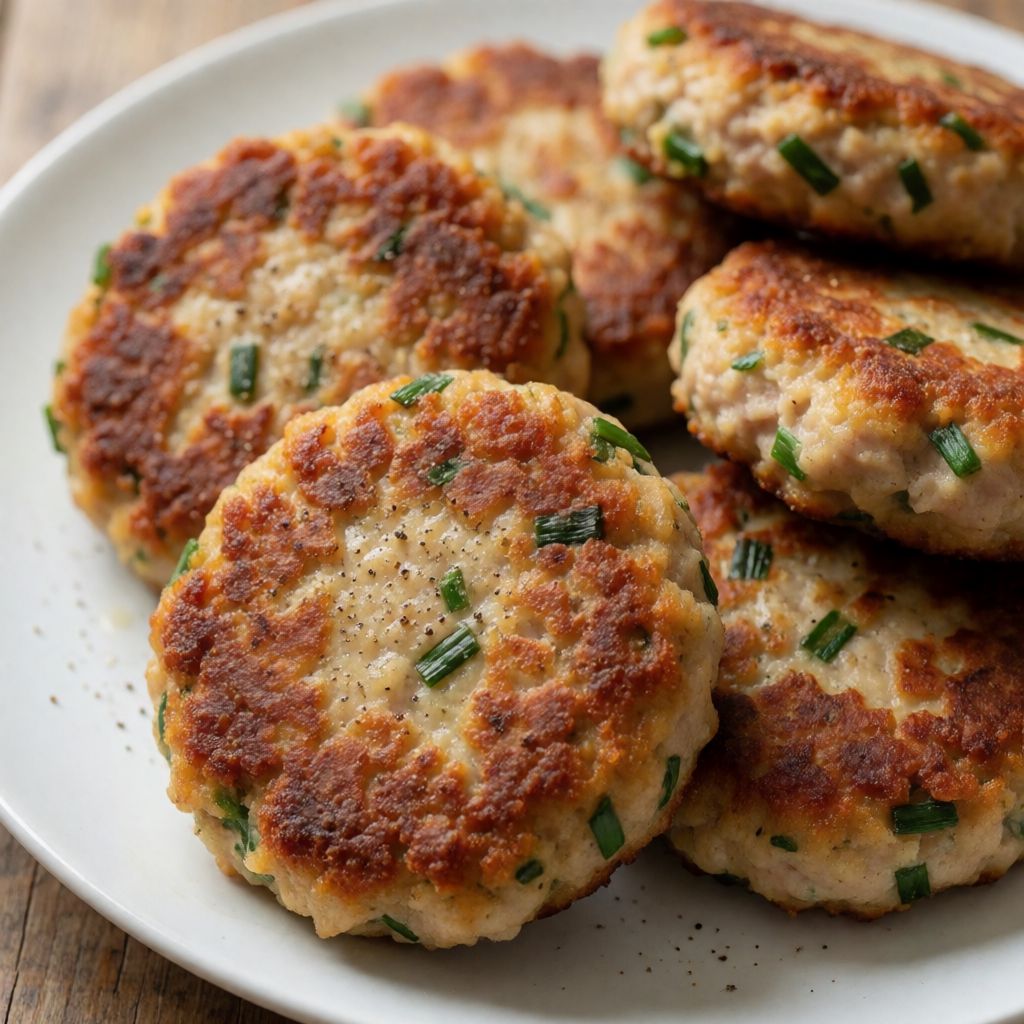
 AI photo
Chicken Burgers: Tasty and Very Simple
Simple homemade chicken burgers, baked or fried until golden and juicy.
Labels are worked out automatically from the ingredients and can be wrong. Check the packaging if it matters to you.
Ingredients
- 700 g Chicken meat breast, thigh, wings
- 2 pcs Eggs
- 100 g Fresh breadcrumbs made from stale bread
- 1 tsp Dried chives
- Salt to taste
- Black pepper to taste
- Dried breadcrumbs for coating, as needed
- Peanut oil as needed
- Olive oil as needed








Steps
Finely chop the meat with a knife until you get an even, soft mixture. Place the chopped meat in a bowl, add the eggs, fresh breadcrumbs, salt, black pepper and chives. Mix well until combined.
Divide the mixture into about 6 balls, flatten them with your hands into a round shape, and coat them in dried breadcrumbs. Press gently on both sides.
Bake in the oven at 200°C for about 15 minutes (the chicken should reach an internal temperature of 74°C).
15 minAlternatively, heat the peanut oil and fry the burgers until golden on both sides, until fully cooked (74°C internally).
Place on a paper towel, season with salt and serve immediately.
What you've got here isn't really a burger in the bread-bun sense — it's a kotleta, the same family as every chopped-meat patty from Moscow to Hamburg: meat bound with egg and bread, fried or baked, needing nothing else to be a meal. Call it a burger if that's the word that gets it eaten at home; the mechanism underneath is older and plainer than the name suggests.
What decides whether it works isn't the chicken, it's the knife. A mincer tears fibres apart and forces them through narrow holes — what comes out is a paste that tightens into rubber the moment it meets heat. A knife leaves short, ragged shreds of muscle that still remember being meat; they stay soft because nobody squeezed the life out of them first. The fifteen minutes with a knife is the actual recipe here. Eggs and breadcrumbs are just scaffolding around it.
Some say chicken burgers are always dry — no, because the chicken was never the problem, the number was. Chicken loses water for one reason only: past 74°C, the protein keeps wringing itself out minute after minute, whether you notice or not. Hit that number and stop. A thermometer tells you the truth; a clock just tells you where to start checking, which is why "about 15 minutes" is a floor, not an answer.
Two eggs for 700g of meat is binder arithmetic, not decoration. Egg white sets somewhere around 61–63°C and that's what holds the shreds of chicken together; the yolk brings fat that stops the breadcrumb from eating sandy and dry. Leave the egg out and the patty falls apart at the first flip — that's a failure the breadcrumb alone can't cover for.
Fresh breadcrumbs and dried breadcrumbs are doing two different jobs here, not the same job twice. Fresh crumb — the kind you tear off stale bread yourself — still carries moisture, and inside the mix it works like a sponge in reverse: it drinks the juice the chicken gives off as it cooks and hands it back instead of letting the pan have it. Dried crumb on the outside wants the opposite — it needs to dry fast in the heat and turn into a shell, which is the crunch that tells your teeth this is a patty and not a dumpling. If fresh bread isn't in the house, soak some of the dried crumb in a splash of milk before it goes into the mix — raw dried crumb inside will pull moisture out of the meat, not hold any in, and that's a quiet way to end up with a dry burger that had nothing to do with the chicken.
The chives — a teaspoon, dried — aren't there to perfume anything, just to remind the mix it's still chicken and not mince of mystery. Dried spring onion does the same job; so does a spoon of fresh, finely chopped, just use more of it since dried is concentrated and fresh isn't.
Peanut oil for the frying because it takes heat without smoking and carries no taste of its own into the crust — any neutral, high-smoke-point oil does the identical job, sunflower or rapeseed, whatever's cheapest on the shelf that week. Olive oil at the end is a different tool for a different moment — flavour, not heat — and using it to finish rather than to fry isn't a contradiction, it's just knowing what each oil is for.
Baking at 200°C gives an even, patient heat that won't spike while your attention's elsewhere — useful on an ordinary UK hob, where "medium" on one ring behaves nothing like "medium" on the next, and there's no kazan involved anyway, just a tray. Frying gives a better crust, because oil in direct contact with meat browns faster than oven air ever will, but it asks you to watch the pan rather than the clock — golden on one face before you turn it, not a fixed count of minutes.
Let the mixture sit a few minutes once it's combined, before you shape it — the breadcrumb needs that time to actually absorb what it's going to absorb, and shaping too early means pressing a mix that hasn't decided what it is yet. The paper towel at the end isn't tradition, it's just physics: the oil needs somewhere to go before it reaches the plate, so give it somewhere.