
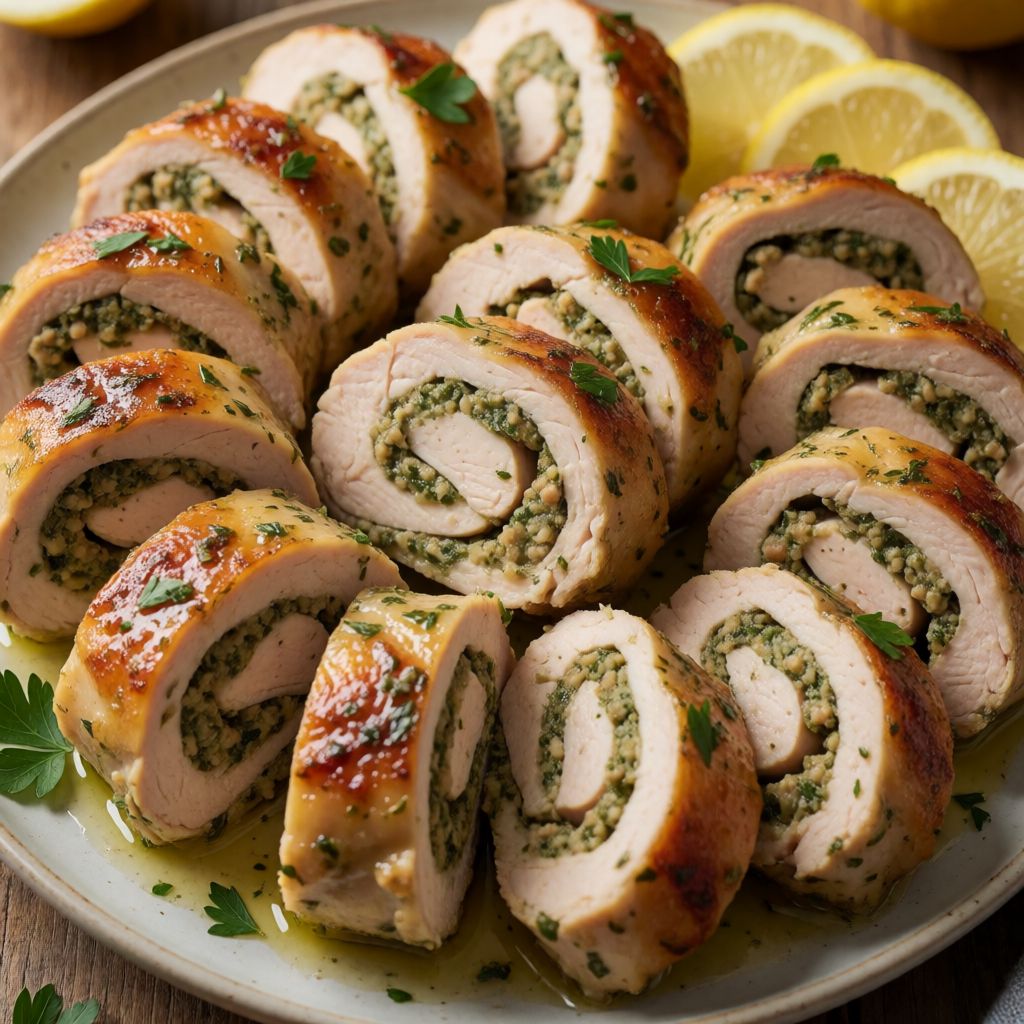
 AI photo
Chicken Rolls with Lemon
Chicken breast roll-ups filled with garlic, anchovy and parsley, served with a warm lemon dressing.
Labels are worked out automatically from the ingredients and can be wrong. Check the packaging if it matters to you.
Ingredients










Steps
Finely chop the garlic together with the parsley and anchovies.
Wash the lemons; slice one and a half of them into rounds.
Salt the chicken fillets; place a lemon slice and a little of the chopped mixture on each piece.
Roll up the pieces and secure with skewers.
In a bowl, whisk the olive oil with the juice of the remaining lemons and the warm water.
Season with salt, add the chopped fresh chilli, parsley and oregano; if you like, add another chopped clove of garlic.
Warm the resulting sauce in a bain-marie.
Cook the rolls on a grill or in a non-stick pan for about 4 minutes on each side. Doneness: 74°C inside.
8 minServe with the spicy sauce.
This is chicken involtini: breast fillets beaten out thin, rolled around a lemon slice and a paste of garlic, anchovy and parsley, then grilled and finished with a warm oil-and-lemon sauce poured over the top rather than cooked in it. It's Sicilian kitchen logic — coastal, poor, resourceful: lemon trees everywhere, salted anchovy as the cheap substitute for proper stock or cured meat, olive oil doing double duty as cooking medium and dressing.
What decides whether this works is thickness, not time. A chicken breast is almost pure muscle with no fat running through it to forgive you — past a certain point the proteins squeeze out their water and you get rope. So the fillet has to be beaten thin enough that it cooks through in minutes, and thin enough that it rolls without cracking. If your breast is still a fat lump, you haven't finished this step, whatever the clock says.
Some say "grill on medium heat" — that tells you nothing, because every hob and every pan heats differently. What you're after is a surface hot enough that the roll takes colour in the first thirty seconds without weeping juice everywhere; if it just sits there pale and sweating, your pan wasn't hot enough when the chicken went in. The 74°C inside is the real finish line — the point poultry is safely cooked — and the 4-minutes-a-side is only the lower bound that gets you there on an average thickness. Probe it if you're unsure; a cut-open roll that's pink in the middle just means the fillet was too thick or the heat too low to start.
Sixteen escalopes for four people sounds like a lot until you remember these are thin and small once pounded — figure two generous mouthfuls worth of chicken per person, not two whole breasts. Buy breast fillets and do the pounding yourself: between two sheets of clingfilm or inside a food bag, a rolling pin or the flat of a heavy pan, until the meat is roughly the thickness of a beer mat. Shop-bought "escalopes" are often already this thin — fine, use them, but check the pack isn't actually thin-cut turkey, which cooks faster and dries out quicker still.
Anchovy here isn't there to taste of fish — chopped fine and worked into the paste with garlic and parsley, it mostly dissolves and leaves behind salt and savoury depth, the way a good stock cube would if stock cubes didn't taste of cardboard. If you've genuinely nothing in the cupboard, a small spoon of fish sauce or even a dash of Worcestershire does the same job of back-of-the-mouth savouriness — not identical, but it's filling the same hole.
Lemon does two separate jobs and you shouldn't confuse them. The slice rolled inside the chicken is there for its oils and a little steam of citrus as it heats, not primarily for juice — don't squeeze it before rolling, you want the peel's fragrance released slowly by the heat of cooking, not spent in advance. The juice of the remaining one and a half lemons goes into the sauce for acidity, to cut the richness of all that oil. Waxed, unsalted lemons are worth seeking out since you're using the peel in direct contact with meat — wash them properly regardless.
The oil is not a neutral cooking fat here, it's half the sauce and most of its character, so don't reach for a bland vegetable oil to save money — use an olive oil you'd be happy to taste raw, because you are tasting it raw, essentially, once it's barely warmed through. If you're substituting, the rule is: anything with genuine flavour of its own that you like — a good rapeseed oil works at a pinch, flax or walnut oil would be too assertive and wrong here.
Skewer the rolls to stop them unravelling on the grill — wooden cocktail sticks are fine for a domestic kitchen, just soak them in water first so they don't scorch and split while the pan's hot. A wide non-stick frying pan is a perfectly honest substitute for a ridged grill pan; you lose the char stripes, not the cooking logic. What you can't substitute is patience with the pounding and the heat-check before the chicken goes in — rush either and you're back to rubber rolls no sauce will rescue.