
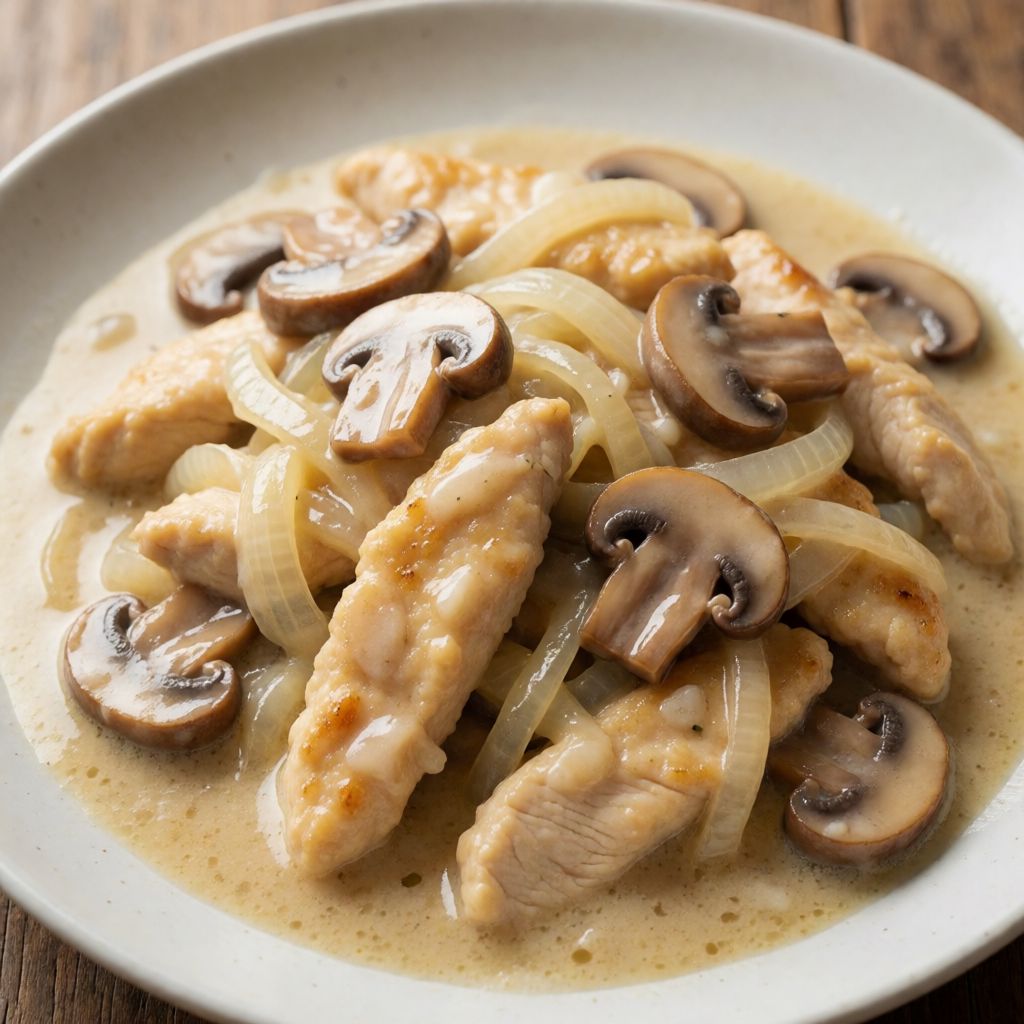
 AI photo
Chicken Strips with Mushrooms
Chicken breast strips cooked with mushrooms in a creamy sauce.
Ingredients
- 800 g Chicken Breast
- 200 g Coconut Milk
- 500 g Mushrooms fresh or frozen
- 1 pcs Onion small
- Olive Oil to taste
- Salt to taste
- Black Pepper to taste
- Parsley to taste








Steps
Cut the chicken breast into thin strips.
5 minFinely chop the onion and fry it for a few seconds in a pan with a little olive oil.
2 minAdd the mushrooms and cook for a few minutes over high heat until the moisture evaporates.
5 minAdd salt and black pepper to taste, sprinkle with parsley and add the chicken.
2 minCook the chicken until done; the internal temperature should reach 74°C.
10 minPour in the coconut milk and let the sauce thicken.
3 minServe immediately.
What was changed
Coconut Milk was used to keep the dish dairy-free, as in the original recipe.
This is a stir of chicken and mushroom, bound at the end with coconut milk — no stock, no wine, no long simmer. Everything happens on direct heat in half an hour, which makes it a weekday supper, not a project. Think of it as the opposite of a Sunday roast: there's no low heat and no resting time here, just a hot pan and attention.
What decides whether it works isn't the chicken — it's the mushrooms, and the heat under them. A mushroom is mostly water, something like nine parts in ten. Thrown into a crowded or lukewarm pan, that water leaks out slowly and the mushroom sits and stews in its own puddle instead of frying. You get grey, slippery pieces and a sauce diluted before it's even started. The step that says 'cook until the moisture evaporates' is not filler — it's the whole dish deciding whether you get a sauce or soup. Keep the pan hot enough that the mushroom hisses the second it lands, and don't pile it three layers deep; in an ordinary flat, your biggest ring probably won't get hot enough to fry 500 g at once without crowding, so if your pan is narrow, do the mushrooms in two goes rather than one slow steam.
Chicken breast: cut into thin, even strips — roughly finger-width. Too thick and the outside is done long before the middle reaches 74°C; too thin and by the time the thickest piece in the pan is safe, the thin ones are already rubber. Breast has almost no fat, so it has zero margin for error — if you want more forgiveness, thigh fillet works in the same cut and handles a few extra minutes without punishing you, though the dish will taste richer and less clean.
Mushrooms, fresh or frozen: either works, but frozen ones carry more water, because freezing ruptures the cell walls and that trapped liquid comes out faster and in greater volume once they hit heat. Fine — just know your high-heat stage will run a little longer with frozen, and don't panic at the extra liquid in the pan; it's meant to leave, not stay.
Onion, one small one, chopped fine and only barely softened before the mushrooms go in. This isn't the long golden-to-amber onion of a stew, where sugars build slowly — here it's just there to round off the raw bite, so a few seconds over the heat is enough. Push it further and by the time the mushrooms and chicken have had their turn, the onion at the bottom is burnt rather than sweet, because it's been in the pan the whole time, cooking alongside everything else.
Coconut milk, 200 g for the four of you: it brings a quiet sweetness and a sauce that clings without being heavy. The criterion for swapping it is simple — any fat-rich liquid that thickens on gentle heat without curdling. Double cream or crème fraîche both do this and are easier to find in a British kitchen than good coconut milk sometimes is; you'll lose the faint sweetness and gain a plainer richness, which is a fair trade, not a loss.
Olive oil, salt, pepper, parsley: the oil here is just a medium for frying, not a flavour in its own right, so the rule is any oil with no smell of its own — sunflower or rapeseed do the job as well as olive, and rapeseed is the one already in most British cupboards. Salt and pepper go in once the mushroom has given up its water, not before, because salting wet mushroom just draws out more liquid and slows the very evaporation you're trying to get. Parsley at the end is for colour and a clean smell against the richness of the coconut milk — chop it last so it doesn't wilt and go dark while you wait for everything else.
Serve it straight from the pan, because the sauce is thin enough to tighten further and go gluey if it sits. This is not a dish that waits for you — it's built to go from stove to table in the same half hour it takes to make.