
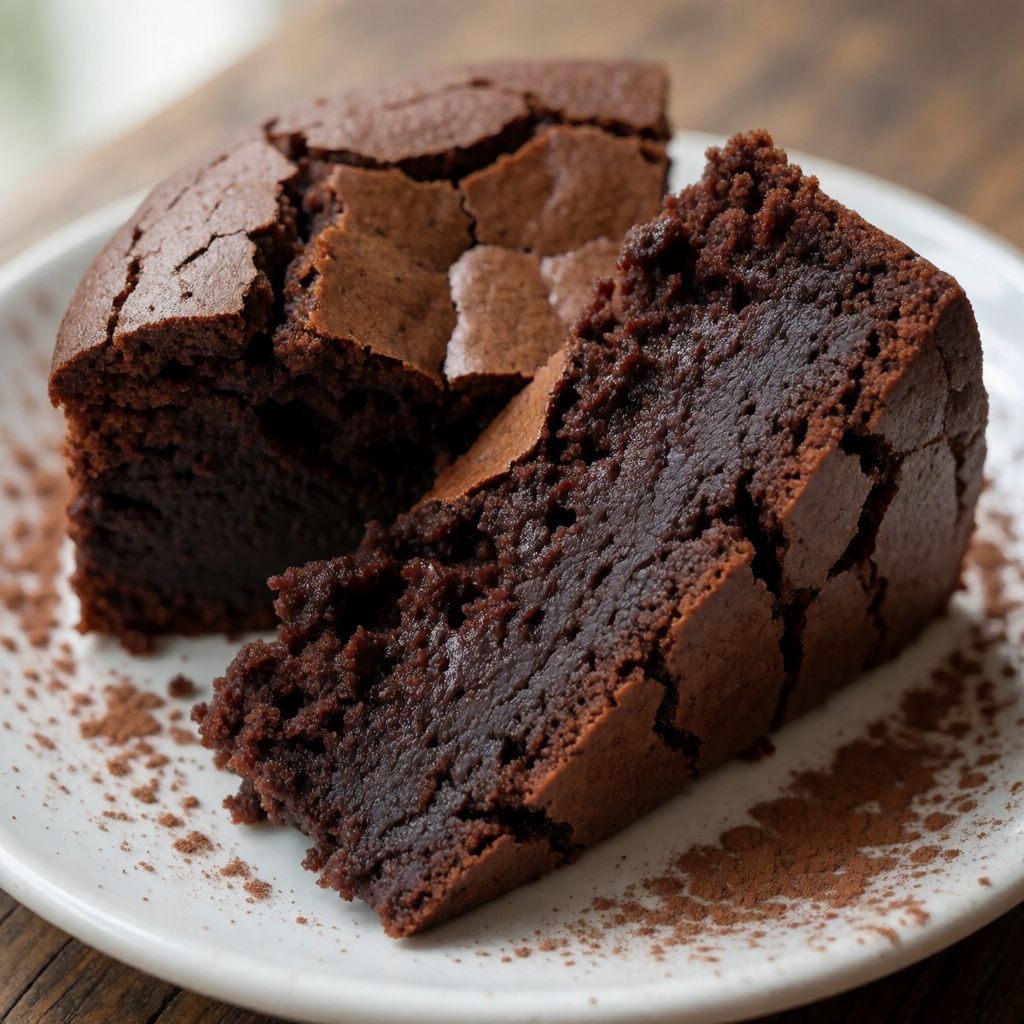
 AI photo
Fudgy Chocolate Cake
A rich, fudgy chocolate cake, served with port wine and mascarpone cream topped with red berries.
Labels are worked out automatically from the ingredients and can be wrong. Check the packaging if it matters to you.
Ingredients
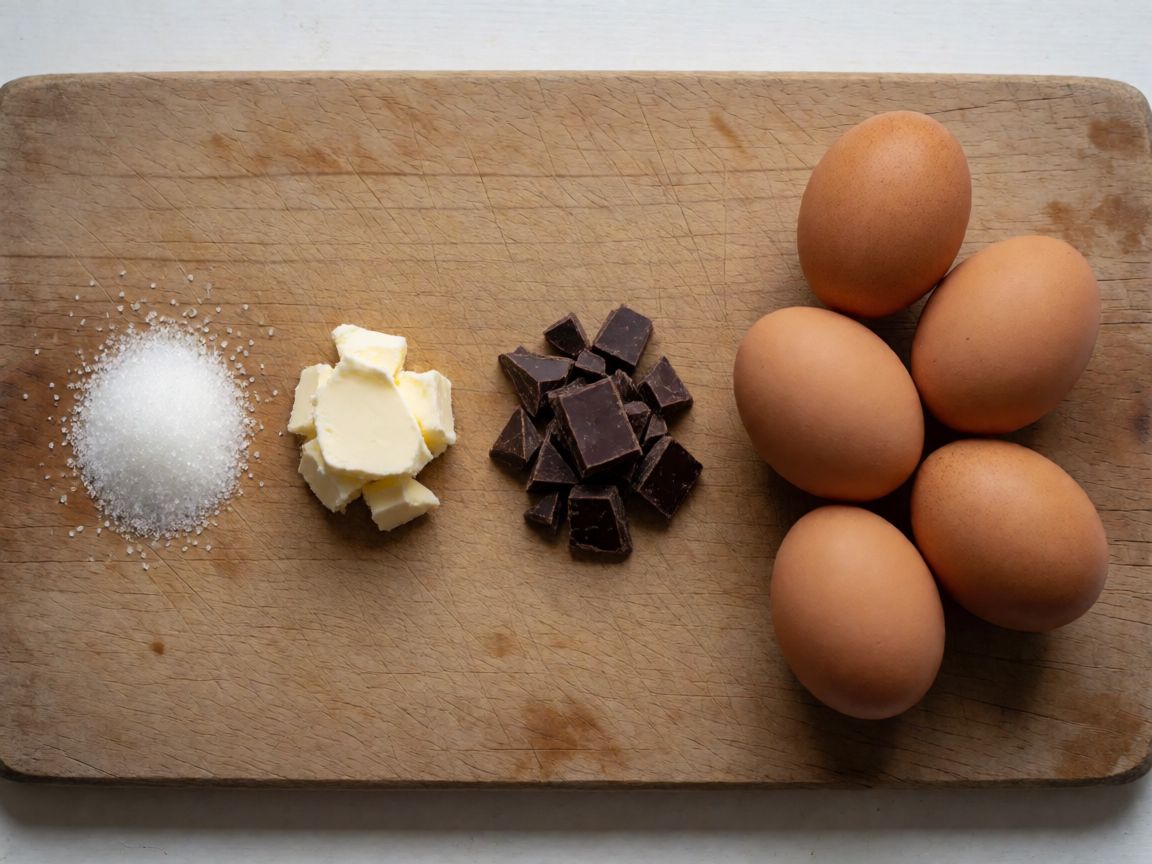
- 200 g Caster sugar
- 150 g Butter
- 250 g Dark chocolate Dark or milk chocolate; if using milk chocolate, reduce the sugar to 150 g
- 5 pcs Eggs




Steps
Melt the butter with the chocolate in a bain-marie (double boiler).
Once melted, remove from the heat and stir in the sugar.
Separate the egg whites from the yolks, whisk the whites until stiff, then fold the yolks and the whisked whites into the batter.
Line a baking tin with baking paper, pour in the batter, and bake for 20 minutes at 180°C.
20 minIf you like, add chilli pepper or cinnamon to the batter.
Serve with a glass of port wine and mascarpone cream with red berries.
There's no flour in this batter, and that's the whole trick of it. Strip a chocolate cake down to eggs, chocolate, butter and sugar and you've got something closer to a French fondant than to anything called sponge — it depends on egg protein for its backbone instead of gluten, and that's exactly why it can afford to stay molten in the middle while looking baked on top.
The whipped egg whites, folded in gently, are the actual skeleton of the thing. No flour means no scaffolding from starch — the air trapped inside whisked whites is doing that job instead. Fold roughly, knock the air out, and the cake collapses into something dense and flat rather than soft. This is the one place in the whole recipe where a heavy hand does real damage, so go slow and don't chase speed here.
Melting chocolate and butter together over a bain-marie isn't fussiness, it's physics: water can't get hotter than its own boiling point, so the chocolate never meets a flame directly and never scorches or seizes while melting unevenly. Some say any low heat on the stove does the same job — no, because a pan on a ring always has hot spots, and chocolate is already liquid well under 50°C, nowhere near where water boils. A domestic kitchen manages this fine with a heatproof bowl sat over a pan of water that's just steaming, not thrashing about.
Chocolate is chosen by cocoa solids, not by the name on the wrapper. Something around 60–70% gives you a dark, slightly bitter backbone that can stand up to 200g of sugar without turning cloying. Milk chocolate already carries its own sugar and milk solids baked into the recipe, which is exactly why the method drops the added sugar to 150g if you go that route — it's not a style preference, it's rebalancing for sugar that's already in the bar.
Butter wants to be unsalted, mostly because there's no other salt anywhere in this recipe to play against it — if salted is all you've got, nothing disastrous happens, the cake just carries a faint extra seasoning. It melts alongside the chocolate in the same bowl so the two fats become one continuous matrix rather than two separate ones fighting for space, which is part of why the crumb stays close and moist rather than crumbly.
Caster sugar earns its place here because the fine grain dissolves fast into a chocolate-butter mix that's warm but not scalding — you've already taken it off the heat by this point, and that's deliberate: cooling it slightly before the yolks go in stops the yolks from scrambling on contact, which would give you flecks of cooked egg instead of a smooth batter. If only granulated sugar is in the cupboard, a spin in a blender or a bit more patience while stirring gets you there — the criterion is fine crystal, caster is just the easiest way to buy it.
The eggs are doing two different jobs and that's why they're split. Yolks fold into the chocolate for richness and to help bind the fat and the rest of the batter together. Whites get whipped on their own to stiff peaks and folded in separately, purely for air — this is your flour substitute, remember, so don't skip the whipping stage or try to save time by just cracking whole eggs in. A cake that sinks hard in the middle after baking isn't failing — flourless cakes settle as they cool, that's the structure finding its real shape, not a defect.
Chilli or cinnamon, if you fancy it, isn't there for sweetness — it's contrast. Mexican cooks have been pairing chocolate with chilli in mole for centuries for the same reason: heat cuts through fat and stops richness turning monotonous on the tongue. A pinch is plenty; this cake doesn't need rescuing, just a counterpoint.
Port and mascarpone with red berries at the end isn't decoration, it's arithmetic — the cake is heavy with fat and sugar, mascarpone adds more fat on top of that, and it's the port's alcohol bite and the berries' acid doing the actual work of cutting through both so the next forkful still tastes like something. Five eggs and 250g of chocolate for two people is a genuinely rich plate — cut it thin if you want it to stretch further, there's no rule saying two must mean two large wedges. Let it cool properly before you slice it; cutting into it warm just means watching the inside collapse onto the knife instead of onto the plate where it belongs.