
 AI photo
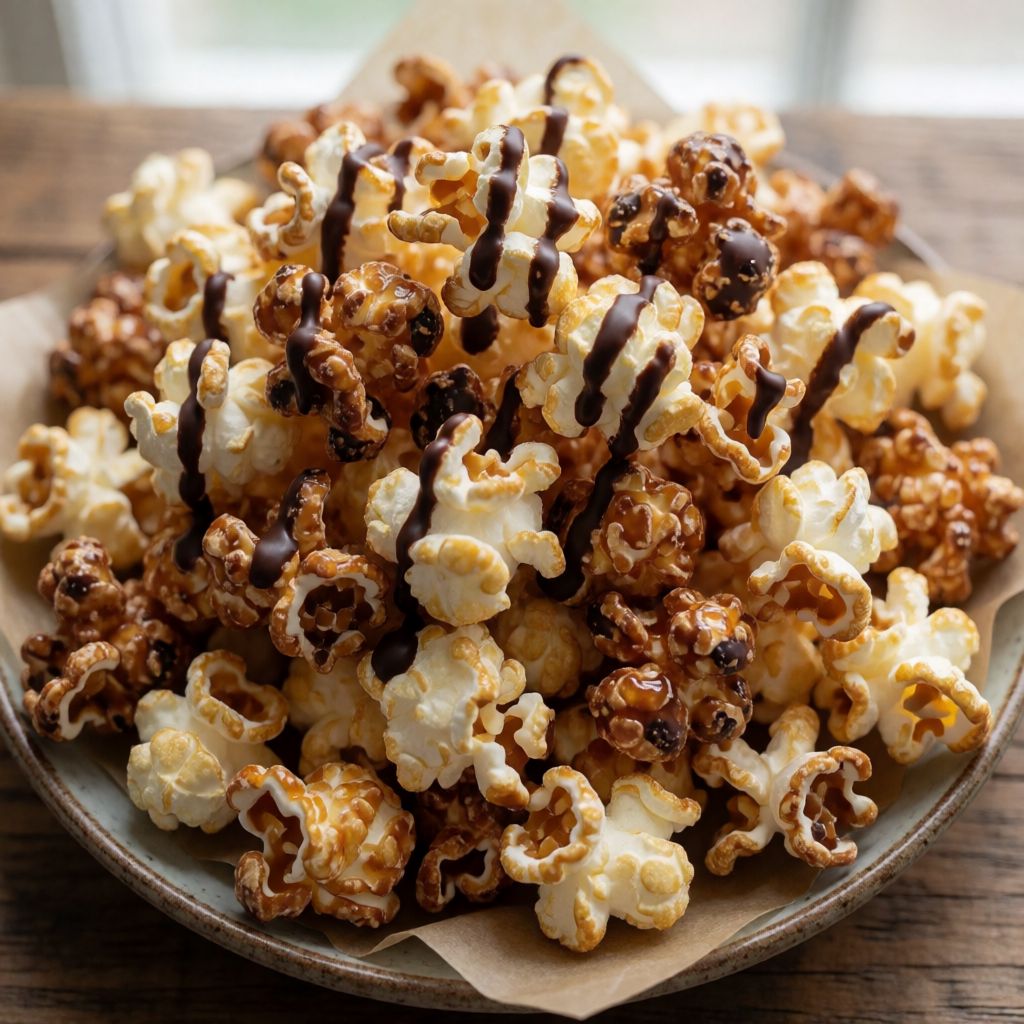
Chocolate caramel popcorn
A crunchy popcorn treat drizzled with buttery caramel and melted dark chocolate.
Labels are worked out automatically from the ingredients and can be wrong. Check the packaging if it matters to you.
Ingredients
- 100 ml Popcorn kernels
- 1 tbsp Butter
- 1 tsp Olive oil
- 100 ml Double cream
- 50 g Caster sugar
- 1 tbsp Glucose syrup
- 0.25 tsp Salt
- 60 g Dark chocolate finely chopped






Steps
Put the popcorn kernels in a saucepan with the butter and oil, cover with a lid and cook over high heat until almost all the kernels have popped.
5 minPut all the caramel ingredients into a separate saucepan. Bring to the boil and simmer over medium heat, stirring often, for 5–10 minutes. The caramel should turn soft and tasty, and set easily when a spoonful is cooled.
7 minTemper the chocolate: melt half of it in a bowl over a pan of simmering water. Remove the bowl from the heat and add the remaining chocolate. Stir until the temperature reaches about 29°C.
Put the caramel and chocolate each into their own piping bag made from baking paper. Twist the tip closed and, if you like, stand the bags in a glass to make them easier to hold. Spread the popcorn out on a baking tray lined with baking paper.
2 minDrizzle lines of caramel and chocolate over the popcorn. Let it cool, and the popcorn is ready to serve.
3 min
This isn't really a popcorn recipe. Popcorn is the delivery system — a dry, airy lattice that catches two liquids and holds them until they set. What decides whether it works has nothing to do with the corn and everything to do with those two liquids: does the caramel stop cooking at the right softness, and does the chocolate come off the heat in temper instead of in a sulk.
Start with the popping, because it's the part people get wrong through pure superstition. The kernel is a drop of water sealed inside a hard, dry shell. Heat it, the water turns to steam, the steam has nowhere to go, pressure builds until the shell can't hold it and — bang — the inside turns itself inside out. Some say you need the oil screaming hot before the corn goes in. No — because if the fat is already fierce, the kernels on the bottom scorch black before the ones on top have even warmed through, and you get a pan that smells of smoke with a third of the corn still hard as teeth. Put butter, oil and kernels in together cold, let them heat as one, and the popping will arrive together too — a few shots, then a flurry, then it tails off like rain easing. That tailing-off is your cue to take it off, not a clock.
On the ingredients, one at a time, starting with the corn itself. You want actual popping corn — a hard, dry kernel bred for a tough hull that holds pressure well. Sweetcorn or feed corn won't do this trick; the hull's too soft, the moisture escapes before pressure builds, and you get scorched kernels sitting next to hard ones that never went off at all. This is also why a lid matters more than people think: it's not there to trap heat so much as to stop the popped kernels flying out and leaving the stragglers behind to burn alone.
Butter plus oil is doing two separate jobs, not one job twice. Butter is flavour — that's the whole reason it's there, nothing subtle about it. But butter alone burns early, its milk solids catching and turning bitter well before the oil of a bland seed oil would. The oil is a heat-buffer: any oil with no smell of its own and a reasonably high smoke point will do — sunflower, groundnut, light rapeseed. It lets the butter ride along for flavour without taking the blame for burning.
Double cream in the caramel is fat and water bound together, and both matter. The fat softens the set so the caramel bends rather than cracks; the water is what lets it boil and reduce in the first place, concentrating the sugar as it goes. Glucose syrup is the thing stopping sugar from crystallising back into grit — its molecule is shaped wrong for sugar crystals to latch onto, so it jams the process. If you've no glucose syrup in the cupboard, golden syrup does the same job by the same logic; honey will work too but brings its own flavour along as a guest you didn't invite, and liquid glucose from a pharmacy is the purest version if you want it invisible. Caster sugar rather than granulated simply because the finer grain dissolves evenly without you needing to stand there stirring constantly — which, incidentally, is another small myth: stir caramel too much at the wrong moment and you drag sugar crystals into contact with each other and seed the very crystallisation you're trying to avoid. Stir often, as the recipe says, not obsessively.
Salt in a sweet is not decoration — it dulls the sweetness enough that you taste the actual caramel flavour underneath instead of just sugar shouting over it. A quarter teaspoon against 50g of sugar is a small amount for a reason; this isn't salted caramel as a flavour statement, it's caramel with the sweetness turned down slightly so it doesn't flatten the chocolate later.
Dark chocolate, finely chopped, because small pieces melt evenly without you having to coax the middle of a bar into liquid while the outside's already thin as water. Pick one you'd happily eat on its own — this isn't the place for cheap compound chocolate with vegetable fat standing in for cocoa butter, because that fat won't temper the same way at all and you'll do all that careful stirring for nothing.
The paper piping bags are the cheapest trick in a home cook's kit: a triangle of baking paper rolled into a cone does exactly what a £15 piping set does, and it's gone into the recycling the moment you're done, no washing-up fairy liquid required to scrub caramel out of a nozzle. Standing the cone in a glass while you fill it is just common sense dressed up as a tip — try holding an open paper cone and spooning caramel into it one-handed and you'll understand why.
As for serving — this scales by greed more than by headcount. One batch as written is a treat for one person with no intention of sharing, or a modest bowl for two if you're feeling generous. Nothing here needs special equipment beyond a saucepan, a lid you probably already use for something else, and patience while the caramel finds its softness — that patience is doing real work, and rushing it is the single most common reason a good caramel turns into a hard, regretful toffee.