
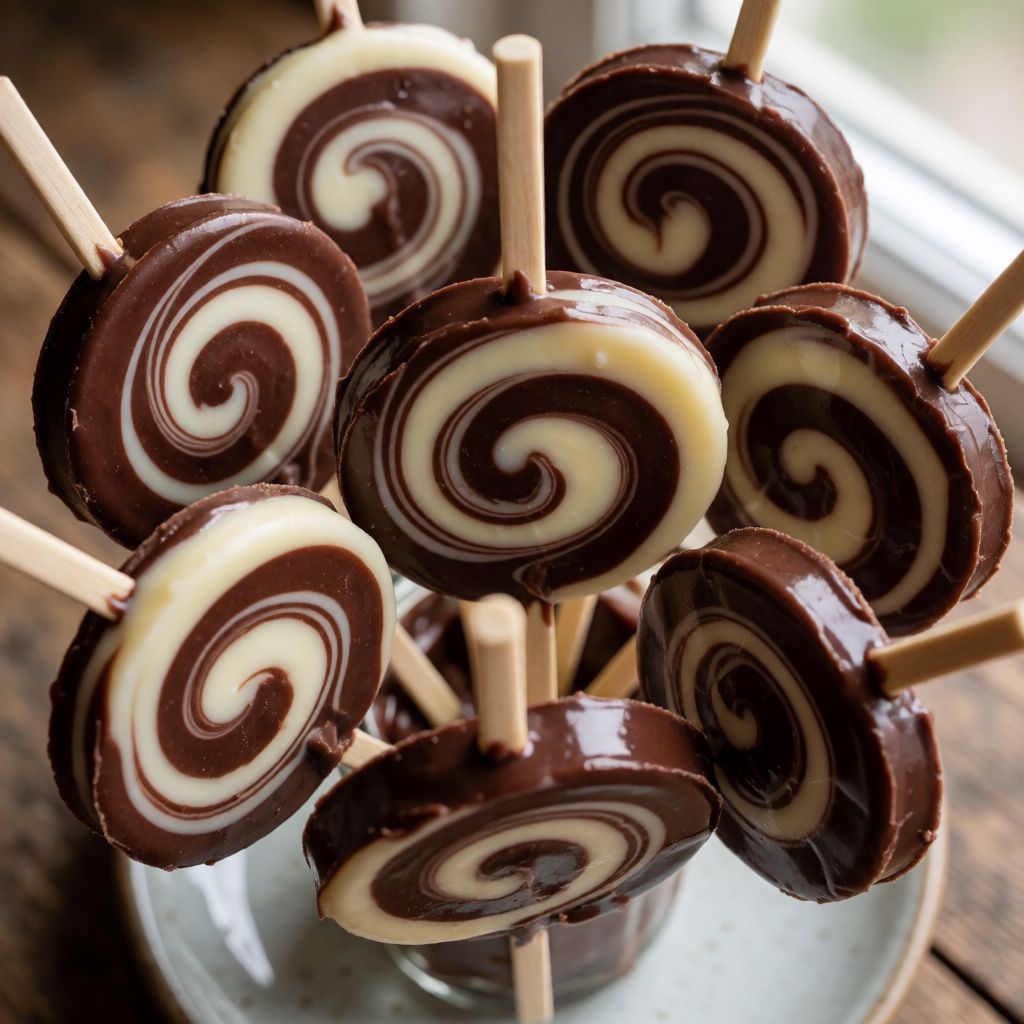
 AI photo
Chocolate Lollipops on a Liquorice Stick
Chocolate lollipops on a liquorice stick, perfect for stirring into a cup of hot milk.
Ingredients
- 50 g White chocolate finely chopped
- 100 g Dark chocolate finely chopped
- 20 pcs Marshmallows
- 4 pcs Liquorice root sticks



Steps
Melt half of the white chocolate in a bain-marie, stirring; take the bowl off the heat and mix in the rest until the mixture is smooth.
3 minPour the white chocolate into 4 shot glasses, then put three small marshmallows into each one.
Put the glasses in the fridge.
Melt half of the dark chocolate in a bain-marie, stirring; take the bowl off the heat and mix in the rest until it has fully melted.
3 minTake the white chocolate glasses out of the fridge, push a liquorice root stick into each one, pour over the dark chocolate and add a few more marshmallows.
2 minPut them in the fridge to set.
150 minAfter a few hours, dip each glass briefly into slightly warm water, holding it by the liquorice root and making sure no water gets inside; after a few seconds the chocolate will come away from the sides and the lollipops will be ready to use.
1 minStir the chocolate sticks into hot milk.
1 min
Strip away the cute name and what you're making is a hot chocolate that comes in solid form, on a stick, flavoured with liquorice root instead of a spoon. You build a little disc in the bottom of a shot glass — white chocolate, then dark, with marshmallows trapped between the layers — and once it's firm you knock it loose and drop the whole thing into a mug of hot milk, where it melts and does the stirring itself. The shot glass is your mould because you don't own a lollipop mould, and a straight-sided glass will do the job just as well.
What decides whether this works isn't the recipe's steps, it's two small physical events: whether the chocolate sets with a clean snap instead of a dull, greasy smear, and whether it comes out of the glass in one piece instead of cracking in your hand. Both come down to heat control, and neither needs a thermometer.
White and dark chocolate here aren't interchangeable for taste alone — they set at slightly different rates and that's why the recipe layers them with a fridge rest in between, so the white has a skin firm enough to hold marshmallows upright before the dark goes on top. The criterion for either is cocoa butter as the fat, not vegetable oil standing in for it — read the label, don't trust the word "chocolate" alone. Supermarket baking chocolate or even good chocolate chips work fine, because, again, this isn't chocolate that needs to hold its temper for months; it just needs to snap once and then dissolve.
Marshmallows are doing two jobs, not one decorative job. The ones buried inside stay as soft pockets in the set disc, giving texture against the snap of chocolate; the ones added on top of the dark layer are there to half-melt when the whole thing meets hot milk later, so the drink gets the marshmallow float you'd expect from a mug of cocoa, without you having to add any separately. Mini ones work better than large — they distribute through a shot-glass-sized disc instead of taking it over.
Liquorice root is the one ingredient worth a word of history. It's not a liquorice sweet — it's the actual dried root, sold as a chew stick, fibrous and faintly sweet-bitter on its own, closer to aniseed than to the black penny-sweet. England has grown and processed it commercially for centuries around Pontefract, which is why liquorice turns up in English sweet shops more than in most other countries' — cheap, local, and already there before sugar was. Here it's doing double duty: handle first, so you've something to hold while dipping the glass in water and pushing it into the set chocolate, then flavouring, released slowly as it sits in hot milk. If you can't find it, a cinnamon stick gives you a flavoured handle with the same logic, though you lose the liquorice note; a plain wooden skewer works as a handle with no flavour at all, which is an honest fallback, not a cheat.
Proportions here feed four, one glass each, and there's no shrinking this sensibly below that — melting less than 50g of chocolate in a bain-marie just means more surface area losing heat relative to volume, and it melts unevenly. If you want eight, double everything and use eight glasses rather than trying to stretch the mixture across more vessels than it was sized for.
Patience is doing real work in the 150 minutes of fridge time, and there's no shortcut through the freezer. A freezer sets the chocolate fast, but when you then take it out into a warm kitchen, moisture condenses straight onto the cold surface, dissolves the sugar sitting right at the surface, and leaves white blotches when it dries again — sugar bloom, not the same fault as the fat bloom from bad melting, but it looks almost identical and it's avoidable the same way: slow, even cold, which only a fridge gives you.