
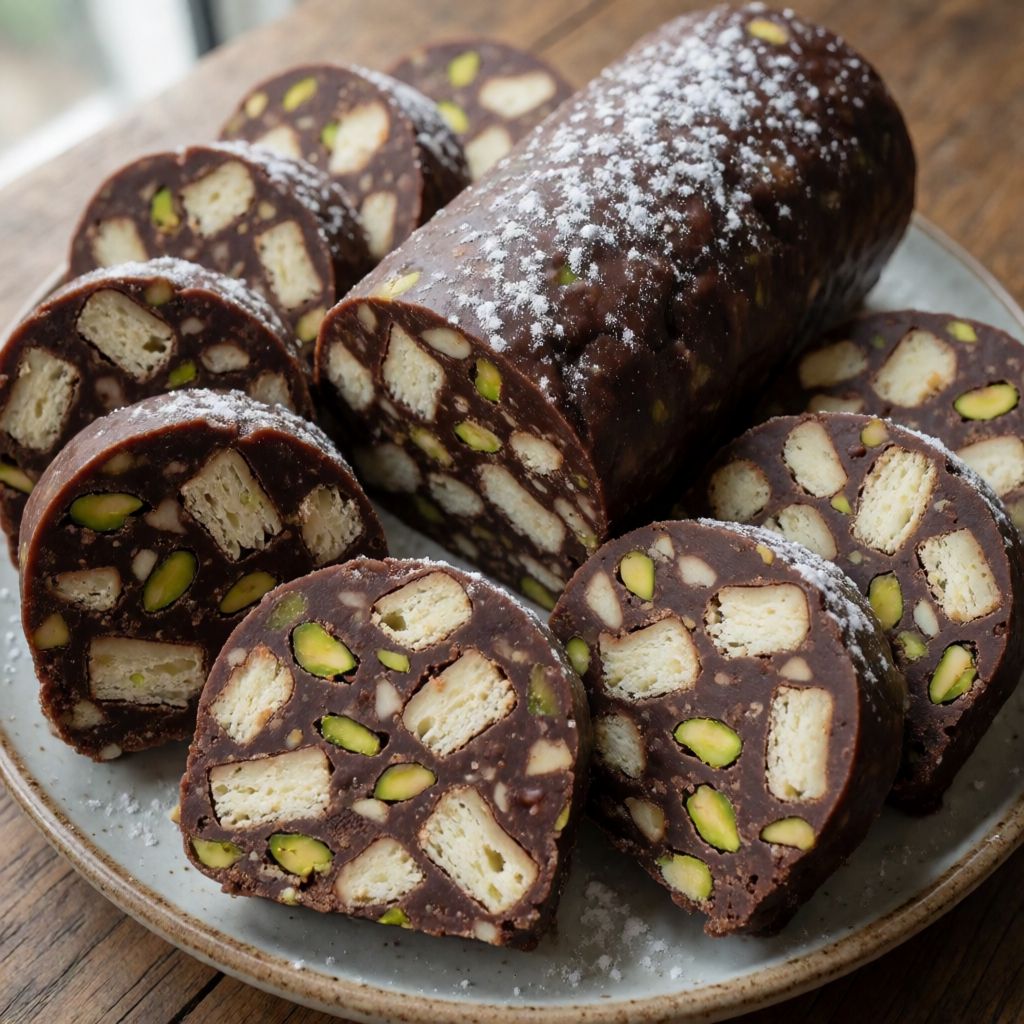
 AI photo
Chocolate Salami
A rich, no-bake chocolate dessert shaped like a salami, studded with crushed biscuits and pistachios.
Labels are worked out automatically from the ingredients and can be wrong. Check the packaging if it matters to you.
Ingredients
- 150 g Butter
- 60 g Icing Sugar
- 270 g Dark Chocolate
- 150 g Digestive Biscuits
- 50 g Pistachios or almonds or hazelnuts
- Icing Sugar to taste





Steps
Coarsely crumble the biscuits by hand.
In a bowl, beat the butter with a mixer for a few seconds, add the icing sugar and beat for a few more minutes until the mixture becomes smooth and creamy.
Melt the dark chocolate in a bain-marie, let it cool slightly, then add it to the butter mixture. Mix thoroughly.
Add the crumbled biscuits and mix with a spatula or spoon.
Add the whole pistachios and mix again.
Place the mixture on parchment paper, shape it in the centre so it doesn't spill over the edges, wrap the paper and firmly shape it into a cylinder with your hands. Pinch the ends closed.
Put it in the fridge for at least 2 hours to set.
120 minSprinkle icing sugar on a work surface and roll the sausage in it on all sides, using your hands to help the sugar coat evenly.
Put it back in the fridge for 10 minutes, then slice and serve.
10 min
What was changed
Digestive Biscuits was swapped in to match the sweet dry biscuits British shoppers would use for this dessert.
This is not a baked thing at all — it is a fat that remembers its shape once you chill it. Butter and melted chocolate, beaten together, hold air and hold crumbs the way wet cement holds gravel. Cold is the only "heat source" that finishes this dish. No oven touches it, which is exactly why it suits a Sunday when the oven is already busy with a roast and you want pudding sorted without a queue for the hob.
What decides whether it works is a small piece of choreography most people skip past: the chocolate has to cool "slightly" before it meets the creamed butter. Skip that cooling and you are pouring something near boiling onto a delicate whipped structure — the butter simply melts back down, the air you beat into it escapes, and when the log sets in the fridge it sets greasy and grainy instead of dense and smooth, because the fat has separated rather than bound. Let the chocolate drop to just-warm-to-the-touch and it folds in instead of flooding in.
Some say you need a proper bain-marie setup to melt chocolate safely — no, because all a bain-marie does is cap the heat chocolate ever feels at roughly the temperature of simmering water, so it can't scorch or split. Any heatproof bowl sitting over a pan with a couple of centimetres of water in it does the same job. No lid, no special kit, just water that never boils hard enough to splash into the bowl.
Butter is the scaffolding. Beating it alone for those first few seconds before the sugar goes in is what gets air into it — that's why it has to be soft, not melted and not fridge-hard. Melted butter won't hold a bubble, cold butter won't move under the beater at all. Unsalted is the sensible default so you're not guessing how salty your chocolate already is; if all you have is salted, don't panic, the dish survives it, just know the balance has shifted slightly.
The icing sugar at this stage isn't for sweetness so much as for texture — it dissolves into the butter without the grittiness granulated sugar would leave, because there's no cooking step later to melt grains down. The second dusting of icing sugar, right at the end, is doing a completely different job: it's cosmetic and practical both, standing in for the white rind on a cured sausage, and also keeping the surface from sticking to your hands or the knife when you slice.
Dark chocolate is the one non-negotiable choice here, not milk or white, because this dish depends on chocolate that is mostly cocoa solids and cocoa butter and comparatively little sugar or milk fat of its own — that's what sets firm in the fridge rather than staying soft. If the label just says "dark," trust it; you're not baking against a precise percentage, you're looking for chocolate that snaps when you break a square off, which tells you it has enough cocoa butter in it to do the setting work later.
Digestive biscuits are the British default for a reason that has nothing to do with flavour and everything to do with what's in every cupboard here — a plain, not-too-sweet, dry biscuit that breaks into honest chunks rather than turning to powder. The real criterion is dryness and lack of its own strong flavour: rich tea, plain shortbread offcuts, even the broken ends of a packet nobody wanted work the same way. This whole dessert, in fact, exists because of biscuits and chocolate that were going spare — it's a kitchen-leftovers dish by origin, no oven, no waste, made to use up what was already there rather than to showcase anything expensive.
Pistachios, almonds, hazelnuts — the only rule is that the nut stays crisp in a cold, fatty environment for days, which rules out anything that goes soft or oily once chilled. Keep them whole, not chopped, because broken nuts disappear into the mix and you lose the studded look that's the whole visual point of calling this a salami rather than a chocolate log.
Shaping it in parchment rather than a tin is the honest domestic answer to not owning a mould: you're using the paper's edge the way a sausage casing is used, to force a cylinder and keep it from spreading sideways into a puddle before the fridge gets a chance to firm it up. Do it while the mixture is still workable — once it's chilled, it won't reshape, it'll only crack. This feeds about six people in thin slices with tea afterwards, which is roughly what a Sunday table needs once the roast itself is done.