
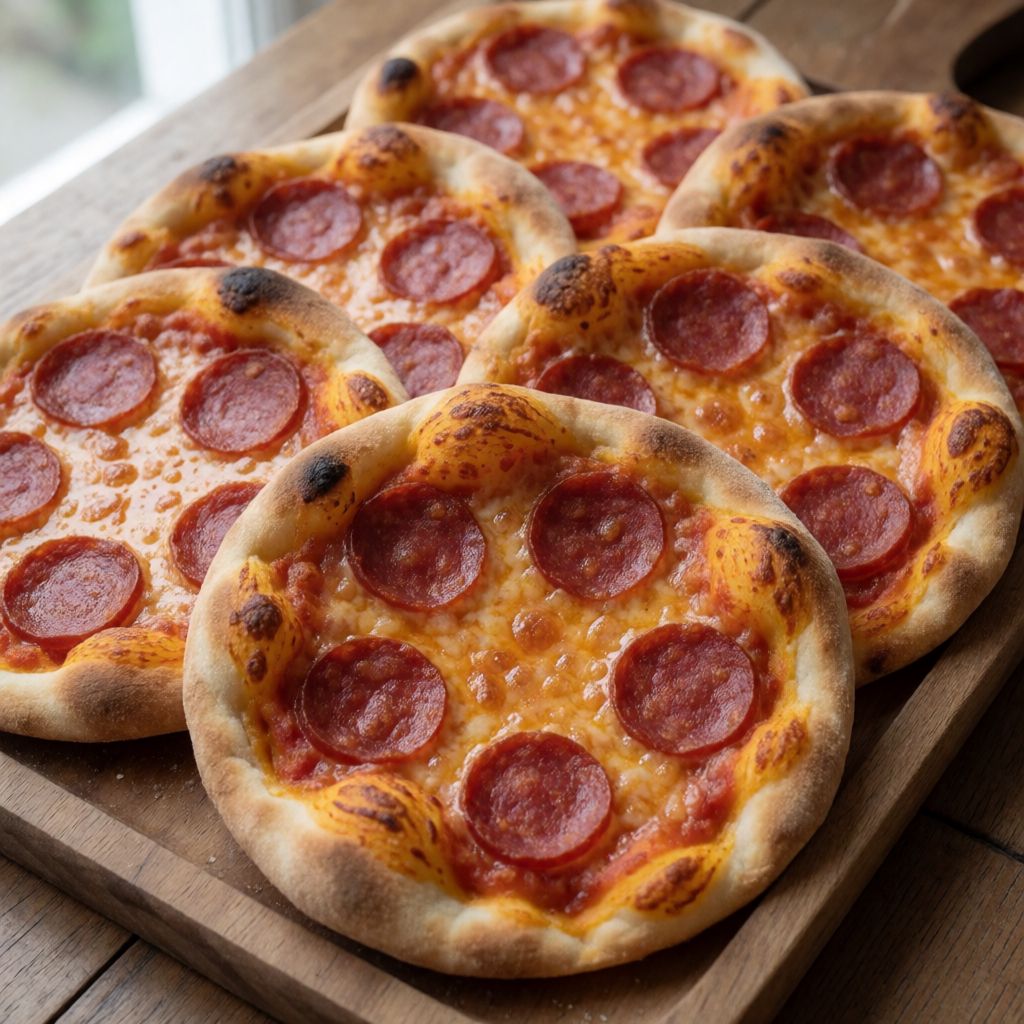
 AI photo
Mini Chorizo Pizzas
Little homemade pizza bases topped with tomato, mozzarella, chorizo, olives and basil.
Labels are worked out automatically from the ingredients and can be wrong. Check the packaging if it matters to you.
Ingredients
- 25 g Yeast
- 250 ml Water warm
- 3 tbsp Olive oil
- 1 tsp Salt
- 500 g Plain flour
- 1 tbsp Olive oil for greasing the bowl
- 140 g Tomato paste
- 75 g Chorizo thinly sliced
- 125 g Mozzarella sliced
- 100 g Black olives, pitted
- 1 bunch Basil 12 leaves








Steps
Dissolve the yeast in a bowl with warm water, add half the flour, the olive oil and the salt, and mix well. Use 5 g of yeast for an overnight cold rise or 25 g if the dough will only rise for 1 hour.
60 minGradually add the rest of the flour, stirring as you go, then dust the work surface with flour and knead the dough by hand until smooth.
Wash the bowl and grease it with olive oil, put the dough back in and turn it so it is coated with oil.
Let the dough rise for about 45-60 minutes, or leave it for a cold rise in the fridge overnight.
50 minDust the work surface with flour, divide the dough into 12 pieces and shape 12 small pizza bases by hand on a lined baking tray.
Spread each base with tomato paste, then top with mozzarella, chorizo, basil and olives.
Bake in the oven at 230°C for 10-14 minutes until done, then sprinkle with basil.
12 min
Twelve little pizzas, fist-sized, not fingers of dough cut from a big sheet but each one shaped on its own. That's the whole point of "mini" here — not cuteness, but surface-area economics. A small base gets more edge, more crust-to-topping ratio, and it cooks right through in the time a full-size pizza would still be pale in the middle. That's what decides whether this works: whether your oven, which is not a pizza oven and was never meant to be one, can get hot enough fast enough to set the crust before the chorizo fat turns the top soggy.
Some say you need a pizza stone or a kazan-hot oven to get proper pizza at home — no, because what you actually need is a short, violent blast of heat on a thin base. A domestic oven at 230°C, which is near the top of what most UK ovens will actually hold steady, does that job on a 12-piece base in 10-14 minutes. A full 30cm pizza in the same oven just dries out at the edges while the centre is still raw — that's the real reason restaurants have ovens that go to 400°C and your flat doesn't, and why going mini is the sensible workaround rather than a compromise.
The yeast split in step 1 is the hinge the whole timing swings on: 25 g for an hour's rise if you're making these today, 5 g if you want to leave the dough in the fridge overnight. More yeast means faster but rougher flavour; less yeast and more time means the dough develops flavour slowly, the way a slow Sunday roast develops flavour that a quick one doesn't. Neither is "correct" — they're just two different relationships with your evening.
Flour and water and yeast are the whole architecture — everything else just sits on top. Plain flour is fine here; you're not after the stretch of a 00 flour because you're not stretching these thin and wide, you're pressing twelve small rounds by hand. Use what's in the cupboard.
The yeast is doing two different jobs depending on which path you choose. Fresh yeast, 25 g, is a sprint: it eats sugars fast, the dough puffs in under an hour, and the flavour is plain and clean — fine for a Tuesday. The same yeast at 5 g in the fridge overnight is a slow fermentation: less yeast means it can't finish the job quickly even in the warmth of your kitchen, so the cold just slows it further, and over hours the dough builds the faint sourness and better chew that a fast rise can't. If you only have dried yeast, use about a third of the weight given — dried yeast is more concentrated, and this is a case where "a packet" is not a substitute for "a weight."
Olive oil is two things, not one. The 3 tbsp in the dough is there to stop the gluten from going tough and to keep the crumb soft once baked — a dough with no fat at all bakes drier and cracks more easily when you shape it. The 1 tbsp for greasing the bowl isn't the same job: it's there purely to stop the dough sticking as it rises, so when you tip it out it doesn't tear and deflate. Any neutral oil does the greasing job — this is where you don't need the good stuff.
The tomato paste wants to be a thin layer, not a pool — too much and the base goes soggy under the weight of it, because the water in a thick layer of paste has nowhere to go but down into your crust during a 10-minute bake. That's not a timing problem you fix with longer baking; longer baking just dries the chorizo out before the water's gone. Spread it thin on purpose.
Chorizo, sliced thin, is there for its own fat as much as its flavour — it self-bastes the base as it cooks, which is also why you slice it rather than dice it: more surface, more fat rendered in the short time it has. If you don't eat pork, a thin-sliced spicy sausage with a similar fat content does the same job; a lean sausage won't, because it has nothing to render.
Mozzarella sliced rather than grated is deliberate too — sliced, it melts into pools and holds its shape in patches; grated, on something this small, it tends to run and pool at the edges of a 10cm base rather than sit where you put it. Black olives and basil are there for sharp, cool contrast against the fat of the chorizo and the melt of the cheese — the basil at the end, after baking, because basil baked at 230°C for 12 minutes just goes bitter and black, not because of tradition but because heat destroys its aromatic oils fast. That's not a rule to be sacred about — it's chemistry, and it's why the recipe has you add it twice, once to cook under the cheese, once fresh on top where it still smells of something.
Patience here isn't really about the baking — twelve minutes is twelve minutes. It's in the rise. If you rush the dough, you get a base that's fine but forgettable; given the overnight option, you get one with a bit more character for genuinely no extra hands-on work. That's the one ingredient in this recipe that costs you nothing but time, and it's the easiest one to skip.