
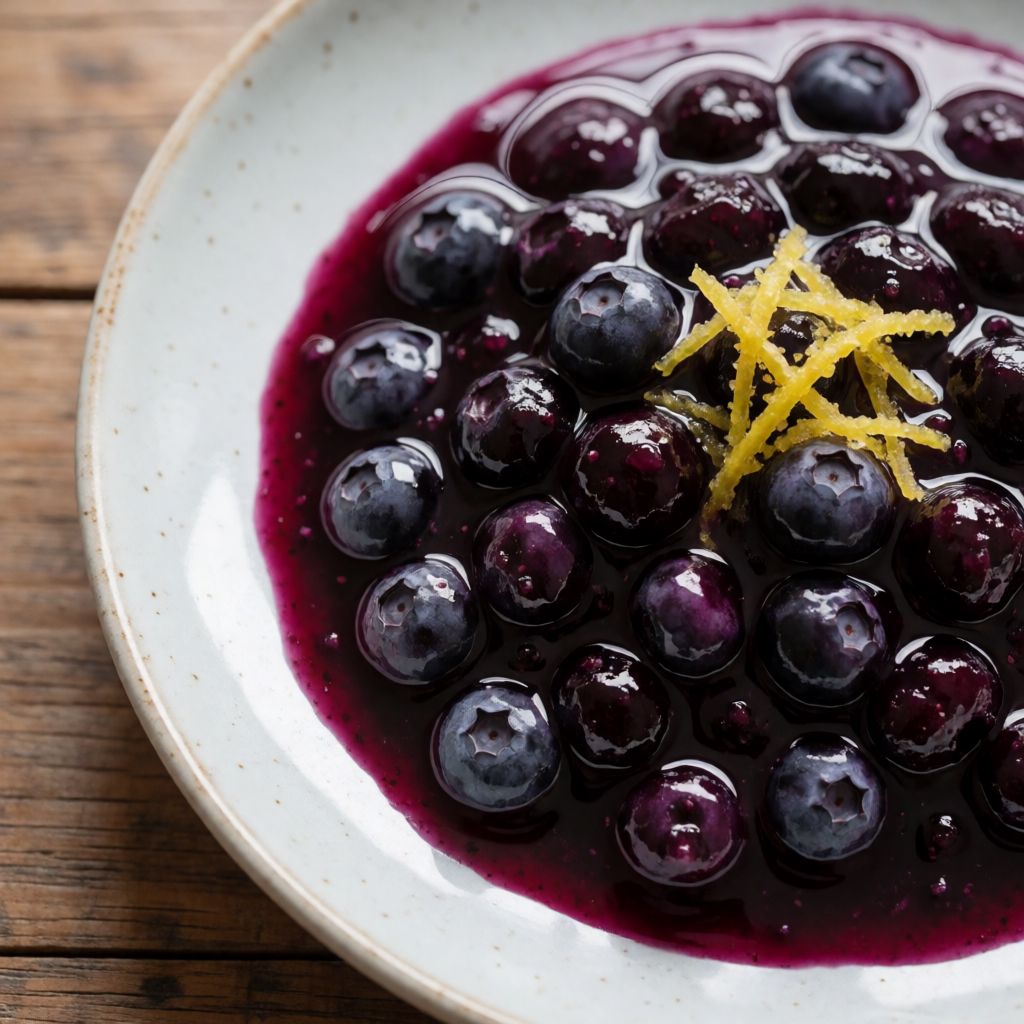
 AI photo
Blueberry Jam
A simple homemade blueberry jam, slow-cooked with lemon until thick and glossy.
Labels are worked out automatically from the ingredients and can be wrong. Check the packaging if it matters to you.
Ingredients
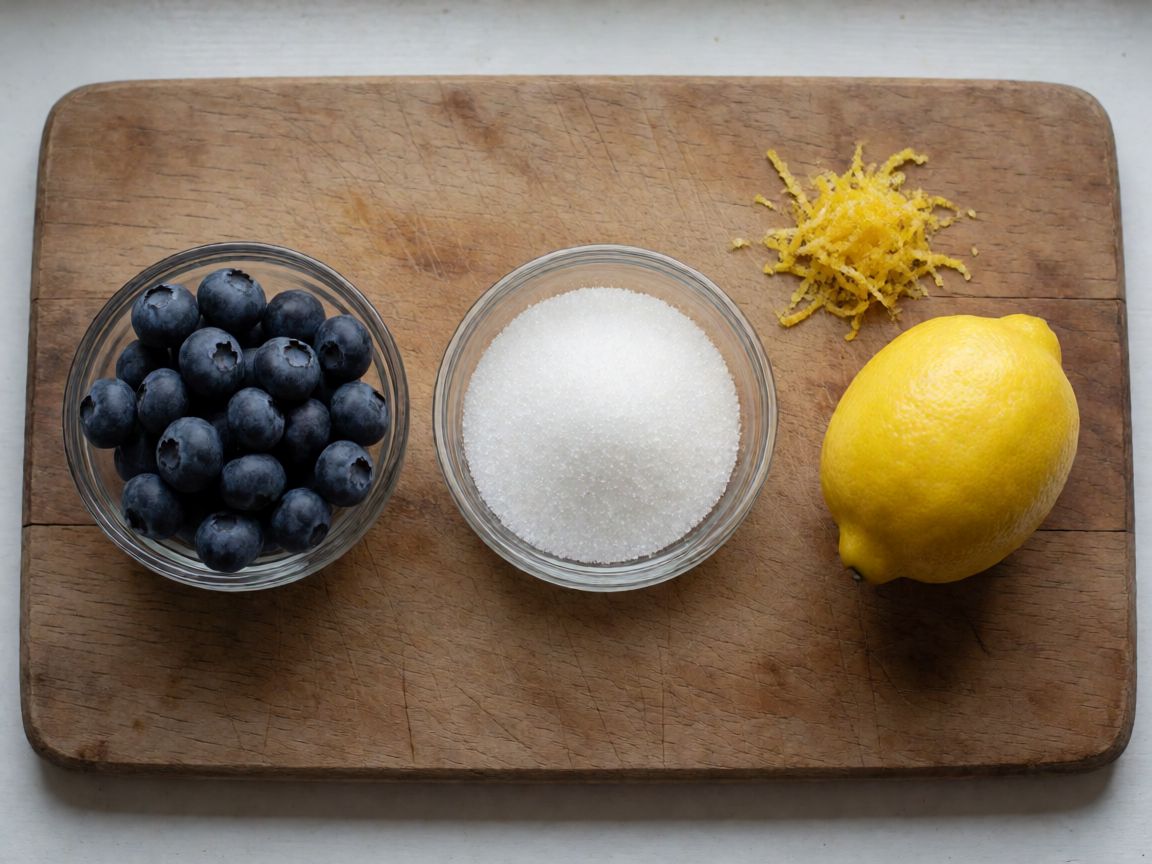
- 1 kg Blueberries
- 600 g Sugar
- 200 ml Water
- 1 pcs Lemon for juice
- 1 pcs Lemon zest zest of one lemon





Steps
Rinse the blueberries thoroughly under running water, drain in a colander and transfer to a deep, heavy-bottomed pot.
Add the water, lemon zest and lemon juice. Bring to the boil and cook for at least 10 minutes.
10 minRemove from the heat, let cool slightly, then stir in the sugar until fully dissolved.
Return to the heat, bring back to the boil and cook for a further 10 minutes.
10 minLower the heat and continue cooking for 40 minutes, stirring occasionally with a wooden spoon.
40 minCheck if it's set: drop a little jam onto a cold plate and tilt it — if it holds and doesn't run, it's ready.
Pour the hot jam into sterilised, completely dry glass jars, seal tightly with lids and turn upside down.
Leave to cool completely.
If you wish, pasteurise the jars: wrap the cooled jars in cloth, place in a large pot and cover with cold water so the level sits 10 cm above the lids.
Bring to the boil and simmer for at least 30 minutes.
30 minLeave to cool for a further 30-40 minutes.
35 min
This is a reduction cooked to a gel, not a boiled fruit soup with sugar stirred through it. Blueberries are a quiet fruit — mild acid, thin skins, and not much natural pectin to speak of. Left to themselves, boiled with sugar and poured into a jar, they'd give you a bright blue syrup that never holds its shape on a spoon. Everything in this method is there to get around that lack: the lemon supplies the acid pectin needs to link up, and the long, patient simmer isn't for softening the fruit — that's done in the first ten minutes — it's for driving water out of the pot so what pectin and acid there are get concentrated enough to actually set.
So the thing that decides whether this works isn't a clock, it's the plate test, and you should trust it over the timer every time. A blob of hot jam on a cold plate, given a few seconds and a tilt: if it slumps and runs, the water hasn't gone yet, keep going. If it wrinkles and holds a line when you drag a finger through it, the sugar and pectin have reached the concentration where cooling will lock them into a gel. Forty minutes is a floor, not a target — depending on how wide your pot is and how hard the simmer runs, it could take longer.
Blueberries: buy them firm and dry, not sitting in juice at the bottom of the punnet — that juice is sugar and water already leaching out, meaning the fruit is past its best and will give you less structure to work with. Frozen berries work, but they release far more water as they thaw, so expect the reduction to take longer and don't be tempted to add less liquid up front to compensate — the water from the fruit itself will more than make up for it.
Sugar here is doing two things, and only one of them is sweetness. The other is pulling water out of the fruit by osmosis and, once concentrated enough, helping lock the whole mixture into a gel as it cools — that's as much a preserving agent as a flavouring. This recipe runs sugar at roughly six parts to ten of fruit, lighter than the old equal-weight rule you'll have heard for jam-making. Some say you must always match sugar to fruit weight exactly — no, that ratio was built for fruits with plenty of their own pectin and acid, where a dense sugar wall was doing the preserving almost on its own. Blueberries don't have that much to protect, so this recipe leans more on the long cook and the lemon to do the work, and uses less sugar so the berry flavour isn't buried under sweetness.
Lemon earns its place twice over: the zest brings aromatic oils that blueberries don't have much of on their own, and the juice brings the acid that pectin needs to link into a gel — without it you'd have syrup, however long you cooked it. If you've no lemon, any acid with no flavour of its own does the same job — a spoon of citric acid dissolved in the water, or the juice of a lime if you don't mind a slightly different edge. Skip the acid altogether and you're relying purely on sugar concentration to thicken things, which takes much longer and tastes flatter.
The water at the start isn't there to be kept — it's there to give the berries something to simmer in before the sugar goes in, so their skins soften and burst rather than seizing against hot sugar syrup straight away. That's also why you let the pot cool slightly before stirring in the sugar: tip sugar onto berries sitting at a hard boil and it clumps and scorches on contact with the hot metal before it's had a chance to dissolve evenly through the liquid.
Jars need to be properly dry as well as sterilised — any film of water left inside dilutes the jam right where it touches the glass, and that's exactly where spoilage likes to start. Turning the filled, sealed jars upside down isn't superstition: the hot jam itself touches and heats the underside of the lid, which helps sterilise that surface and, as everything cools and contracts, pulls the lid down into a proper vacuum seal. The pasteurising step afterwards is belt and braces, not essential if your sealing's gone well, but worth doing if you're storing jars in a kitchen cupboard through a British summer rather than a cold cellar.
And patience really is the last ingredient on the list, even though nobody writes it down. The forty minutes of low, steady simmering is the whole mechanism of this jam — skip ahead on high heat to save time and you'll either scorch the sugar or seal in water that hasn't gone anywhere, and no amount of chilling in the fridge afterwards will fix either of those.