
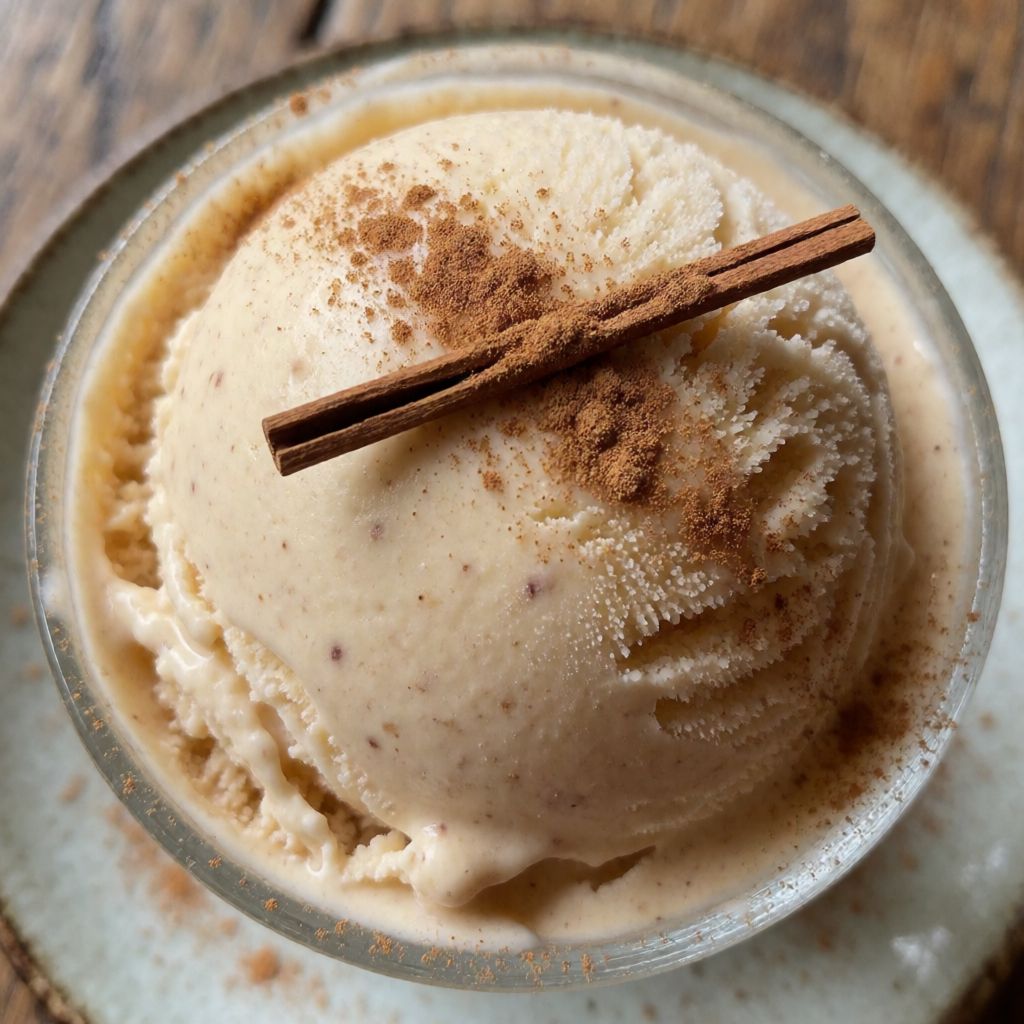
 AI photo
Cinnamon Ice Cream
A creamy custard base flavoured with cinnamon, chilled and churned into a smooth, spiced ice cream.
Labels are worked out automatically from the ingredients and can be wrong. Check the packaging if it matters to you.
Ingredients
- 400 ml Milk
- 300 ml Whipping Cream
- 4 pcs Egg Yolks
- 110 g Caster Sugar
- 2 tsp Cinnamon




Steps
Pour the milk and cream into a saucepan and bring almost to the boil, then remove from the heat.
In a clean bowl, whisk the egg yolks with the sugar until thick and pale, then stir in the cinnamon.
Pour the warm milk-and-cream mixture into the egg mixture in a thin stream, whisking constantly.
Pour everything back into the saucepan and heat the custard gently, stirring constantly, until it reaches 80°C.
Pour the ice cream base into a bowl and refrigerate for 1 hour, or overnight.
60 minChurn the mixture in an ice cream maker, then transfer to a lidded container and freeze for at least 2 hours before serving.
120 minIf the ice cream has been stored for longer, take it out of the freezer 15 minutes before serving.
15 min
This is not whipped cream frozen solid — it's a custard, crème anglaise, turned into ice cream. The egg yolks are doing real work: they bind fat and water together so the mixture stays smooth instead of splitting into ice crystals and greasy cream. Leave them out and you get something closer to flavoured ice, hard and grainy under the spoon. Get them right, and you get a scoop that gives way without turning to soup.
What decides whether this works is one number: 80°C. Below that, the yolks never thicken the milk — you'll have warm sweet milk with cinnamon floating in it. Above about 85°C, the proteins in the yolk seize into curds, and you've made cinnamon-scented scrambled eggs in cream. Eighty is the narrow gate between "not yet" and "too late." No thermometer? Watch the custard thicken until it coats the back of a wooden spoon and holds a line when you draw a finger through it — that costs you nothing but attention.
Some say raw egg yolks are what make ice cream risky, so better to skip them and just whip cream. No — because here the yolks are cooked properly, to 80°C, well above the point where that risk disappears. The danger was never the yolk. It's leaving it raw.
Then two stages that have nothing to do with the stove: chilling the base before churning, and the churning itself. Skip the chill, and you ask your machine to cool and freeze at the same time — it struggles, and the ice crystals that form are bigger because everything sets more slowly. Skip the churn, or rush it, and you lose the air that makes ice cream light instead of a frozen custard brick.
Milk and cream together, not cream alone. Cream's fat is what keeps the inside silky, but all cream gives you something dense, almost like frozen butter, stubborn straight from the freezer. Milk thins that down and lets the water in it form smaller crystals once the structure the yolks build is holding everything together. In a UK fridge that usually means whole milk and double cream side by side — don't reach for anything lower-fat here; the structure depends on that fat content, and a semi-skimmed substitute will show up later as icy grit on the tongue.
Egg yolks: four for 700ml of liquid is a proper custard ratio, not a token addition. They're an emulsifier first, a thickener second — they let fat and water sit together instead of separating once frozen. Fewer yolks and the result turns icier; more, and you tip toward a dense, rich frozen custard. This batch feeds four as a proper dessert bowl each, the kind of thing you'd put out after a Sunday roast when nobody wants anything heavy but everybody still wants pudding.
Sugar: beyond sweetness, it lowers the freezing point of the mix, which is why ice cream out of a home freezer is soft enough to scoop rather than a block of glass. Cut the sugar and you get something harder and icier, not just less sweet — if you want it less sweet, look elsewhere in the dish for balance, not here.
Cinnamon: two teaspoons looks generous until you remember cold mutes flavour — a custard that tastes exactly right while warm will taste flat once churned and frozen, so the dose has to overshoot a little on purpose. Stir it into the cold egg-and-sugar mixture, as the recipe has you do, not straight into the hot milk — tip it into hot liquid and it clumps, and you end up chewing little specks of bark-dust instead of tasting it evenly through the whole bowl.
No ice cream maker — and plenty of kitchens don't have one? You can still get there: pour the chilled base into a wide, shallow container, more surface means faster, more even freezing, and put it in the freezer, but take it out and whisk hard every half hour or so for the first two to three hours. You're doing the churn's job by hand, breaking up ice crystals as they form instead of letting them grow undisturbed while you forget about the freezer. That's where patience stops being a word on a page and becomes an actual ingredient — the kind you have to keep adding, one trip back to the freezer at a time.
That final rest — out of the freezer fifteen minutes before serving — isn't fussiness. A custard-based ice cream, straight from a hard freeze, is dense enough to bend a teaspoon before it gives up any ice cream. Fifteen minutes lets the edges soften without the middle melting through, so it scoops the way it's meant to rather than fighting you for it.