
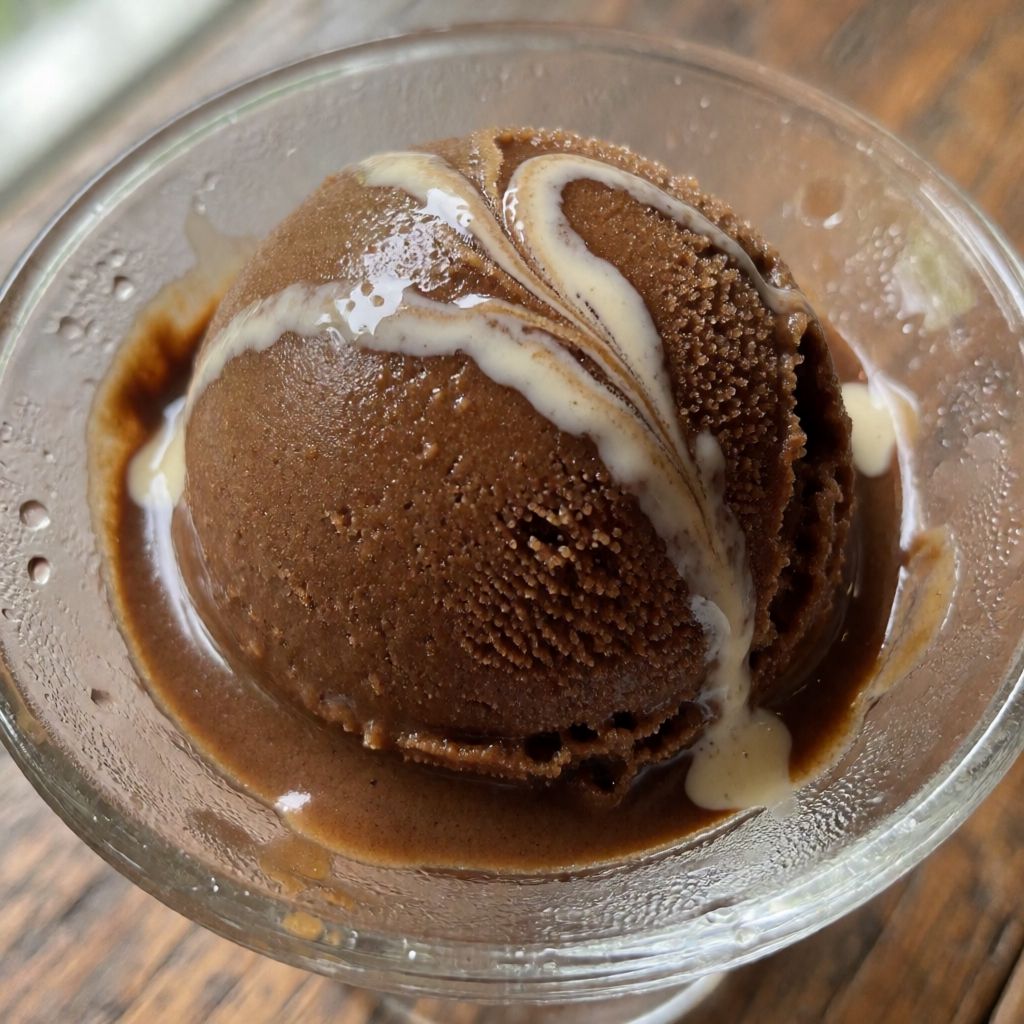
 AI photo
Coffee Sorbet
A simple frozen coffee dessert made by freezing a sweetened coffee syrup until firm.
Labels are worked out automatically from the ingredients and can be wrong. Check the packaging if it matters to you.
Ingredients
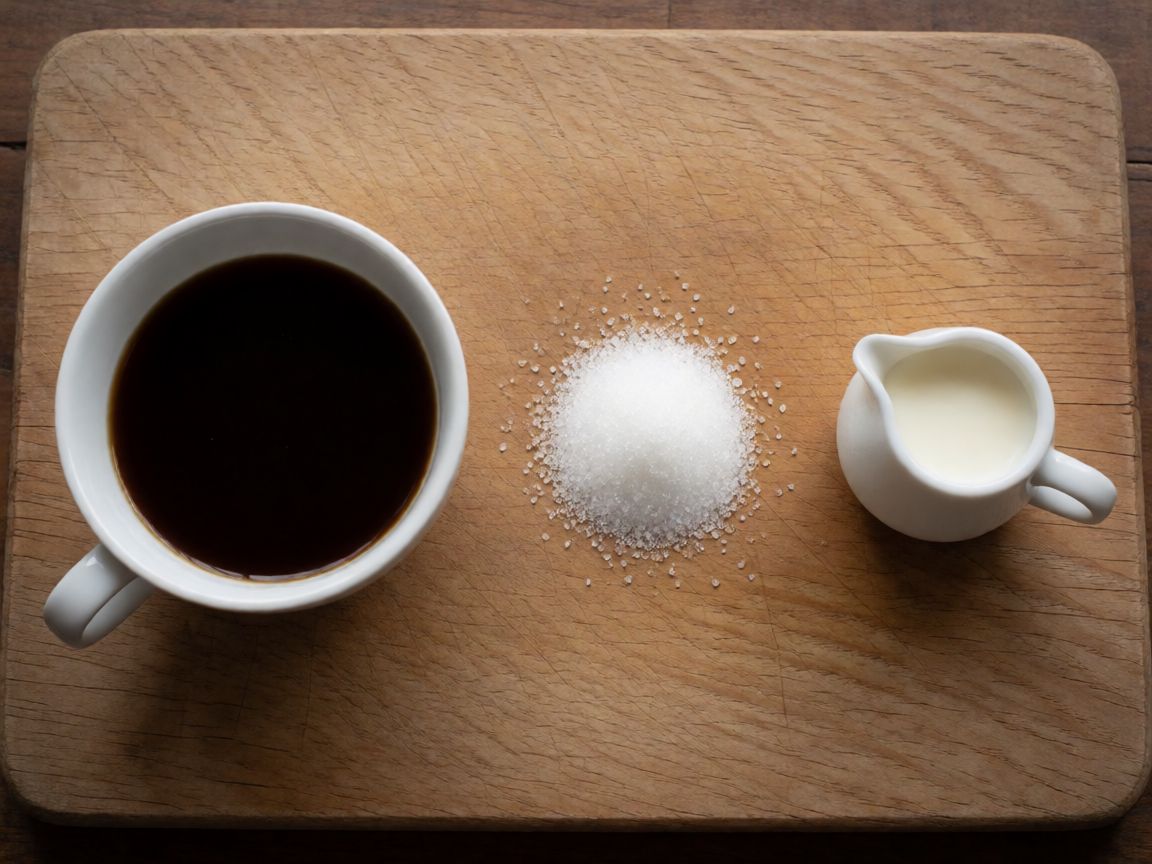
- 220 ml Water
- 125 ml Coffee strong brewed
- 140 g Caster sugar
- 125 ml Double cream




Steps
Pour the water and coffee into a small saucepan and add the caster sugar. Whisking constantly, bring to the boil.
Remove from the heat, stir in the double cream and leave to cool.
Pour the syrup into a wide glass or metal container.
Freeze for at least 6 hours, stirring roughly every 2 hours.
360 minServe topped with a dollop of whipped cream and coffee beans.
This isn't a churned sorbet, whatever the name on the card says. There's no machine here, no paddle turning inside a frozen canister — there's a fork, a tray, and your own patience doing the job a £150 gadget does for you. What you're actually making is closer to a granita with a splash of cream stirred through it: a liquid that you freeze while repeatedly breaking it apart, so it never sets into one solid block.
The whole dish lives or dies on one thing: the size of the ice crystals. Water left alone in a freezer links up into long, hard crystals — that's what gives shop granita its crunch and gives a badly made homemade sorbet its unpleasant, tooth-aching bite. Every time you go in with a fork and break the half-frozen mass apart, you're interrupting that linking-up, forcing the water to refreeze into many small crystals instead of a few big ones. Do it every couple of hours and you get something fine, almost snow-like. Skip it, or do it once, and you get an ice brick with syrup pooled at the bottom, because sugar lowers the freezing point and gets pushed out of the ice as it forms, concentrating wherever it's allowed to settle.
Some say you need an ice cream maker for a sorbet. No — because all a machine does is exactly this stirring, just continuously and by motor instead of by hand every two hours. It's more convenient, not more necessary. People made flavoured ices long before anyone owned a compressor; they just had more arm-hours to spend.
Start with the coffee. 'Strong brewed' isn't a style note, it's a correction for what cold does to flavour — cold mutes both sweetness and aroma, so anything you freeze needs to taste a touch too intense while it's still liquid, or it'll read as watery once frozen. Espresso, or a filter coffee pushed stronger than you'd drink it, both work. Instant coffee made weak will give you a sorbet that tastes mostly of sugar and water with a coffee rumour somewhere in the back.
The water and sugar are doing chemistry, not just bulk. Boiling them with the coffee, whisking the whole time, dissolves the sugar completely before the mixture has any chance to cool and crystallise again — that's the defect this step prevents: gritty, undissolved sugar sitting in your finished sorbet like sand. Caster sugar is chosen over granulated for the same reason — finer grains dissolve faster, so less time at the boil, less risk of anything sticking or scorching on the bottom of a small pan.
The cream goes in off the heat, and that matters. Boil cream too long or too hard and the fat can separate out, leaving you with a thin, oily layer instead of a smooth one. Added once the syrup is off the flame, the fat stays suspended through the liquid, and that fat is doing real work in the freezer: it gets in the way of ice crystals linking up into long chains, the same job it does in proper ice cream, just less thoroughly because there's no churn here. This is also why the result is softer and creamier than a plain water-and-sugar granita, and why it's called a sorbet loosely rather than exactly. Double cream is picked for its fat content, roughly half fat by volume — any cream in that range will behave the same; a single cream or, worse, milk, brings too much water and not enough fat, and you'll feel the difference as extra crunch.
Container and freezer deserve a word, because a British kitchen freezer isn't a blast chiller. Metal conducts cold faster than glass, so a metal tray will set and refreeze between stirrings quicker — useful, since you're repeating this four or five times over six hours and don't want to be standing over a half-set puddle each time. If your freezer is a frost-free model, which most modern ones are, it cycles air through the compartment to stop ice building up on the walls; that same airflow can dry the surface of anything left uncovered, so don't be surprised if the top layer looks slightly different from what's underneath — a quick stir folds it back in anyway.
The topping — whipped cream, coffee beans — isn't flavour engineering, it's contrast: something soft and faintly warm-tasting against something cold and granular, something to look at besides a scoop of brown ice. Treat the six hours and the stirring as the real ingredient here. There's no shortcut that skips the patience without also handing you a worse texture; that trade is the whole recipe.