
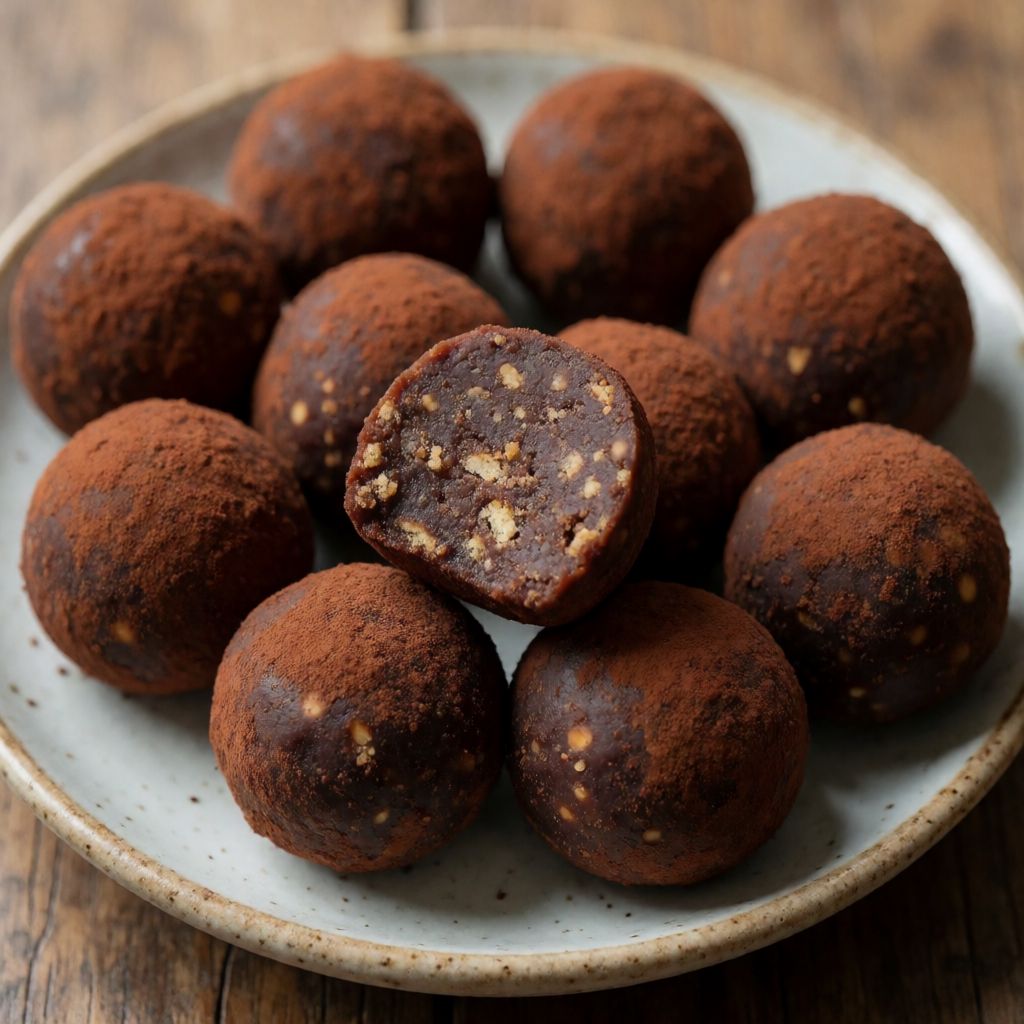
 AI photo
Coffee Truffles
Coffee truffles are a rich, chocolatey treat flavoured with coffee and rolled in cocoa powder.
Labels are worked out automatically from the ingredients and can be wrong. Check the packaging if it matters to you.
Ingredients
- 200 ml Double cream
- 250 ml Coffee
- 220 g Dark chocolate
- 100 g Milk chocolate
- 40 g Butter
- 220 g Chocolate biscuits
- Cocoa powder to taste



Steps
In a small saucepan, bring the cream and coffee to the boil.
Remove from the heat and add the milk chocolate and dark chocolate, chopped into small pieces, along with the butter.
Stir until the ingredients have completely melted and the mixture is smooth, with no lumps.
Let the mixture cool.
Blitz the biscuits in a blender into fine crumbs and add them to the chocolate mixture.
Mix thoroughly until combined, cover and refrigerate.
360 minTake a small amount of the mixture and shape it into small balls with your hands.
Roll each ball in cocoa powder and place in paper cases.
Let the truffles rest in the fridge a little longer.
What was changed
The dry cocoa biscuits were swapped for Chocolate biscuits, a choice more familiar to UK shoppers.
This is not a truffle in the French patisserie sense — no tempered couverture, no dipping fork, no glossy shell that cracks under your teeth before giving way to something soft. This is a coffee ganache bulked out with biscuit crumbs until it's firm enough to roll in your palms. Call it the home version: one saucepan, one fridge, patience instead of a thermometer.
What decides whether it works is the balance of fat against crumb, and little else. Too little biscuit and the mixture stays a sauce — you'll be chasing melted chocolate round a bowl at midnight, wondering where it went wrong. Too much and you get a dry chocolate meatball that tastes mostly of digestive. The crumb's job is to soak up just enough cream and chocolate fat that the mixture sets cold but still gives in the mouth, not a second before.
Some say you need to temper chocolate to make truffles — no, because tempering is for a shell that has to snap and shine on the outside while something softer waits underneath. Here the whole truffle is the filling. It just needs to be firm enough to pick up without smearing, and cold does that job for you, not technique.
The six hours in the fridge are not padding in the recipe — they are the recipe. Cocoa butter needs real time, undisturbed, to settle into a stable crystal form. Rush it and the balls slump the moment your hand warms them, because your palm, at roughly body heat, sits only a few degrees above the point where cocoa butter gives up and turns liquid again.
Start with the cream and coffee boiled together, not separately. The heat does two jobs at once: it infuses the cream with coffee rather than just mixing two liquids, and it stores enough warmth to melt the chocolate once poured over — off the heat, never on it. Chocolate melted directly in a pan on a flame scorches before the centre of each piece softens; poured hot liquid melts it evenly from the outside in. This is why the recipe asks you to chop the chocolate small — a big block takes so long to melt that you're tempted to put the pan back on the heat, and that's when chocolate seizes into a grainy paste that won't come smooth again. Double cream specifically, not single or half-fat, because at around 48% fat it has enough body to emulsify with the chocolate's own fat into something glossy rather than splitting into chocolate lumps floating in thin liquid. As for the coffee, any strong, hot coffee works — cafetiere, filter, even good instant stirred into boiling water. Its job is flavour and heat, not a particular extraction method, so there's no reason to defend a specific brewing ritual here.
The two chocolates aren't there by accident. Dark chocolate carries more cocoa solids and cocoa butter, which means more bitterness and a firmer set — it's what gives the truffle backbone. Milk chocolate is softer and sweeter, and it's there to stop the dark from dominating and to keep the texture from setting rock-hard. Change the ratio and you change both flavour and firmness in the same move, so if you only have one kind in the cupboard, expect a different truffle, not a failed one — more dark, sharper and firmer; more milk, sweeter and softer. The only real criterion for either is plain eating chocolate with no fillers or vegetable fat substituting for cocoa butter — cooking chocolate sold cheap often has less cocoa butter, and it shows in how reluctantly it sets.
Butter is the smallest ingredient here and the easiest to underrate. It's not adding richness you'd notice as butter — it's smoothing the set, giving the ganache a bit of shine and a slightly lower melting point so the truffle gives way cleanly rather than crumbling. Unsalted is the safer choice since the chocolate already carries sugar and salt in its own balance, but a little salted butter won't wreck anything.
Biscuits, blitzed fine, are the part that makes this recipe sensible for a kitchen without a sugar thermometer. A classical ganache that's meant to be rolled by hand needs careful chilling and a steady touch, because there's nothing in it but fat holding fat together. Biscuit crumb is a dry, absorbent filler — it drinks up the extra moisture and fat so the whole thing firms into something forgiving, closer to a fridge cake than a confectioner's truffle. This is thrift, not tradition for its own sake: a way of stretching good chocolate with cheap crumb, the same logic behind a British chocolate fridge cake. Use any biscuit that's dry and not too sweet — digestives, Rich Tea, even Hobnobs if you don't mind a coarser bite from the oats. No blender at home is no obstacle: a rolling pin and a sealed bag get you the same crumb, just with more effort and a little noise.
Cocoa powder for coating does two things, not one. It cuts the sweetness with real bitterness, and it's a dry surface that stops the truffles sticking to your fingers, to each other, or to the paper case. There isn't a good substitute if you want that bitterness — icing sugar instead will give you a sweeter, softer-looking coating, which is a different truffle, not a mistake, just be honest with yourself about which one you're making.
And when you roll them: work fast, or run your hands under cold water first. Your palm is close enough to body temperature to melt the cocoa butter in the mixture the moment you start handling it, which is exactly the heat the fridge spent six hours fighting. Patience got the mixture firm; don't let five warm minutes of rolling undo it.