
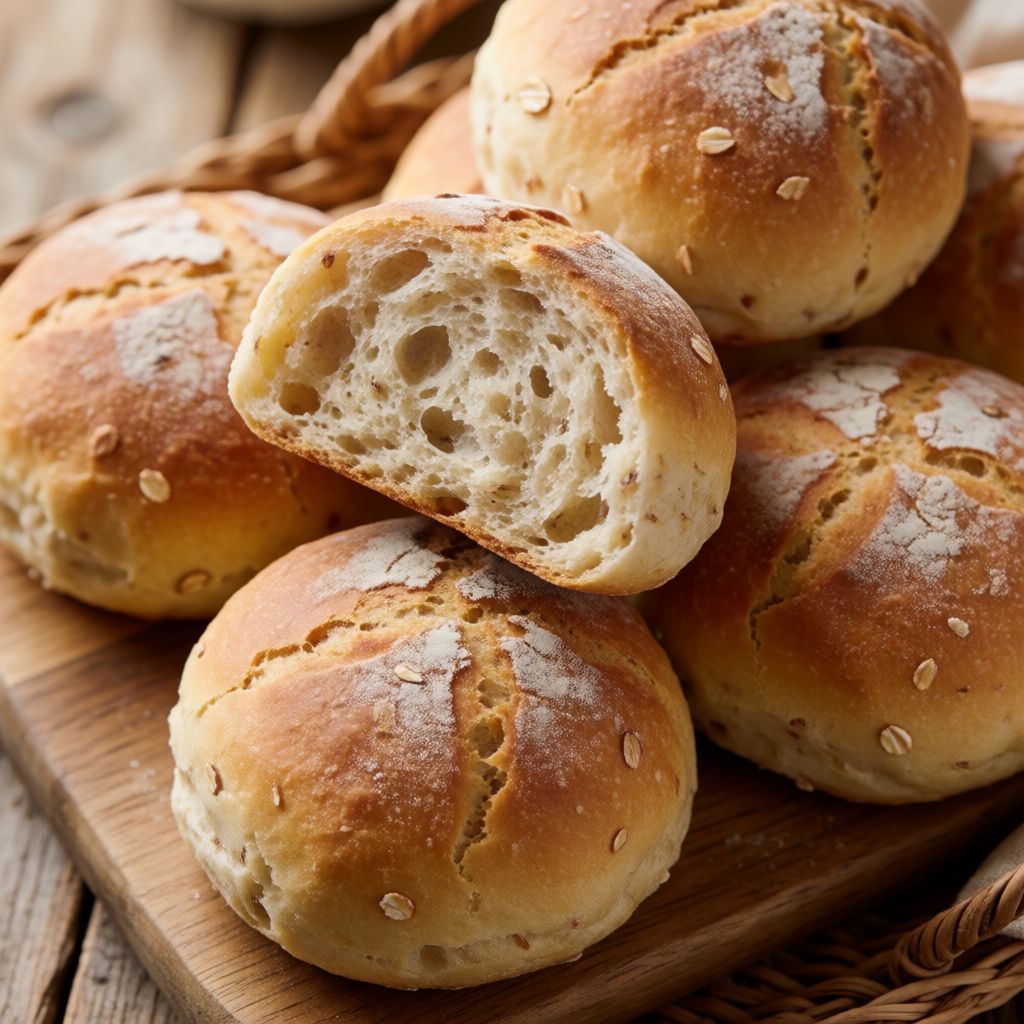
 AI photo
Cold-Fermentation Rolls
Soft rolls made from a dough that rests and ferments slowly overnight in the fridge for extra flavour and texture.
Labels are worked out automatically from the ingredients and can be wrong. Check the packaging if it matters to you.
Ingredients
- 500 ml Water
- 10 g Yeast
- 500 ml Wholemeal Flour
- 100 ml Porridge Oats
- 300 ml Plain Flour optional: up to 100 ml more
- 1 tsp Salt






Steps
In the evening, combine the water and yeast in a large bowl and stir.
Add the wholemeal flour and porridge oats, mix with a wooden spoon, then add the plain flour and salt.
As you mix, check whether the dough can take an extra 100 ml of flour. The dough should remain easy to stir but not become completely runny.
Cover the bowl with a lid and place it in the fridge overnight.
In the morning, preheat the oven to 250°C (fan/convection).
Spoon the dough onto a baking tray lined with parchment paper and brush with water.
Just before baking, reduce the temperature to 220°C (fan/convection), place the rolls in the middle of the oven and bake for about 15 minutes.
15 minLet the rolls cool on a wire rack before serving.
This is bread that works while you sleep. You mix a wet, almost pourable dough in the evening, put it in the fridge, and by morning it has done on its own everything a baker usually does with his hands — built gluten, developed flavour, grown bubbles. You spoon it onto a tray in the morning, no shaping, no proving on the worktop, and twelve rough rolls come out of a hot oven fifteen minutes later.
The whole trick is temperature and time working against each other on purpose. A fridge runs at around 4°C. Yeast at that temperature doesn't stop — it just slows right down, and slow is the point. Fast fermentation in a warm kitchen gives you gas and not much else. Eight or ten hours in the cold gives the enzymes in the flour time to break starch into sugar the yeast can actually use, and gives the gluten time to line itself up into sheets without you ever touching it with your hands. Kneading is just a shortcut for time. Here you have the time, so you skip the kneading.
Some say yeast needs warm water to "wake it up", and that a fridge will kill it. No — because yeast doesn't need heat, it needs food and moisture, and cold only tells it to work patiently instead of frantically. What kills yeast is heat above body temperature, not the absence of it. This recipe is built around that slow patience; rushing it by proving on the radiator defeats the entire reason the dough is wet enough to pour instead of stiff enough to knead.
Water and yeast go in first and get stirred before anything else touches them, because yeast needs to be fully wetted and loosely distributed before flour arrives and starts tying water up. Any baking yeast will do this — fresh, dried active, fast-action — the amount and the overnight cold simply mean you don't need the fast kind; it has all night to work regardless.
Wholemeal flour carries the bran and the flavour; it's also the reason you can't knead this dough the usual way even if you wanted to — bran edges are sharp under a microscope and they cut through developing gluten strands rather than helping them, which is part of why this method leans on time instead of mechanical work. Porridge oats aren't decoration. They sit in the wet dough overnight and slowly drink liquid, so by morning they've gone soft and swollen, which is what gives these rolls their chew rather than a crumb that's purely bread. Use rolled oats, the ordinary slow-cook kind — instant oatmeal has already been pre-cooked and flattened and will turn to paste rather than holding any texture.
Plain flour is there to rebuild the structure the wholemeal and oats take away — it's the flour with the least interference, mostly just gluten-forming protein and starch, no bran cutting it down. This is also why the recipe tells you to judge, mid-mix, whether it can take more: flours vary batch to batch in how much water they'll absorb, so the "up to 100ml extra" isn't vagueness, it's an honest acknowledgement that you're reading the dough, not a bag.
Salt does two jobs that have nothing to do with taste on their own. It tightens the gluten network, and it puts a brake on fermentation. Skip it and an overnight fridge rise can run further than you want and the dough can look slack and tired by morning instead of alive. One teaspoon for this amount of flour is modest and deliberate — enough to control the ferment over eight-plus hours, not enough to taste as salt.
In a flat kitchen, a lidded bowl big enough for this dough is not something everyone owns — a large bowl with a plate on top, or clingfilm, does exactly the same job: keeping a skin from forming on the surface overnight. Brushing the shaped rolls with water just before they go in the hot oven isn't a glaze, it's a thin layer of steam at the surface in the oven's first few minutes, which keeps the crust from setting too early and locking the rolls from rising further.
The drop from 250°C down to 220°C the moment the tray goes in is a domestic-oven correction, not a flavour step: opening the door loses real heat fast, and a cold tray of dough pulls more heat out again, so preheating hotter than you need means the oven settles near the temperature you actually want for the bake, rather than limping up to it too late for the rolls to catch any oven spring. Judge doneness by colour — a deep gold, not pale — and by weight in the hand once cool: a roll that still feels heavy and damp inside hasn't had its full time, whatever the fifteen minutes on the clock say. Twelve rolls feed a table alongside a Sunday roast for gravy-mopping, or split for breakfast with butter and a mug of tea with milk — either way, they keep a day or two before they start drying out, which for a dough with no fat in it is doing rather well.