
 AI photo
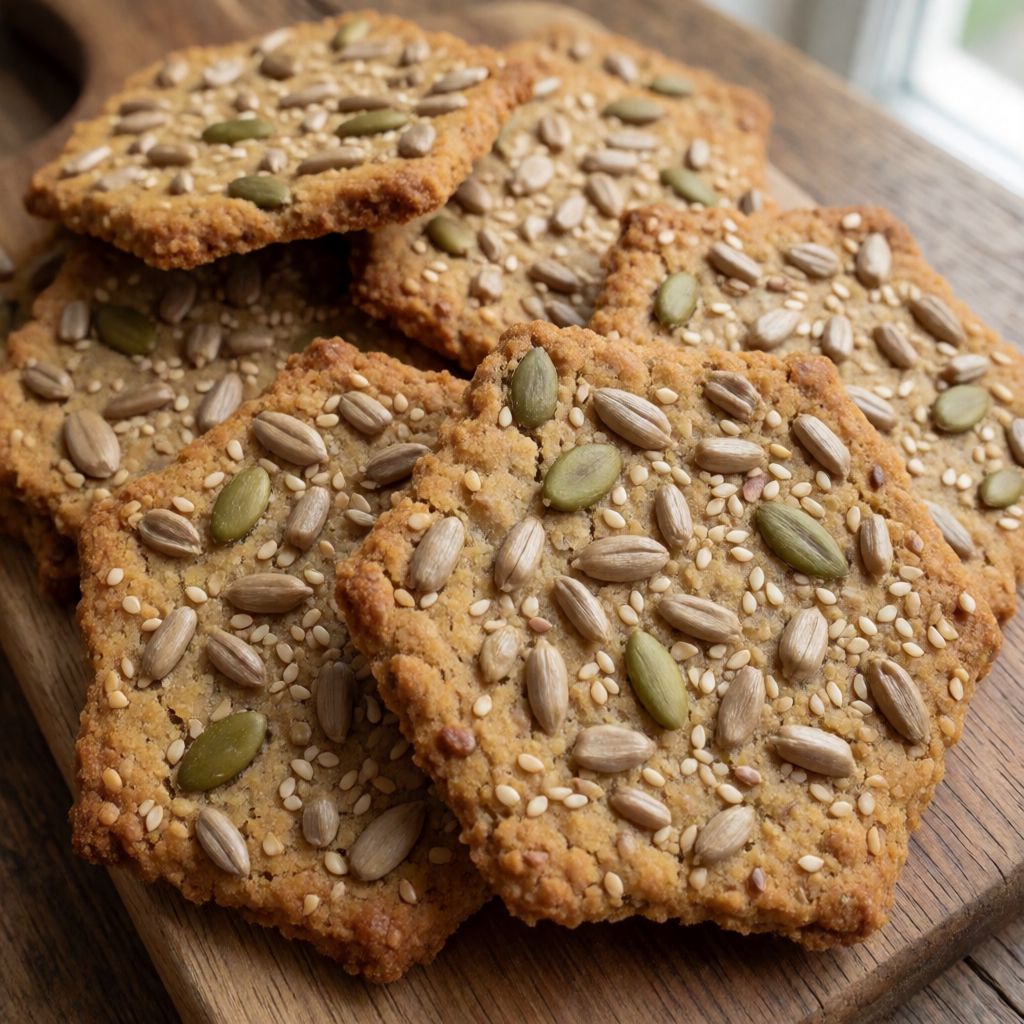
Crispy Seed Crackers
Thin, crunchy homemade crackers packed with seeds and oats — great with cheese or dips.
Labels are worked out automatically from the ingredients and can be wrong. Check the packaging if it matters to you.
Ingredients
- 180 g Plain flour
- 75 g Oats
- 35 g Sunflower seeds
- 50 g Sesame seeds
- 50 g Pumpkin seeds
- 0.5 tsp Baking powder
- 1 tsp Caster sugar
- 1 tsp Salt plus a little for sprinkling
- 200 ml Water
- 100 ml Olive oil






Steps
Mix the dry ingredients well in a bowl, add the olive oil, then the water. Stir until smooth, until the dough is thick and even, like porridge.
Leave the dough to rest for 30 minutes.
30 minDivide the dough between two sheets of baking paper, splitting it roughly evenly.
Cover with another sheet of paper and roll out the dough to a thickness of 2-2.5 mm on each sheet.
Remove the top sheet of paper and transfer the dough with the bottom paper onto a baking tray.
Cut the dough into cracker pieces with a sharp knife, a roller or a pastry wheel.
Bake in a fan oven preheated to 175°C for about 30 minutes, until the crackers are crisp.
30 minBreak or cut the crackers along the score lines. Cool on a wire rack until completely cool and fully crisp.
This is a flatbread pushed past bread into glass — a seed cracker that's really a batter, not a dough, baked until every bit of moisture has left it. The whole mechanism rests on one decision: you're not kneading gluten for chew, you're building a thin, seed-studded sheet that bakes dry enough to snap. Get the thickness wrong and you get either a biscuit that bends (too thick, still has give) or a shard that's half-burnt before the middle cooks (too thin, no buffer).
The batter itself tells you this isn't bread. Oats and seeds make up almost half the dry weight, and seeds don't develop gluten — they just sit there, breaking up the flour's structure. That half-teaspoon of baking powder isn't for rise, it's just enough to stop the cracker tasting flat and pasty; you're not after lift, you're after crispness, and lift is the enemy of crispness.
What decides success is thickness and doneness together. 2-2.5mm isn't a fussy baker's tic — it's the thinnest you can go and still handle the dough without it tearing, and the thickest you can go and still get the water out in half an hour at a sensible oven heat. Some say crackers need a very hot oven to crisp quickly — no, because speed isn't the goal here, drying is. A hot oven colours the top before the middle loses its water, leaving you with a dark, soft-centred disappointment. 175°C fan gives the whole thickness time to dry evenly before the surface scorches.
Flour here is just scaffolding — plain flour, nothing strong or "bread" about it, because you want some structure to hold the seeds together, not elasticity to fight against when you roll. If you only have self-raising, use it and drop the baking powder; anything stronger will make the cracker chewy at the edges where you want it to shatter.
Oats are bulk and texture, not flavour. Porridge oats, the ordinary rolled kind from any UK shop, do the job — they soak up water during the rest and give the baked cracker a slightly rustic, uneven bite instead of a smooth biscuit snap. Don't reach for instant oats; they turn to paste and you lose the texture entirely.
The three seeds — sunflower, sesame, pumpkin — aren't interchangeable with each other in function, only in principle. Sunflower and pumpkin are the "meaty" seeds, giving bite and visible studding; sesame is smaller and toasts faster, giving a background nuttiness and helping bind the surface where it touches the paper. Any seed with some oil in it and no strong perfume of its own will work here — linseed, chia, even chopped nuts in small amounts — but keep the total weight roughly the same, because the seed-to-flour ratio is what keeps this from baking into bread.
Salt does two jobs, which is why it's split: the teaspoon in the dough seasons the whole cracker, the pinch on top before baking gives you a burst of salt on the tongue before the seed flavour arrives — texture of seasoning, not just presence of it. Skip the top sprinkle and the cracker tastes curiously muted even though the dough itself is seasoned correctly; taste isn't just quantity, it's where the salt sits relative to your tongue.
Olive oil is for crispness and shelf life, not flavour drama — use one with no strong taste of its own if you want the seeds to lead, or a fruitier one if you want the oil itself to register. Any neutral vegetable oil works as a substitute; what you lose is a slight richness and a longer shelf life, since olive oil's own antioxidants help these keep their crunch for days in a tin rather than going soft by the next morning.
Patience is the real ingredient twice over here: once in the thirty-minute rest, so the dough behaves when rolled, and once in the cooling, on a wire rack, fully flat. Some say you can cut and eat them warm — no, because a cracker that feels crisp warm is often still faintly leathery in the centre; it's only on full cooling that the last of the structure sets hard. Rush that step and you'll remember these as "alright" instead of properly crisp, and the whole point of the exercise was the crunch.