
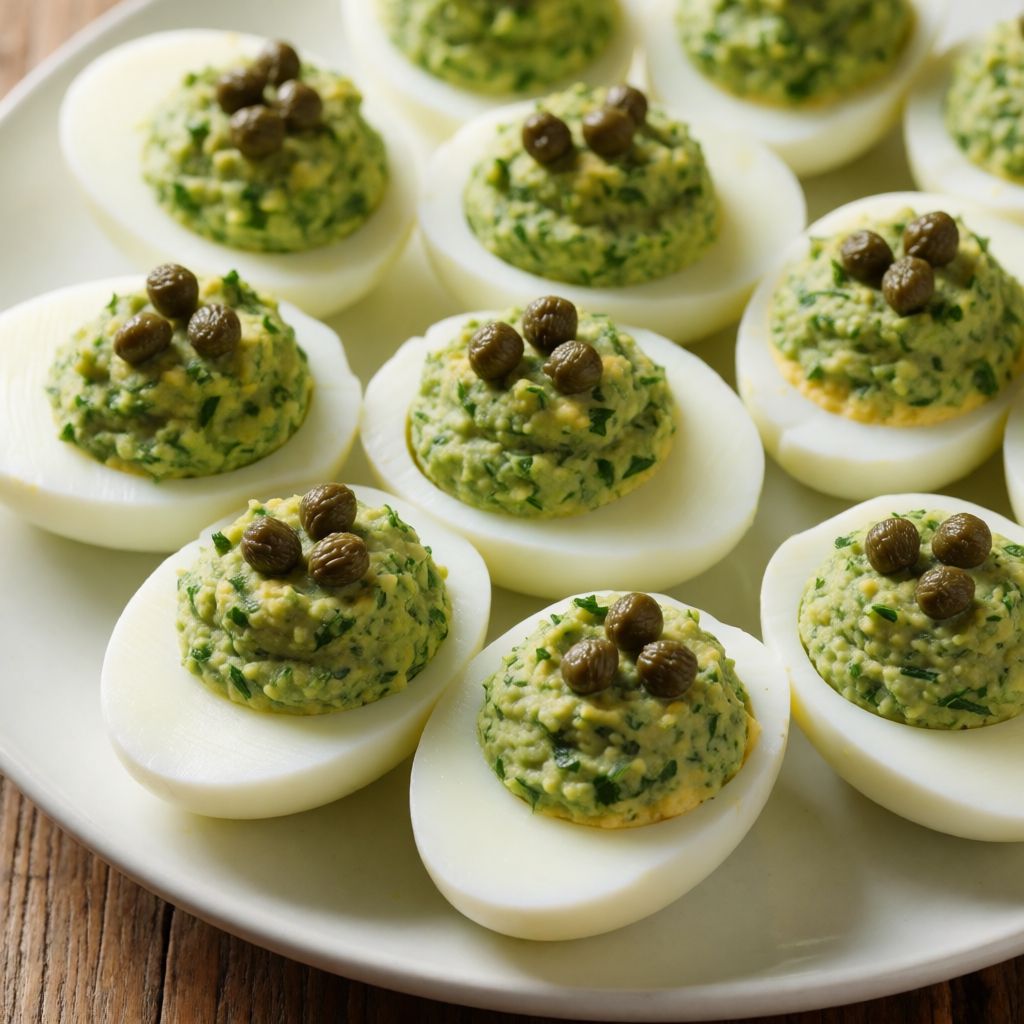
 AI photo
Parsley-Stuffed Eggs
Classic hard-boiled eggs filled with a creamy parsley and caper yolk mixture.
Labels are worked out automatically from the ingredients and can be wrong. Check the packaging if it matters to you.
Ingredients
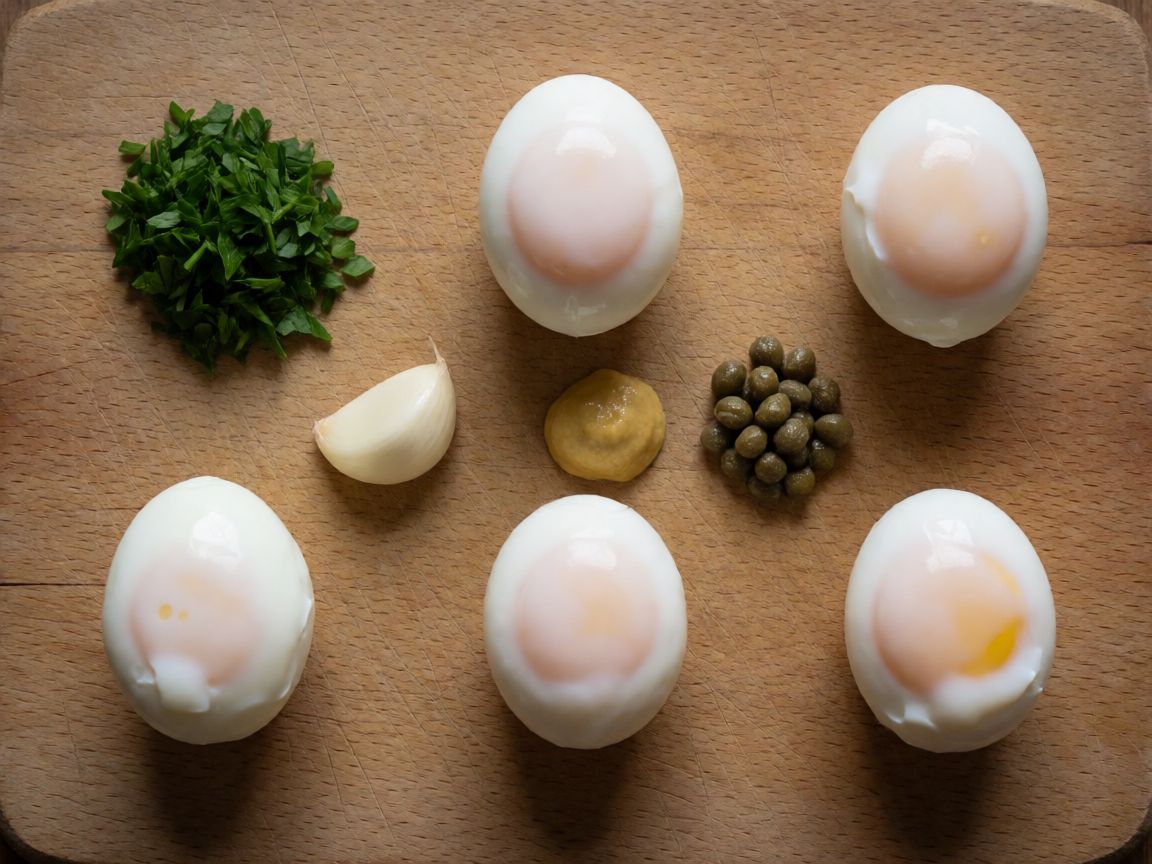
- 6 pcs Hard-boiled eggs
- 30 g Parsley
- 1 clove Garlic optional
- 1 tbsp Mustard
- 1 tsp Capers in apple cider vinegar
- Salt to taste
- Black pepper to taste
- Olive oil to taste






Steps
Cut the hard-boiled eggs in half, scoop the yolks into a separate bowl, and arrange the egg-white halves on a serving plate.
Add the roughly chopped parsley, capers, a pinch of salt and black pepper to taste to the yolks.
Add the mustard and pour in the olive oil in a thin stream, mixing until the mixture turns creamy.
Fill the egg-white halves with the yolk mixture; if you like, garnish with extra capers, olives or parsley leaves.
Chill the eggs in the refrigerator before serving.
This is a stuffed egg, the French-British hybrid that turns up at every buffet table under names like devilled eggs or oeufs mimosa. The white is just a cup; everything that matters happens in the yolk bowl. Two mechanisms decide whether it works: how the egg was cooked, and how the yolk mixture was built.
An overcooked yolk is dry and crumbly, and worse, it turns the mix grainy instead of creamy no matter how much oil you beat into it — because a yolk cooked too hard and too long loses its fat-holding structure and can't take on liquid smoothly. So the first fork in the road isn't about flavour at all, it's about texture, and it's decided in the pot, before parsley or mustard ever touch the bowl.
The second mechanism is the emulsion. Mustard plus oil, worked in slowly, behaves exactly like the start of a mayonnaise: mustard's own emulsifiers grab the oil droplets and suspend them in the yolk fat instead of letting them pool and separate. Pour the oil in fast and you get a yolk mixture that looks curdled, oily at the edges — not a flavour fault, a mechanical one, fixable only by slowing down.
Some say you need mayonnaise from a jar for this to be creamy. No — mustard already does that job, and does it with more bite, less sugar, and no raw egg risk. The capers are there for the same reason a squeeze of lemon turns up in rich dishes: acid cuts the flat richness of yolk-and-oil so the whole thing doesn't sit heavy on the tongue.
Eggs: don't chase a magic boiling time, chase a magic cooling. Pull them straight into cold water the moment they're done — this is what stops the grey-green ring on the yolk, which is iron and sulphur meeting at the surface when a hot egg sits and cooks on in its own heat after you think you've stopped it. Separately, the myth that long boiling makes peeling easier is backwards: it's the age of the egg, not the time in the pot, that decides this. A week-old egg peels clean because its air pocket has grown and the white has pulled slightly away from the shell. A fridge-fresh egg from this morning will fight you for every scrap of shell, however long you boil it. If peeling is a battle in your kitchen, buy the eggs a few days ahead and let them sit.
Parsley: flat-leaf, not curly, if you have the choice — curly parsley is tougher and more bitter, bred originally to survive as a garnish, not to be eaten by the spoonful. Chop it roughly, not to a paste; you want flecks of green and bite, not a smear. It's also worth knowing why parsley turns up with egg so often in Britain specifically — it was the one fresh herb that survived a cold garden through most of the year, cheap and always there, so it became the default partner for anything plain: eggs, fish, gammon. No mystery, just what grew.
Garlic, marked optional for a reason: raw garlic doesn't mellow in a cold dish the way it does cooked — it sharpens as it sits in the fridge. If you want it, grate half a clove, not a whole one, and taste before deciding on more.
Mustard: English mustard and Dijon are not interchangeable one-for-one. English is hotter and more one-dimensional; Dijon brings its own acidity, which helps the emulsion and softens the heat. If you're using English mustard — Colman's is the obvious one on a British shelf, and it has sat next to cold meat and eggs on this island for two centuries, which is also why it feels so natural here — use a little less than the tablespoon and build up.
Olive oil: the brief here is an oil with no smell of its own that still gives body. A sharp, peppery extra virgin can turn bitter once you whisk air and acid into it fast, so a light or mild olive oil works better than the expensive one you'd drizzle over a salad. Any neutral oil — sunflower, rapeseed — does the structural job just as well if that's what's in the cupboard; you lose a bit of roundness, not the mechanism.
Capers in cider vinegar are the ready-to-use kind — no rinsing needed, unlike salt-packed capers, which would need a rinse or they'll dump raw salt into a dish you're also seasoning by hand. If you have neither, a small chopped gherkin or even a few drops of the vinegar on its own will do the acid's job, just with less of the caper's particular green pop.
Last thing, and it's not really optional: taste before you chill, then taste again after. Cold mutes salt and fat the same way it mutes most things — a mixture that seems well seasoned warm from the bowl can taste flat once it's cold on the plate. Season a shade more boldly than instinct tells you, and give the finished eggs the time in the fridge the recipe asks for. That wait is doing real work — it's not decoration, it's the last ingredient.