
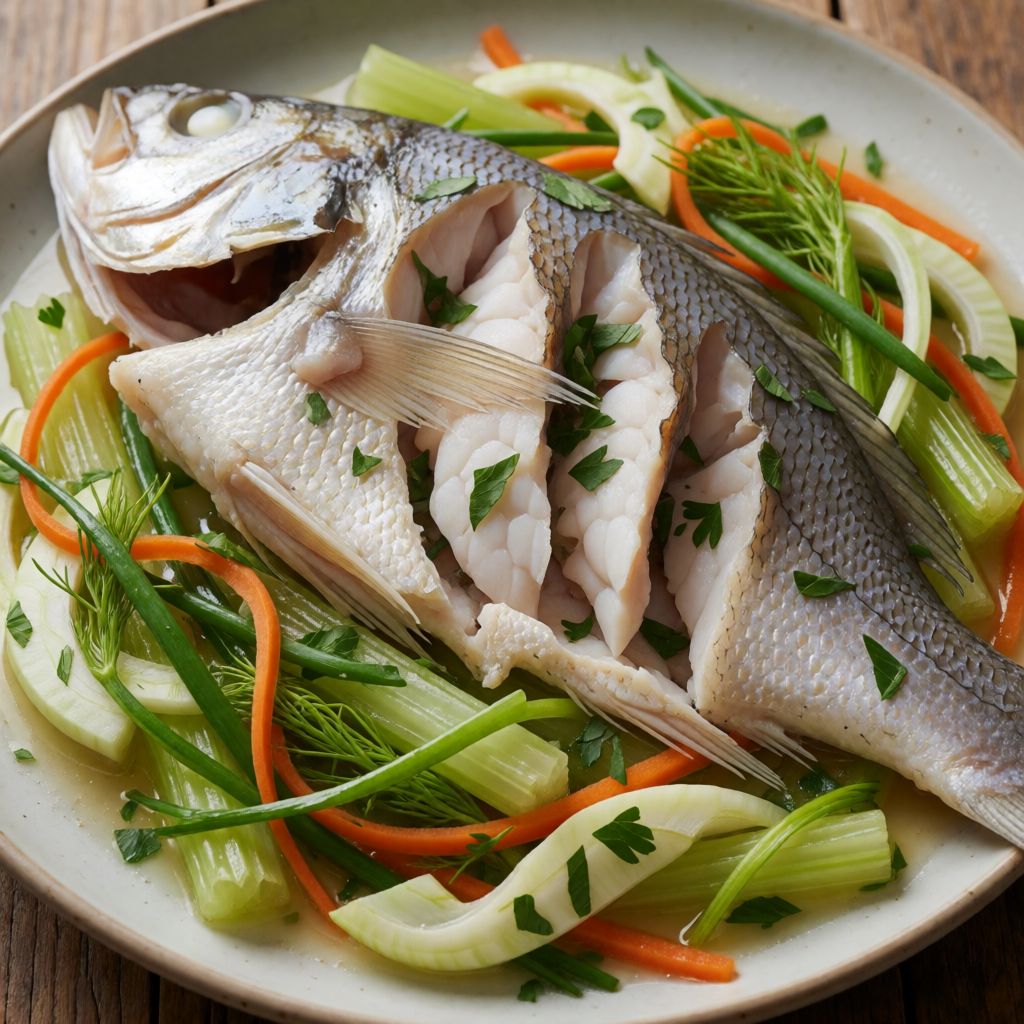
 AI photo
Steamed Sea Bream
Delicate steamed sea bream with celery, fennel, carrot and lemon, served with white rice or potatoes.
Labels are worked out automatically from the ingredients and can be wrong. Check the packaging if it matters to you.
Ingredients
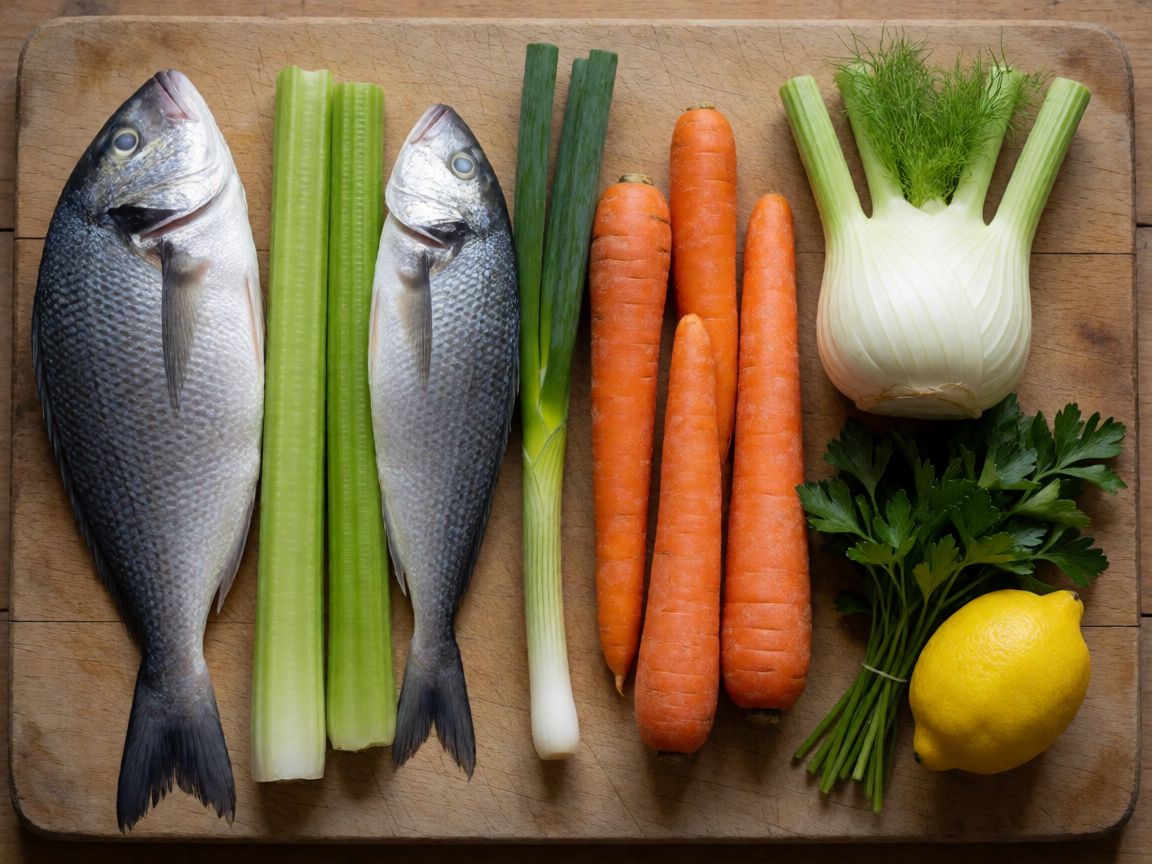
- 2 pcs Sea bream about 400 g each
- 2 pcs Celery sticks
- 1 pcs Spring onion
- 3 pcs Carrot
- 1 pcs Fennel
- 1 bunch Parsley
- 1 pcs Lemon
- 1 l Water
- Olive oil to taste
- Salt to taste










Steps
Bring water to the boil in a steamer with a perforated basket.
Clean the celery, spring onion, fennel and carrot, and cut into small pieces.
Stuff the sea bream's cavity with finely chopped parsley leaves and two slices of lemon.
Brush the fish with olive oil and sprinkle with lemon juice.
Make a bed of fennel and spring onion on the bottom of the steamer basket, place the fish on top and sprinkle with herbs.
Put the celery and carrot into the boiling water.
Set the steamer basket over the pan and turn on the heat to cook the fish. Ready when the thickest part reaches 63°C.
15 minCarefully remove the sea bream and place it on a serving plate.
Serve the steamed sea bream with white rice or potatoes.
Steamed sea bream is the dish that proves cooking isn't always about heat hitting the flesh directly — here steam carries the heat, gently, so the fish arrives at the plate still holding its shape and its own taste, not the taste of fat or char. Two whole bream, about 400 g each, feed two people properly — one fish per person, head to tail, because a whole fish steams more evenly than a fillet and tells you itself when it's done.
What decides whether this works is not minutes but one number: 63°C at the thickest part, usually where the backbone runs through the body behind the head. Steam below that and the flesh stays translucent and sticks to the bone; a little above and it turns from moist to chalky, because fish proteins seize hard and fast — there's only a narrow band between "raw-feeling" and "dry," unlike a Sunday joint which forgives you by the half hour. Some say you can tell by time alone, 15 minutes and done — no, because a 350 g bream and a 450 g one are not the same animal, and your steamer isn't a kazan with one fixed rhythm. Fifteen minutes is where you start checking, not where you stop.
The bed of fennel and spring onion under the fish isn't decoration — it keeps the skin off the hot metal basket, which would otherwise fuse to it and tear the skin when you lift the fish out, and it perfumes the steam rising through the flesh from below. The lemon and parsley inside the cavity do the same job from the inside: aromatics carried by steam penetrate meat far more than aromatics sitting on a plate next to it ever could.
On an ordinary UK hob you won't have a proper tiered steamer most likely — a wide pan with a lid and a metal colander or a round cake-rack set inside it does the same job: water boiling below, fish sitting above it in moving steam, never touching the water. If your pan lid doesn't seal well, a sheet of foil crimped over the rim holds the steam in almost as well — a plate balanced on top, the kind people use when they've no lid at all, works only if it actually traps steam; otherwise you're just drying the fish out from above while undercooking the middle.
Sea bream is chosen here because its flesh holds together under gentle moist heat without falling apart the way a very soft fish like flounder might. If your fishmonger has no bream, any firm white round fish of similar size — a bass, a bream relative, even a smallish salmon trout — behaves the same way; what matters is "whole fish, roughly 400 g, firm enough to hold its shape," not the species by name.
Celery, carrot and fennel go into the boiling water, not under the fish, for a practical reason: they take longer to soften than the fish takes to cook, so they get a head start in the water itself while the fish sits above in steam. Carrot is ready when it bends rather than snaps — that's your doneness cue, not a clock. Fennel and spring onion form the aromatic bed because their flavour is mild enough not to fight the fish but assertive enough to carry through steam; if you've no fennel, a few bay leaves or a sliced leek under the fish does a similar, if plainer, job — any mild aromatic vegetable with no strong smell of its own competing with the sea bream.
Parsley and lemon inside the cavity are there because the cavity is the thickest part of the fish and the part most likely to lag behind in cooking — packing it with something aromatic uses that dead space instead of wasting it, and the acid in the lemon firms the surface flesh slightly, a small insurance against overcooking at the edges while the centre catches up.
Olive oil brushed on the skin before steaming isn't for flavour so much as protection — it's a thin barrier against the skin drying and splitting under steam, which happens more than people expect, because fish skin has very little fat of its own compared to meat. Use any oil without a strong smell of its own if olive oil feels wrong here — a light vegetable or rapeseed oil, common enough in a British kitchen, does the same barrier job without adding its own character.
Serve it with rice or potatoes, plainly boiled — they're there to be background, soaking up whatever juice runs off the fish, not to compete with it. And patience is the real ingredient in this one: the urge to pull the fish out the moment the clock says fifteen minutes is exactly the urge to resist — wait for the thermometer, or failing that, for the flesh at the backbone to flake cleanly rather than cling.