
 AI photo
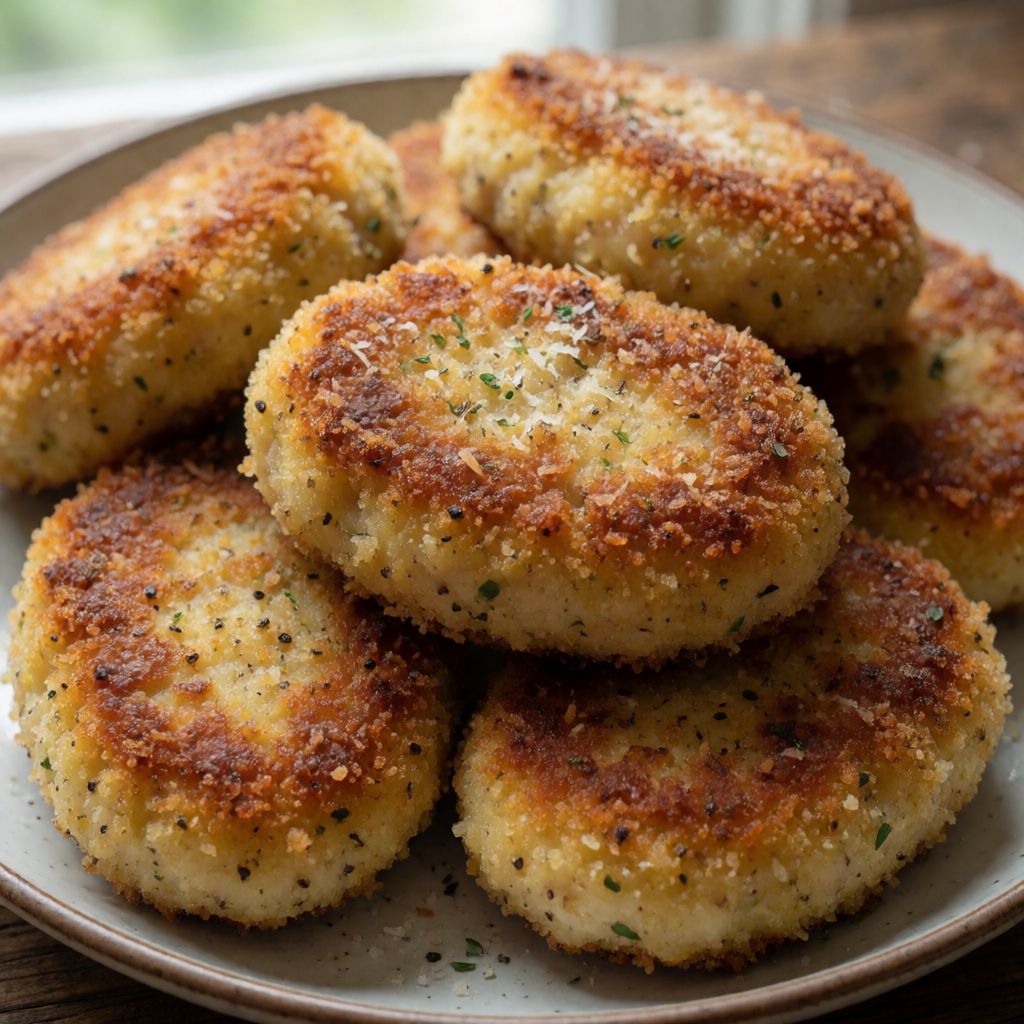
Egg Cutlets
Simple homemade patties made from eggs, breadcrumbs and parmesan, pan-fried and simmered briefly in tomato passata.
Labels are worked out automatically from the ingredients and can be wrong. Check the packaging if it matters to you.
Ingredients
- 50 g Breadcrumbs
- 1 pinch Salt
- 1 pinch Black Pepper
- 2 tbsp Parsley chopped
- 30 g Parmesan grated
- 4 pcs Eggs
- 2 tbsp Milk
- 2 tbsp Olive Oil for frying, more as needed
- 200 g Tomato Passata









Steps
In a bowl, combine the breadcrumbs with the eggs, salt, black pepper, chopped parsley, parmesan and a little milk.
5 minMix well until smooth, then shape into small balls and lightly flatten them.
5 minFry the patties in olive oil until golden brown, then place on kitchen paper to drain.
10 minWarm the tomato passata and add the cooked patties to it, letting them soak up the sauce before serving.
5 min
What was changed
Tomato Passata was used instead, to avoid confusion with ketchup in British kitchens.
This is Italian kitchen thrift wearing a meatball's clothes — polpette di uova, egg patties, born on the days when a household couldn't or wouldn't put meat on the table but still wanted something round, fried, and sitting in tomato sauce like it belonged there. The trick is that egg alone won't hold a shape — it just runs and scrambles. Breadcrumbs are what change that. Dry crumb acts like a sponge: it drinks the egg and milk, swells, and turns a liquid into a mass you can actually pick up. Take the crumb away and you have an omelette. Take the egg away and you have stuffing. Together they make something that holds its shape raw and sets firm the moment heat hits it.
What decides whether this works is balance, not skill. Too little crumb and the mixture slides off your hands into the pan — you'll know because it won't hold a ball at all, it'll pool. Too much crumb and you get something dry and crumbly that falls apart at the first poke of a fork, because there's not enough egg left to bind it. The milk is there to loosen the crumb back down when it's drunk too much — add it a little at a time, feel the mixture, don't trust the spoon's memory of a previous batch.
Breadcrumbs: dry, with no strong taste of its own, is the whole point — its job is to absorb and structure, not to flavour. Stale bread grated fine is the original version of this, because the dish exists to use up exactly that. Panko works, cream crackers crushed fine work, even the dried heel of a loaf blitzed in a food processor works. What won't work well is fresh soft bread torn in — it's already full of moisture and can't do the sponge job the recipe needs.
Eggs: four of them for two people is generous, but they're doing two jobs at once — protein for structure, and the main bulk of the patty, since there's no meat here at all. Use the freshest eggs you have; a tired egg whites more thinly and gives you a looser mixture, which just means go gentler with the milk.
Parmesan: hard, aged, grated fine — its job is salt and savoury depth, standing in for some of what meat would normally bring. Any hard grating cheese with that same salty, long-aged character does the job — pecorino, grana padano, even a strong mature cheddar at a pinch, though the flavour shifts English rather than Italian. Don't reach for soft cheese here; it adds moisture you don't want and none of the saltiness you do.
Parsley: fresh, chopped — flat-leaf if you can get it, but curly from a UK supermarket shelf works fine too, it just chops a little coarser. Its job is lift against all that egg and cheese, which on their own can taste flat and a little sulphurous. Don't skip it for dried — dried parsley is mostly colour by this point, barely any smell left in it.
Milk: here purely to loosen the mixture once the crumb has drunk its fill. Any milk does this — whole, semi-skimmed, even a splash of water in a pinch, though milk's fat rounds off the egg smell a little better than water does.
Olive oil: for shallow frying at this scale you don't need the costly, peppery, drizzling kind — a plainer, cheaper olive oil is fine, or any neutral oil without a smell of its own that can take shallow-fry heat without complaining, sunflower or rapeseed both do the job. Save the good extra virgin for the table, not the pan.
Tomato passata: smooth, sieved tomato, no bits — its job in this recipe is not to cook the patties further but to marry with them, warming through gently so the fried crust can soak a little of it back up without dissolving. If you haven't got passata, blitz a tin of chopped tomatoes smooth, or thin tomato purée with a splash of water until it pours rather than sits in a spoon.
A note on your hob: a domestic ring rarely holds its heat the way a professional burner does, and oil cools fast once you drop cold patties into it. Fry in batches rather than crowding the pan — crowd it and the oil temperature collapses, the patties steam instead of frying, and you lose exactly the crust this whole method depends on. Better four small batches with proper sizzle each time than one big one that goes quiet.