
 AI photo
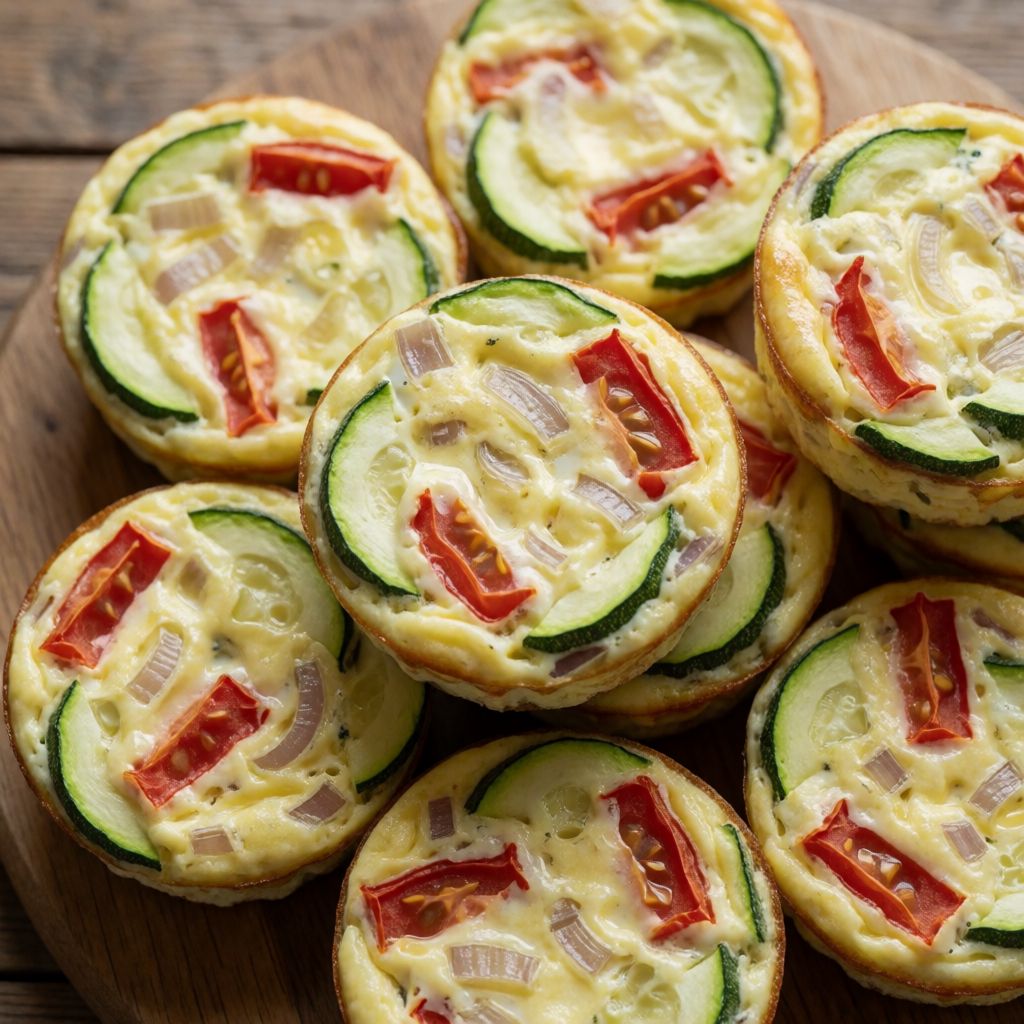
Egg Muffins with Courgette and Tomatoes
Light egg muffins with courgette and cherry tomatoes, great warm or cold.
Labels are worked out automatically from the ingredients and can be wrong. Check the packaging if it matters to you.
Ingredients










Steps
Fry the finely chopped onion in a little oil until soft.
Beat the eggs with the water, salt and pepper, then add the coarsely grated courgette, finely chopped basil and fried onion, mix well and spoon the mixture into muffin tins.
Place the cherry tomatoes on top of each egg muffin.
Bake in a preheated fan oven at 175°C for 12 minutes.
12 minLet cool on a wire rack.
Before serving, sprinkle each muffin with finely chopped basil.
Can be served warm or cold.
This is a frittata that someone had the sense to bake in a muffin tin instead of a pan — which solves the one problem frittata always has: the middle staying wet while the edges turn to rubber. In a tin, every portion is its own edge and its own middle, cooked through at the same rate, so you get set custard everywhere, not a soft disc in the centre you have to gamble on with a knife tip.
What decides whether it works is the ratio of egg to vegetable and how much water sits in that courgette. Courgette is over 90% water. Grate it in and leave it be, and that water comes out in the oven, pools under the egg, and you get a pale, separated puddle at the bottom of each muffin rather than a clean set custard. So the move — even though the recipe doesn't spell it out as a separate step — is to treat grated courgette as something that needs squeezing or at least a few minutes to drain in a sieve before it meets the egg. Skip that and no amount of extra baking time fixes it; you're just drying out the egg while the water keeps leaking.
Some say muffin-tin eggs need paper cases to come out clean. No — the real release agent is fat on a hot metal surface, which is why the recipe asks for butter on the tin, not paper. Butter browns and crisps the contact edge slightly, which is also where you get the only textural contrast in an otherwise soft, custardy bite.
Temperature here is a fan oven at 175°C, and what that number is actually doing is setting egg protein evenly without scorching the thin edges of a muffin cup before the centre firms up. Eggs start to set around 60-65°C and fully coagulate not far above that; 175°C ambient heat gets you there inside twelve minutes because the portions are small — a whole frittata in a pan needs a gentler finish precisely because it's thick and the outside would overcook long before the inside caught up. Twelve minutes is where this batch landed in a fan oven of known temperature; it's a floor, not a clock you set and walk away from. The real cue is the dome: when it's risen, matte rather than wet-shiny, and springs back rather than wobbling like a water balloon when you nudge the tin, it's done. A fan oven runs hotter and more evenly than a conventional one for the same dial setting — if yours is conventional, expect it to take longer and to need checking rather than trusting the twelve minutes blind.
The onion is fried first for one reason: raw onion folded straight into egg stays crunchy and sharp-tasting even after twelve minutes of baking, because that's not long enough or hot enough to break it down the way a slow sauté does. Frying it separately first, until it goes soft and loses its raw bite, means the onion's job — sweetness and body — is already finished before it ever meets the egg. A teaspoon of olive oil is about right for a small chopped onion in a reasonably nonstick pan; the oil's only job is to stop sticking and carry heat evenly, so any neutral, clean-tasting oil does the same work — sunflower, a mild rapeseed, whatever's already open in a British kitchen. You don't want an oil with a strong character of its own fighting the basil later.
Seven eggs plus 50ml water for twelve muffins is a deliberately light ratio — barely over half an egg per muffin — which is why the courgette and the fried onion are doing real structural work, not just flavour. The water is there to loosen the mixture so it pours rather than scoops, and to steam the egg slightly from within as it cooks, giving a softer set than egg alone would. If you're out of water, a splash of milk does the same loosening job and adds a little more richness, though milk's proteins will brown the top faster, so watch the twelve minutes a little more closely if you swap it in.
Courgette is the one ingredient that needs handling, not just adding. Three hundred grams, coarsely grated, releases a genuinely surprising amount of liquid once it's salted or simply left to sit — press it in a clean tea towel or a sieve for a few minutes before it goes anywhere near the egg. This isn't tradition for tradition's sake; it's the one concrete thing standing between you and a soggy base. If courgette's out of season or you don't fancy it, a firm vegetable with similarly low moisture after draining works — grated carrot squeezed dry, or finely chopped spinach that's been wilted and pressed hard first, since raw spinach would do the same wet-puddle trick as unsqueezed courgette.
Basil goes in twice for different reasons, and that's worth noticing rather than treating as one ingredient listed twice by accident. The bunch chopped into the batter cooks down, loses most of its brightness, and becomes background sweetness rather than herb flavour — that's what twelve minutes in an oven does to basil. The half-bunch reserved for scattering after baking is the one that actually tastes of basil, because it never meets heat at all. If you've no fresh basil, don't bake dried basil into the mix hoping it'll do the same job — dried herbs want time and moisture to rehydrate, which this dish doesn't give them. Better to drop the basil from the batter and finish with something fresh and leafy you do have — parsley, or chives — rather than force a stand-in that can't work the same way.
As for the tin itself: no paper liners needed, no silicone magic. A standard twelve-hole muffin tin, buttered properly into the corners and up the sides — not just a wipe across the base — is what lets these turn out clean once they've cooled a little on a wire rack. Butter straight from the fridge, rubbed on with a bit of paper rather than melted and poured, coats more evenly and burns less at the edges than a thin melted layer. These keep well cold, which is their quiet advantage over a full frittata — a good thing to make on a Sunday alongside the roast prep and have sitting in the fridge for weekday breakfasts, eaten standing at the counter with a cup of tea, no reheating required.