
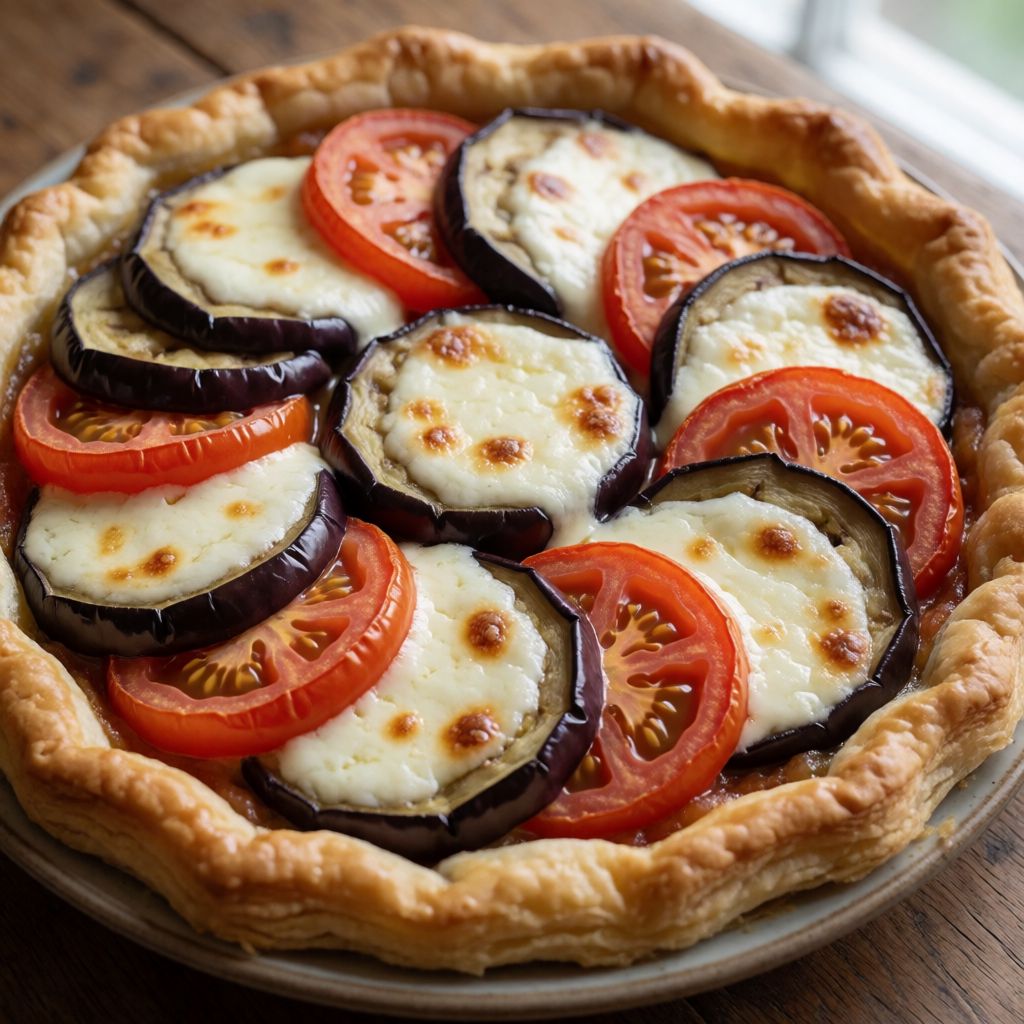
 AI photo
Aubergine and Mozzarella Pie
A puff pastry pie layered with grilled aubergine, mozzarella, cherry tomatoes and Parmesan.
Labels are worked out automatically from the ingredients and can be wrong. Check the packaging if it matters to you.
Ingredients
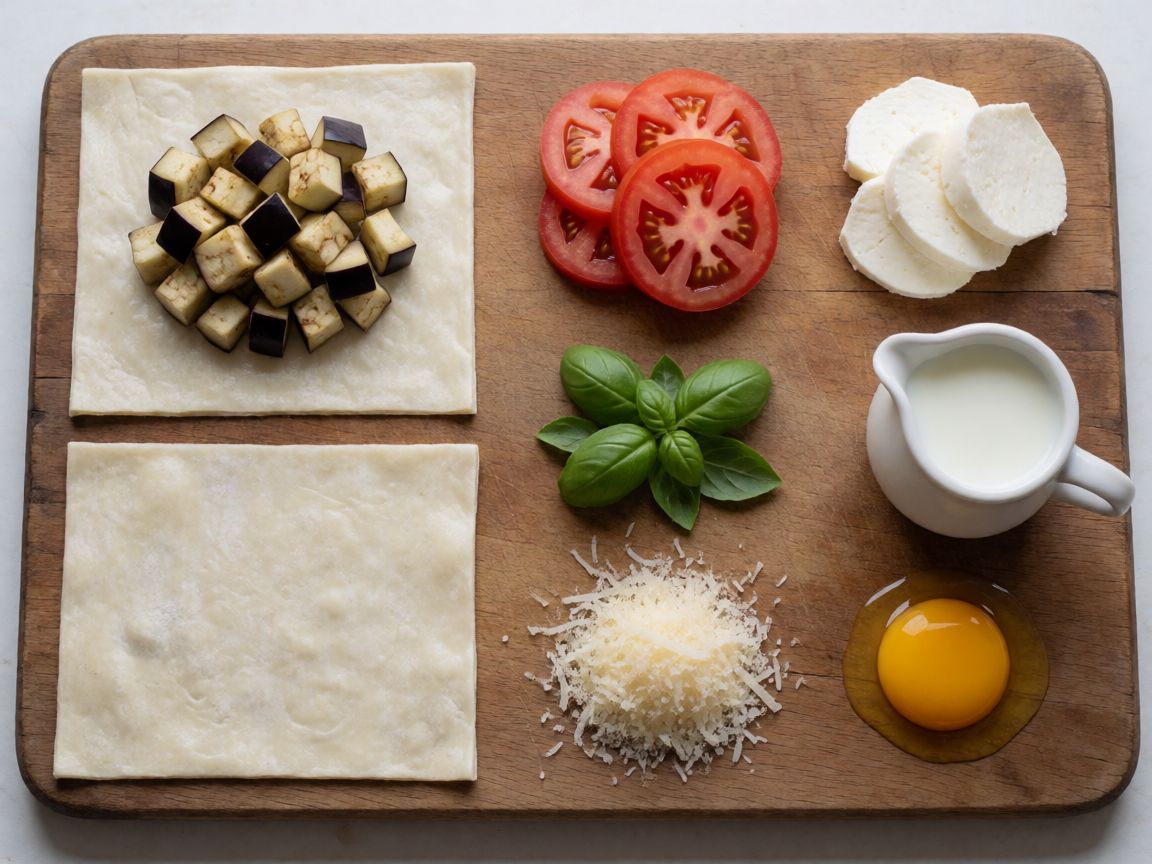
- 2 pcs Ready-rolled puff pastry sheets
- 250 g Aubergine
- 200 g Cherry tomatoes
- 200 g Mozzarella
- Basil to taste
- 2 tbsp Parmesan
- Salt to taste
- 1 pcs Egg yolk
- 1 tbsp Milk







Steps
Wash and dry the aubergines, trim off the inedible parts and cut into thin slices about half a centimetre thick.
Heat a grill pan and fry the aubergine slices on it.
Slice the mozzarella and place it in the fridge so excess moisture drains off.
Wash and dry the cherry tomatoes and cut each into quarters.
Line a baking tin with one sheet of ready-rolled puff pastry together with baking paper. Prick the pastry all over with a fork.
Arrange the aubergine slices evenly over the pastry and season lightly with salt.
Lay the well-drained mozzarella slices on top, then distribute the tomato pieces evenly over them.
Sprinkle everything with Parmesan, add a few basil leaves torn by hand, and a little more salt.
Cover the pie with the second sheet of ready-rolled puff pastry, carefully sealing the edges of both layers together. Fold the edge over to form a sort of crown.
Brush the surface of the pie with the egg yolk beaten together with the milk.
Prick the surface of the pastry so it doesn't puff up during baking.
Bake the pie in a preheated oven at 180°C.
30 minRemove the pie from the oven and let it rest before serving.
15 min
This is a pie built on a problem: aubergine and mozzarella are both full of water, and puff pastry is a fat laminate that only puffs if that water stays away from it. Everything in this recipe — the grilling, the fridge rest for the cheese, the quartered tomatoes draining on their cut faces — is defence against a soggy bottom. Get the moisture question right and you have something that lifts and shatters; get it wrong and you have a flatbread with a wet middle.
So the aubergine goes on a dry grill pan first, not because it needs cooking through, but because that's how you drive steam out before the vegetable ever meets pastry. Some say aubergine must be salted and left to weep for half an hour before anything else happens to it — no, that trick earns its keep with old, bitter aubergines full of seeds; a young one from a UK supermarket, firm and pale-fleshed, doesn't carry that bitterness, so salting is just extra washing-up. The grill marks are a bonus, not the point.
The mozzarella's trip to the fridge does the same job by a different route: cold mozzarella sheds its brine more readily and firms up enough to slice without smearing, so it sits as discs instead of melting into the pastry layer before it even reaches the oven. If all you've got is a ball of fresh mozzarella rather than a block, tear it and press it between kitchen roll — same end, fewer dishes.
Ready-rolled puff pastry is the honest choice here, and I won't pretend otherwise. Proper puff, made from scratch, is butter folded into dough dozens of times so it lifts in layers in the oven — that's a few hours of turning and resting you don't owe a weeknight pie. Shop pastry gives you the same mechanism, pre-done, at the cost of a slightly blunter rise. If you've only got shortcrust in the fridge, use it, but expect a tart, not a pie that shatters — shortcrust has no water trapped between fat layers to flash into steam, so it won't lift the same way.
The aubergine wants to be sliced thin and even — about half a centimetre — because a grill pan cooks by contact, and a slice that's uneven in thickness is cooked on one edge and raw in the middle on the other. Don't reach for a thicker, "meatier" slice thinking it'll hold up better under the cheese; it'll just leave you with pockets of unrendered moisture sitting directly on your pastry base. Any firm, pale-fleshed aubergine works; there isn't really a substitute here that keeps the texture, though courgette sliced and grilled the same way will do the same job of taking on char without flooding the pie.
Mozzarella for cooking is really a choice between the ball-in-brine kind sold for salads and the drier, blockier kind sold for pizza. The block holds its shape under heat and in slices; the ball is wetter by design, built to be eaten fresh and cold, which is exactly the problem the fridge rest is fighting. If block mozzarella isn't to hand, any semi-firm melting cheese with a mild flavour and low water content — a young provolone, for instance — will behave better here than squeezing brine out of fresh mozzarella balls.
Parmesan isn't decoration, it's drainage and seasoning in one move: it's dry, hard, and salty, so a couple of tablespoons grated over the wet layers pulls a little more moisture out by osmosis while doing the salt's job without a wet brine. Any hard, aged grating cheese with that same dry, salty character — a mature pecorino, a well-aged Gouda — covers for it. Basil torn by hand rather than cut with a knife is not fussiness: a blade bruises the leaf and the cut edge blackens and turns bitter within minutes under heat, while a tear along the leaf's own lines leaves it green and leaves none of that metallic edge.
The egg-and-milk wash is for colour and nothing structural — it's what turns pale baked pastry into the amber crust people associate with "done." A splash of cream does it richer, water alone does it but paler and more matte; either is fine, it's not the piece this pie lives or dies by.
The fifteen-minute rest at the end is not optional laziness — it's letting the cheese, which is liquid-hot from the oven, firm back up enough to hold a slice together when you cut it. Cut straight from the oven and you get a wound, not a slice, cheese running everywhere and the layers collapsing into each other. Fifteen minutes on the counter, pastry still audibly crackling if you listen for it, and the slice holds its shape — that's the doneness cue worth trusting more than any clock.