
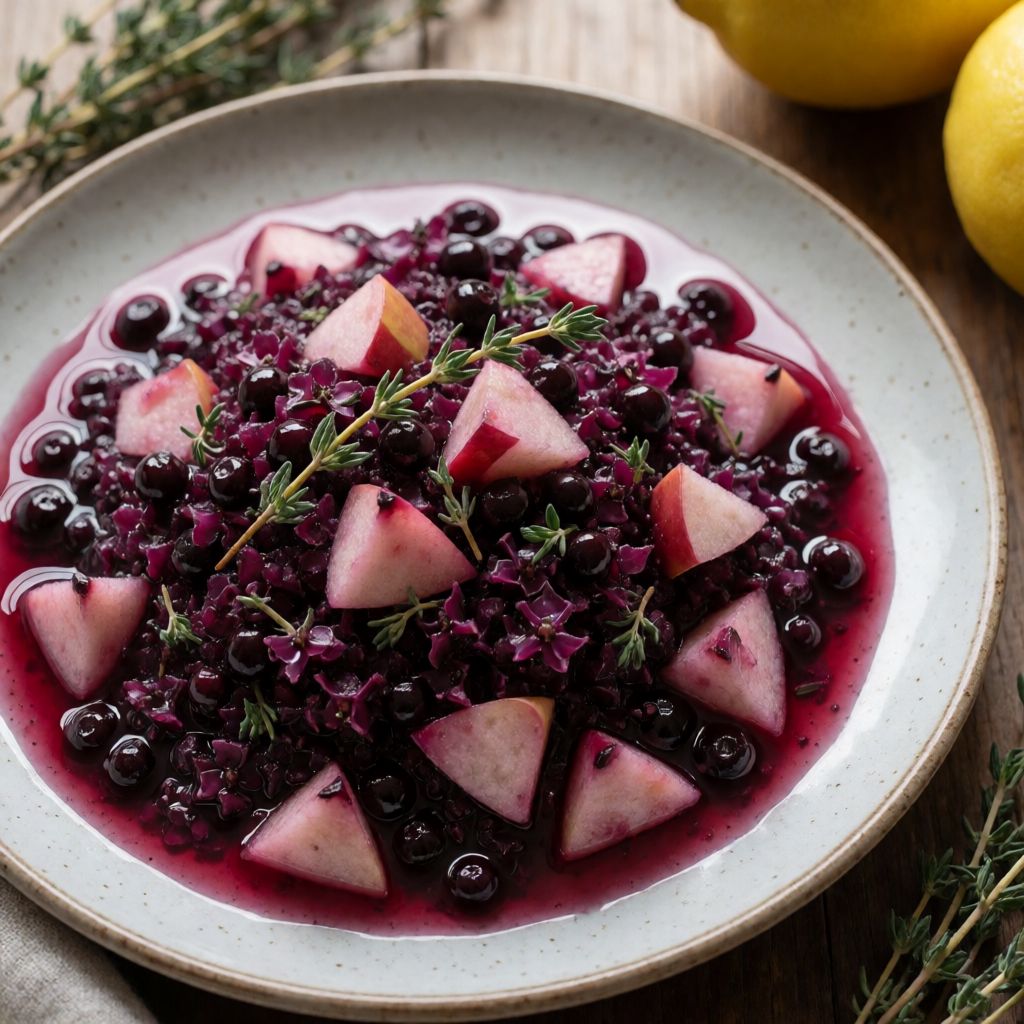
 AI photo
Elderberry Syrup
A homemade elderberry syrup infused with apple, thyme and lemon.
Labels are worked out automatically from the ingredients and can be wrong. Check the packaging if it matters to you.
Ingredients




Steps
Rinse the elderberry clusters and trim off the thick, coarse stems along the clusters.
Put the elderberries into a pot with the apple, thyme and water. Bring slowly to the boil.
Simmer gently for 20 minutes.
20 minPour everything through a sieve set over a large bowl. Discard the pulp.
Strain the liquid again through a clean sieve lined with a clean cloth, set over a clean pot.
Add the sugar and lemon juice to the strained liquid and bring the syrup to the boil to dissolve the sugar.
If you prefer a less sweet syrup, start with two-thirds of the sugar and add the rest to taste.
Pour the syrup into clean, scalded bottles and seal them immediately.
This is a preserved cordial base — elderberries boiled down, strained twice, sweetened and acidified, then sealed hot in bottles so it keeps for weeks instead of days. The whole point of the exercise is turning three weeks of hedgerow fruit into a winter's worth of flavour you draw on a spoonful at a time.
What decides whether it works is mostly the straining and the acid, not the cooking. Elderberries give up colour and flavour fast in hot water — that's why the simmer is short, twenty minutes and no more. This fruit doesn't need coaxing, it needs containing. Boil it hard or long and you start pulling tannin and a faint bitterness out of burst skins and crushed seeds that no amount of sugar afterward will talk you out of.
Raw elderberries and their stems carry compounds that genuinely upset the stomach — this isn't superstition, it's why the stems get trimmed off and why nobody tastes the raw cluster, however glossy and tempting it looks on the bush. The gentle simmer is the step that makes the fruit safe to drink at all, not just pleasant.
And the lemon juice isn't there for brightness. Sugar at roughly half the weight of the finished liquid preserves against mould, but it's the acid that keeps the syrup from drifting into fermentation on the shelf. Leave it out, or go light on it, and you may well open a bottle in three weeks to find the lid has popped itself.
Elderberries are the one ingredient with no real substitute — there's no other fruit that tastes like this, so choose on ripeness alone. You want the clusters fully turned to deep purple-black, no green or reddish berries mixed in, because the under-ripe ones carry more of the stomach-troubling compound and taste sharp rather than winey. In most of the UK that means late August into September, off hedgerows, railway embankments, the scrubby edge of a park — this was always a free fruit, which is half the reason it became a cottage tradition in the first place. Nobody was buying elderberries; they were preserving what grew outside the door before sugar got cheap enough, in the nineteenth century, to make bottling worthwhile at all.
The apple is doing two jobs at once: it's a source of pectin, which gives the finished syrup a little body instead of letting it run thin as water, and its own sugar takes the raw edge off the elderberry's sharpness before you've added a grain of the real sugar. The criterion for a substitute is "tart, high in pectin" — a crab apple or a quince does the same work, even a hard cooking apple you'd otherwise think too sour to eat.
Thyme is a lift, not a structure. It's there to cut the slightly green, stemmy smell that clings to elderberries even after trimming. Any soft, resinous herb does the same job — rosemary in smaller quantity, or just leave it out if you don't want the complication. It changes the character, not the outcome.
Sugar's criterion is "a sugar with no flavour of its own," so plain white granulated is the right choice, not because tradition says so but because honey or dark brown sugar would fight the elderberry rather than frame it, and honey behaves differently in storage — it can ferment on its own terms. Lemon juice gives acid and a little aroma; bottled lemon juice or a pinch of citric acid does the acid job just as well if you've only got half a lemon going mouldy in the fridge and no fresh one to hand.
For the cloth-lined strain, you don't need to buy muslin specially — a clean tea towel that's been through a boil wash, or a coffee filter for smaller batches, does exactly the same thing: catches the fine pulp and stem grit that the first sieve lets through, which is what separates a clear jewel-coloured syrup from a muddy one. Don't squeeze the cloth to speed things up — squeezing forces the fine solids straight through it, and you'll have done the second strain for nothing. Let gravity do it. This step wants patience, not force; if it's dripping slowly, that's the cloth working, not failing.
Scalding the bottles and sealing them while the syrup's still hot isn't ritual either — it's a vacuum. Hot glass, hot liquid, lid on straight away: as it all cools, the contraction pulls a faint seal that keeps airborne mould spores out before they've had a chance to land. Wait for the syrup to cool first and you've given the mould a window instead of a closed door. And treat the "serves 2" on this one loosely — a kilo and a half of berries makes several bottles, and this is a thing you spoon into hot water or pour over yoghurt by the glassful over weeks, not a dish you plate up once.