
 AI photo
Empanadas
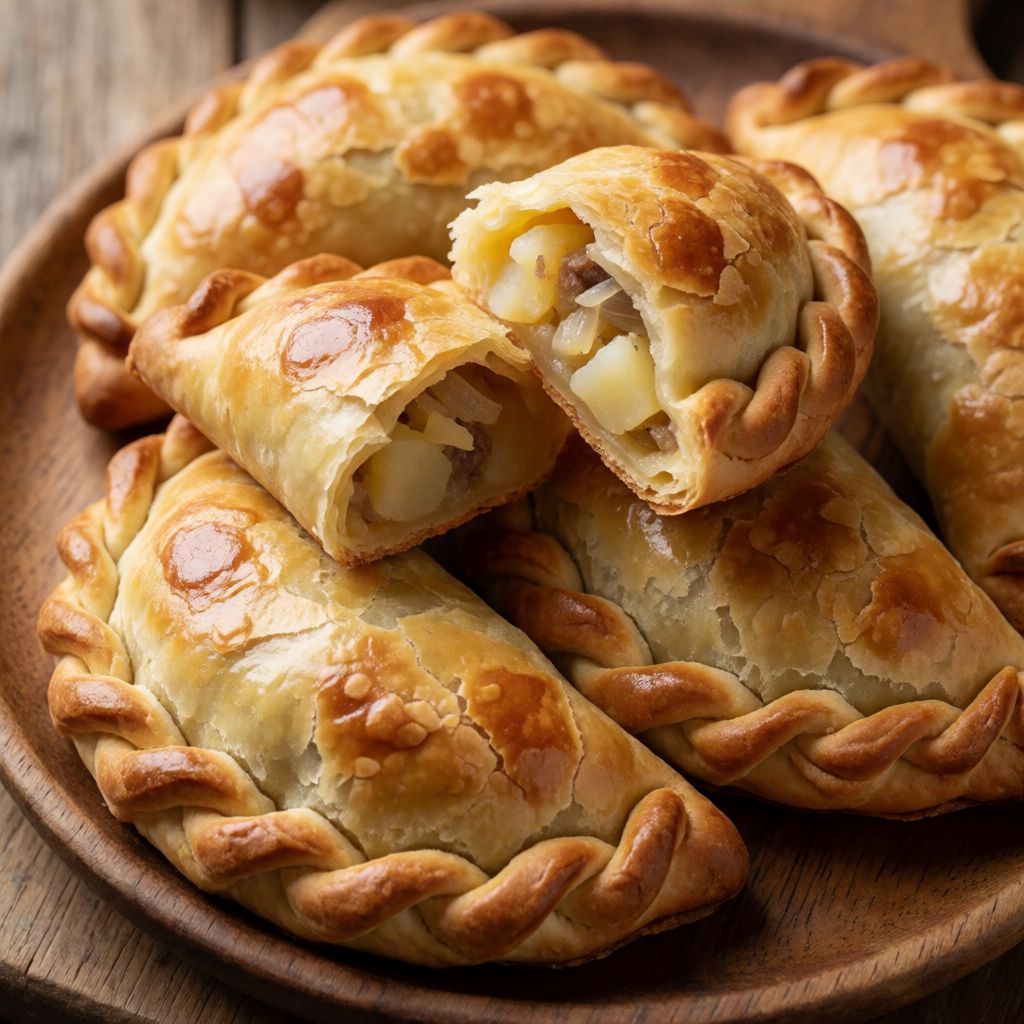
Golden hand pies with a savoury beef, potato and olive filling, finished with a hidden quail egg.
Labels are worked out automatically from the ingredients and can be wrong. Check the packaging if it matters to you.
Ingredients
- 450 g Plain flour
- 150 g Water cold
- 6 tbsp Olive oil
- 1 pinch Salt
- 3 pcs Potato
- 1 pcs Onion
- 450 g Beef mince
- 1 tsp Paprika
- 1 pinch Chilli flakes hot, to taste
- 14-16 pcs Pitted black olives
- 14-16 pcs Quail eggs
- 1 pinch Vegetable oil for frying









Steps
Sift the flour and pile it on the work surface, add the cold water, olive oil and salt, and knead by hand to a soft, even dough.
Transfer the dough to a bowl, cover with cling film and let it rest.
30 minWash and peel the potatoes, cut into small dice, and finely chop the onion.
Heat olive oil in a large frying pan, add the potato and onion, and fry for a few minutes over high heat.
Add the beef mince, stir, season with salt and paprika, cover with a lid and cook over medium heat.
15 minBoil water, add the quail eggs, hard-boil them, then plunge into cold water and peel.
4 minRoll out the dough, cut out rounds about 9-10 cm across, and fill each with the mixture, an egg and an olive.
Fold the dough over into a half-moon shape and pinch the edges tightly to seal.
Fry the empanadas in hot vegetable oil for a few minutes, until the surface is crisp and golden.
Lift the empanadas out with a slotted spoon, drain on paper towels and serve hot.
What was changed
Vegetable oil Vegetable oil is used for frying instead of corn oil, as it is the more common frying oil locally.
An empanada is a pie built to be eaten standing up, with no plate underneath it. That's the whole engineering brief: a dough tough enough to carry a hot, wet filling in one hand without weeping through the seams, and a filling cut small enough to cook through before the dough outside burns. Everything about this recipe is Argentina's answer to that brief — beef and potato for a working family's dinner on the move, an olive and a quail egg tucked in because a cook with a bit of pride wants a surprise in the middle of an ordinary thing.
What decides whether it works is the seal. Not the frying, not the filling — the seal. If the edge isn't pinched tight, the oil finds the gap before the dough sets, and you get a split, weeping parcel instead of a crisp half-moon. That's why the dough rests half an hour under film: gluten that's just been kneaded is tight and springy and tears when you try to fold it; thirty minutes of rest lets it relax so the fold holds without cracking. Skip the rest and you're not saving time, you're guaranteeing a leak later.
The flour is just plain flour — nothing fancy, because this dough isn't meant to be delicate like shortcrust. It's meant to be strong enough to be picked up, folded, pinched, and dropped into hot oil without falling apart. Olive oil in the dough rather than butter does two jobs: it keeps the dough pliable cold (butter would set hard and crack when you fold it), and it means you're not relying on a fridge — you can make this dough on a kitchen counter in a flat with no marble slab, no special tools, just your hands. The cold water matters for the same reason the rest matters: cold slows gluten development while you're mixing, so the dough comes together soft rather than tight and rubbery. Any neutral oil with no scent of its own could stand in here if olive oil feels wasteful for a dough you're about to fry anyway — but olive oil's faint flavour is part of why this tastes like an empanada and not a dumpling.
Beef mince is the traditional filling because this is poor-man's food dressed up — mince was cheap, it stretched a long way when cut with potato, and it cooked fast. If you've only got a wide frying pan and no proper kazan-style wok, that's fine; a wide pan is actually better here, because you need the mince and potato to fry in a thin layer over fierce heat, not stew in a deep pile. Crowd it and the potato steams instead of browning, and you lose the point of frying it first at all — which is to drive off moisture so the filling doesn't turn the dough soggy from inside once it's wrapped.
Paprika and chilli flakes are there because plain mince and potato is dull, and because Argentine empanadas lean on paprika's colour and gentle warmth rather than a wall of chilli heat — the chilli is "to taste," a pinch, not a feature. If you haven't got paprika, a mild curry powder or even just extra black pepper will do something similar in principle, though the colour won't match; the point is warmth and colour in the filling, not a specific spice jar.
The olive and the quail egg aren't filler — they're the reason someone bites into this and smiles rather than just eats it. Pitted olives, because a pit in a hand-held pie is how someone chips a tooth and never trusts you with pastry again. Quail eggs because of their size, as above — if you can't find them, you could quarter a single hard-boiled hen's egg across several empanadas instead of halving it into two, keeping each piece small enough not to burst the seal.
For frying, use a pinch of vegetable oil and use plenty of it, deep enough that the empanada mostly floats rather than sits on the bottom of the pan scorching on one side. Vegetable oil here, not olive oil, because you want a neutral taste at high heat — olive oil frying at the temperature needed to crisp a dough fast would smoke and turn bitter before the job's done. Don't try to shortcut this in an oven out of nervousness about deep frying in a flat kitchen: an oven gives you a drier crust and a pale one, because there's no oil carrying heat fast and evenly into the surface — you lose the crisp shell that makes this dish what it is.
Patience is the ingredient nobody lists. The dough's thirty minutes of rest, the mince's slow cook under a lid until the potato bends rather than crunches, the egg's four minutes in boiling water timed from when it actually starts boiling, not from when you put the pan on — rush any of these and the recipe punishes you later, at the seal, in the fryer, or on the plate when you cut one open and the middle isn't done.