
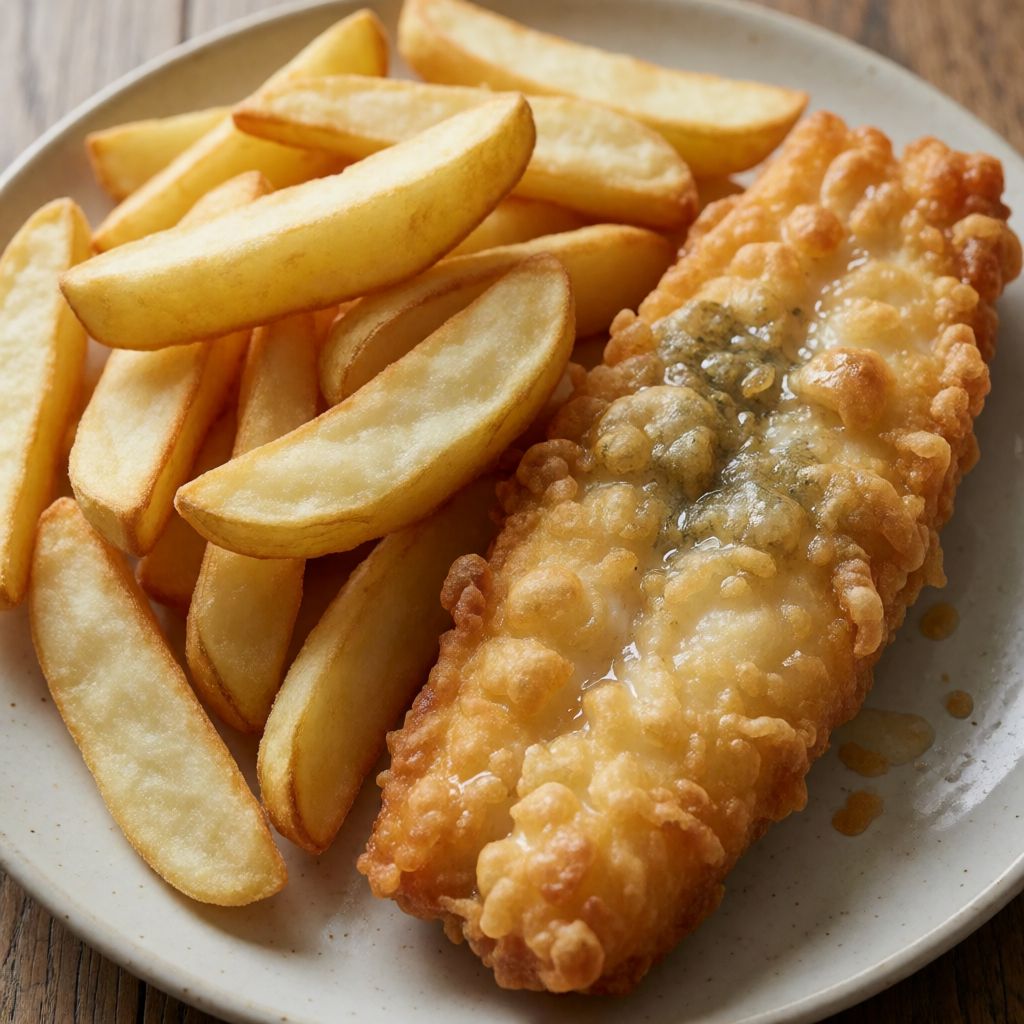
 AI photo
Fish and Chips
Crispy beer-battered cod served with golden chips, fried until crunchy and served hot.
Labels are worked out automatically from the ingredients and can be wrong. Check the packaging if it matters to you.
Ingredients
- 500 g Cod
- 500 g Potatoes
- 200 ml Beer
- 100 g Plain flour
- Plain flour as needed
- 4 g Bicarbonate of soda
- Salt to taste
- Black pepper to taste
- 500 ml Vegetable oil





Steps
Wash the potatoes, peel them and cut into thin chips.
Pour vegetable oil into a frying pan and heat it, then add the chips and fry until soft with a light golden colour.
Transfer the cooked chips onto a plate lined with paper towel to drain off excess oil.
Prepare the batter: in a bowl combine the flour, a pinch of salt, the bicarbonate of soda and a pinch of black pepper.
Pour in the beer and mix the batter until smooth and semi-liquid.
Coat the cod fillets in flour so that each piece is evenly covered.
Dip the fillets into the batter, making sure both sides are evenly coated.
Heat the pan with oil and fry the cod fillets until golden and crisp.
Place the cooked fish on paper to drain off the oil.
Return the chips to the same pan and fry for a few more minutes until golden.
Drain the cooked chips on a paper towel and serve together with the fish.
Serve the fish and chips hot.
Fish and chips is two separate fried things pretending to be one dish, and the whole trick is that neither one borrows time from the other. The fish gets a wet, bubbling jacket of beer batter; the chips get cooked twice, once to go soft inside, once to go hard outside. If you fry them in the wrong order, or try to do both at once in a crowded pan, you get soggy chips and pale fish — which is the fate of most "fish and chips" made at home, and why most people just queue for it instead.
The batter is not flour-and-water with ambition. The bicarbonate of soda meets the slight acidity in beer and throws off little bubbles of gas right as the batter hits hot oil — that's what gives you the craggy, blistered crust instead of a flat shell. Beer also brings its own bubbles and a bit of bitterness that cuts the oiliness of deep-fried fish, which is why it's there and not just for the alcohol. Some say batter needs eggs to set — no, because the egg's job here (binding, a bit of structure) is already done by the flour and the gas bubbles; egg would only make it heavier and softer, closer to a pancake than a shell.
On a domestic hob you don't have a deep fryer with a thermostat, so you're reading the oil by what it does, not by a number. For the first chip fry you want oil active enough to make a constant quiet fizz around the potato, not an aggressive roar — if it's roaring, the outside is colouring before the inside has softened, and you'll bite into a crunchy shell wrapped around raw potato. You'll know the chips are ready to come out the first time when a fork meets no resistance in the middle — they bend, they don't crack. For the second fry and for the fish, you want the oil hot enough that a drop of batter dropped in sizzles up to the surface immediately and starts bubbling within a second or two; if it just sits there, your oil is too cool and the fish will stew in fat instead of crisping, which is the usual reason home-fried fish comes out grey and greasy rather than gold.
Doneness on the fish is about the batter's sound and colour, not a clock: it should be matt gold going on amber, with the surface gone from wet-shiny to dry-crackling — press it lightly and it should sound hollow-crisp, not give a wet crunch. Cod cooks fast once the batter's crisp, because the fillet is thin and surrounded by oil hot enough to cook it through by the time the outside is done; cutting a too-thick fillet is the real cause of "crispy outside, translucent middle," not an unlucky pan.
A pan instead of a kazan or a deep-fat fryer means you're working with less oil depth and less heat reserve, so you fry in batches and you don't crowd the pan — dropping in all the chips or all the fillets at once cools the oil in one go, and cool oil is exactly what makes things absorb fat and go soggy instead of sealing fast. A plate with paper towel is your drainer; it's doing a real job, pulling surface oil off so it doesn't pool and go rubbery as it cools, not just a garnish step.
On ingredients: cod is chosen for being a firm, white, large-flaked fish that holds its shape in batter and doesn't fall apart in a hot pan — any firm white fish works the same way, haddock, pollock, even hake if the fillet isn't too thin. The beer in the batter wants to be a plain lager, nothing dark or heavily hopped, because you want the bubbles and a light bitterness, not a flavour that fights the fish; if you've got none, sparkling water with the same pinch of bicarb will still give you lift, just a flatter taste. Bicarbonate of soda is not optional seasoning — it's the one thing making your batter crisp rather than doughy, so don't swap it for baking powder without expecting a softer, less blistered crust, since baking powder reacts more slowly and loses its best bubbles before the batter ever meets the oil. The extra "flour as needed" for dusting the fish before battering isn't fussiness — it's there so the wet batter has something dry to grip, otherwise it slides off the fillet's slick surface in the oil and you're left fishing bits of crust out of the pan.
The oil itself should have no smell and no strong flavour of its own — a neutral vegetable or sunflower oil, nothing virgin or cold-pressed, because those have a low smoke point and will scorch and taste bitter well before your chips are even soft. Potatoes should be a variety that goes fluffy rather than waxy — a floury type, the kind that falls apart a little in a stew — because that's what gives a soft, almost mealy inside to contrast the shell; a waxy potato just gives you a firm, slightly rubbery chip no matter how well you fry it.
Last thing: patience is the one ingredient not listed in grams. The temptation is to rush the first chip fry to get to the fish faster, or to fry everything together to save washing up one pan twice. Both shortcuts show up on the plate as soft chips or pale fish. Nobody queues outside a chip shop because the fryer there is magic — it's because they never crowd the pan, and they never skip a stage.