
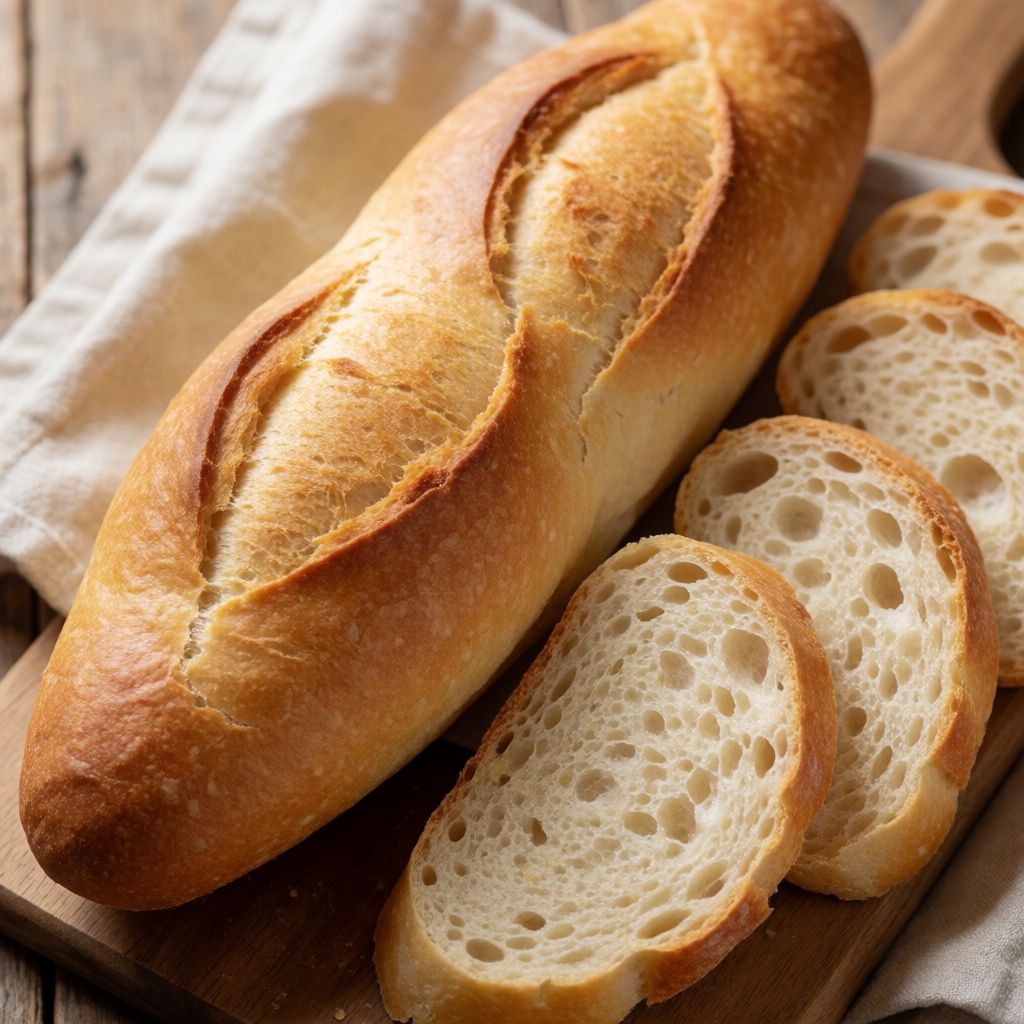
 AI photo
French Bread
A soft, golden French bread, perfect for home baking.
Labels are worked out automatically from the ingredients and can be wrong. Check the packaging if it matters to you.
Ingredients





Steps
Melt the butter over low heat in a small saucepan and remove it from the heat.
Pour the milk into the saucepan, then transfer the mixture to a bowl along with the yeast.
Stir until the yeast has completely dissolved.
Add the sugar, salt and half of the flour, and mix well.
Mix again, then add the remaining flour.
If kneading with a mixer, run it on medium speed for 7-10 minutes.
10 minIf kneading by hand, knead the dough until it becomes soft and elastic.
Let the dough rise in the bowl on the kitchen counter for 30 minutes.
30 minShape the loaf by gently stretching and folding the dough.
Repeat several times until the dough becomes elastic and holds its shape.
Place the dough into a well-greased baking tin.
Let the loaf rise on the kitchen counter for 1 hour.
60 minGently brush the loaf with milk and bake in a preheated fan oven at 175°C for 30-35 minutes.
35 min
Call this French bread if you like, but it's closer to a soft milk loaf than anything you'd pull out of a wood oven in Poilâne. The crust stays thin and pale-gold, the crumb stays soft and a bit sweet — that's the butter and the milk talking, not flour and water and salt the way a true baguette dough would insist on. Nothing wrong with that. It's just a different animal, built for a tin on your counter, not a stone floor at 250°C.
What decides whether it works is what happens to the gluten, long before the oven gets a say. Flour alone won't give you stretch — you have to build it, by working the dough until it stops tearing and starts resisting you back. That resistance is the whole point of kneading: it's not time on a clock, it's a texture you're waiting for. Ten minutes in a mixer is a guess, a lower bound. The dough tells you when it's done by going smooth, satiny, slightly tacky but not sticking to your palm.
Some say you knead bread to "activate" the yeast. No — the yeast doesn't need kneading at all, it's already working the moment it hits warm liquid. Kneading is purely mechanical: it aligns gluten strands into a net that can trap the gas the yeast produces. Skip it or rush it, and the loaf rises fat and soft in the bowl, then collapses in the oven because the net has holes in it.
Butter here isn't for taste so much as for texture — fat coats gluten strands and shortens them slightly, which is why this crumb is soft and tears rather than being chewy. Melt it gently; if it browns or spits, you've cooked off moisture you need and risked scalding the milk that follows it into the pan. Any neutral fat with no flavour of its own will do the same mechanical job — a flavourless vegetable oil, or margarine if that's the cupboard situation — but butter also brings a little milk solids and sugar that help the crust colour, so swapping it changes the tan on your loaf a shade.
Milk, not water, is doing two things: feeding sugars to the yeast straight away, and giving you that tender, slightly rich crumb. If you're out of milk, water plus a spoon of milk powder gets you close; water alone works, but the loaf will taste thinner and the crust will brown less eagerly, because there's less lactose around to caramelise.
Yeast needs to meet warm liquid, not hot. Pour milk straight off a boil onto yeast and you kill it outright — that's the actual mechanism behind "don't let it get too hot," not some vague caution. The butter-and-milk mixture should feel like a warm bath on your wrist, not hot on your skin. If you're using dried yeast instead of fresh, know that it's more tolerant of temperature swings but still won't forgive scalding.
Sugar is yeast's first meal, nothing more mystical — it speeds the initial fermentation along, especially useful on a cold British kitchen counter where "room temperature" in winter can be a genuinely sluggish 16°C. Salt does the opposite job: it tightens the gluten structure and, crucially, slows the yeast down so it doesn't exhaust itself before the oven gets hot. That's why salt and yeast don't get mixed directly together at the start — dump salt straight onto yeast and you can stun it before it's even begun. Here it's folded in with the sugar and half the flour, by which point the yeast's already dissolved and working, so no harm done.
Plain flour, not strong bread flour, is deliberate for this loaf — it has less protein, so less gluten forms, and that's exactly why the crumb stays soft rather than chewy. If you only have strong flour, it will still work, just knead a little less vigorously or you'll toughen it past the character this bread is going for.
On the tin: a well-greased tin isn't fussiness, it's physics — a rising dough that sticks to metal on one side rises unevenly and tears as you try to free it, giving you a lopsided loaf with a scarred flank. And the milk brush before baking isn't decoration either; it's what lets the crust take on colour and shine in a domestic oven that, without steam injection like a bakery deck oven, would otherwise bake this loaf pale and matte. Watch the crust, not just the clock — 30 minutes is where you start checking, not where you stop. Patience through both rises is the one ingredient this recipe doesn't list but absolutely requires; rush them and no amount of oven time buys back what the dough didn't get to do on its own.