
 AI photo
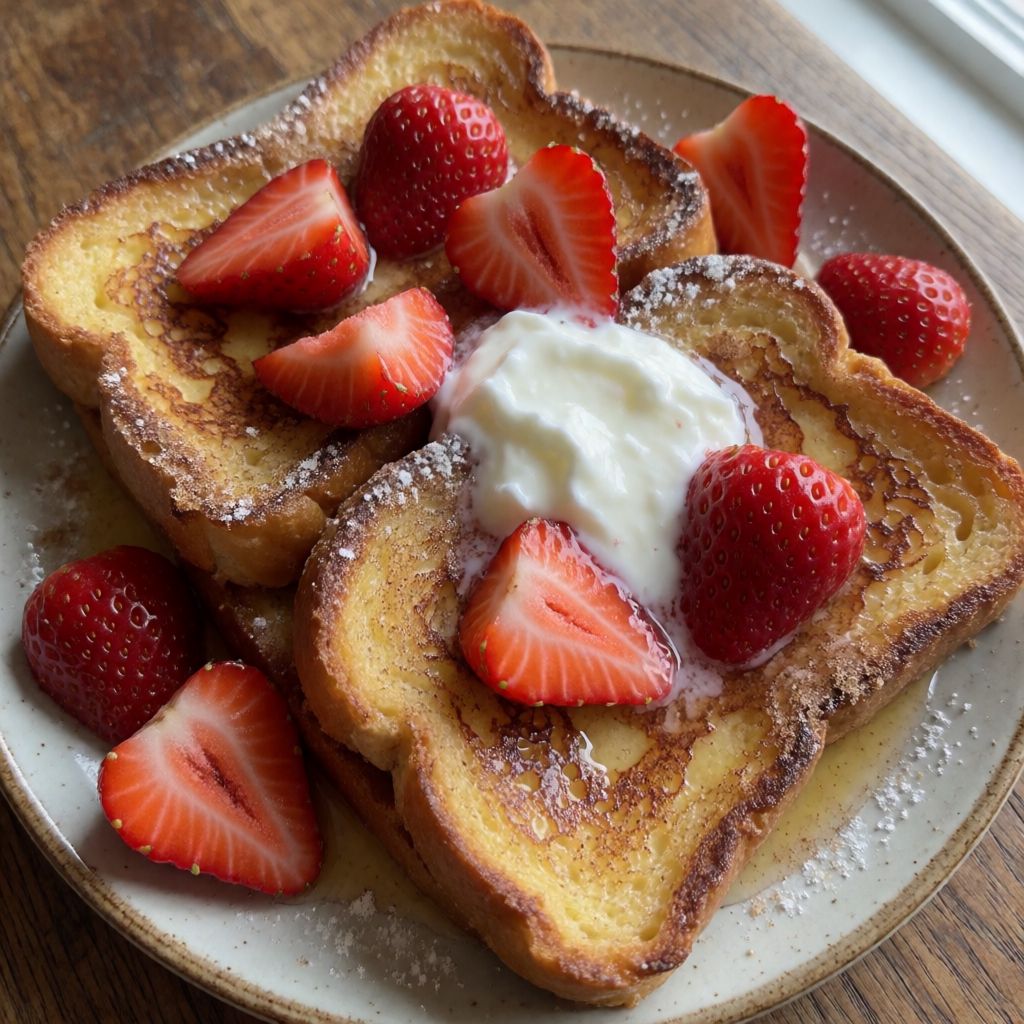
French Toast with Strawberries and Skyr
A simple French toast with macerated strawberries and vanilla skyr.
Labels are worked out automatically from the ingredients and can be wrong. Check the packaging if it matters to you.
Ingredients
- 4 pcs Bread
- 100 ml Milk
- 0.5 tsp Cinnamon ground
- 2 tbsp Sugar
- 1 pinch Salt
- 20 g Butter for frying
- 100 g Strawberries
- 25 g Sugar
- 1 tsp Vanilla sugar
- 100 ml Skyr preferably vanilla





Steps
Put the strawberries in a glass, sprinkle with the sugar and vanilla sugar, and mix well.
Leave the strawberries for 30 minutes, stirring occasionally, until they start to release their juice.
30 minPour the milk into a deep plate and quickly dip the bread slices in the milk.
Mix the cinnamon with the sugar and sprinkle this mixture over the bread slices.
Heat a pan over medium heat with a little oil, melt the butter and let it sizzle.
Fry the bread slices in the pan for a few minutes on each side, until the sugar and cinnamon caramelise.
5 minServe on plates with a spoonful of vanilla skyr and the quick-macerated strawberries.
This is French toast with the egg missing — and that is worth saying out loud, because most people think French toast needs egg to work. No: egg gives the custard wobble and the deep brown crust you see in a diner. Here the milk only softens the bread, and the real browning job is handed to sugar and butter in the pan. The result is lighter, crisper at the edges, less "pudding," more "toast with a sweet crust." Different mechanism, different dish — not a worse version of the other one.
What decides whether it works is speed and watching, not minutes. The dip in milk has to be quick — bread is a sponge, and a sponge left too long in liquid falls apart the second you try to turn it in a hot pan. A second or two per side, enough to wet the surface and just under it, no more. Then the cinnamon-sugar goes on while the bread is still damp, because dry sugar on dry bread just falls off into the pan and burns there instead of on the toast.
The pan tells you when it's ready the same way every fried thing does: butter in an empty hot pan burns before you've blinked, because its milk solids scorch fast and butter alone has a low ceiling. A little neutral oil first raises that ceiling — the oil doesn't burn as readily and it buys the butter time to do what it's good at, which is flavour, not heat tolerance. You know the pan is right when the butter sizzles and foams the instant it hits the metal, not when it melts quietly and sits there.
Bread: use yesterday's loaf if you have it, not today's. Fresh bread is still full of soft, unset starch, and milk turns it to paste before it ever sees the pan. A day old, the starch has firmed up a little — bakers call this retrogradation — so the bread can take on milk at the surface and still hold its shape when you lift it with a spatula. This is also, historically, the entire reason French toast exists: it's a way to spend bread that's gone a day too far to eat plain, dressed up with sugar so nobody notices it's leftovers. Pain perdu — lost bread. Nothing mystical about it, just thrift with a nice crust on top.
Milk, not egg-and-milk: this is the point that makes the dish what it is. Egg would add protein that sets firm in the heat and gives you that custardy centre everyone associates with French toast. Skip it and you get a drier, more honest piece of toast — crisp outside, warm bread inside, no wobble. If you want richer, splash in a spoonful of cream; don't reach for egg thinking it's missing by accident. It isn't.
Cinnamon and sugar, mixed before they touch the bread: sugar on its own melts and runs; mixed with ground cinnamon and a pinch of salt it clings better and caramelises more evenly, because the cinnamon particles break up the sugar's tendency to pool into one sticky patch. Watch for the colour change, not the clock — pale sugar grains turning glossy and amber at the edges is your crust forming. Past amber is burnt, and burnt sugar tastes only of burnt sugar, nothing else, which is the real reason this step fails for people: too hot a pan, not too little attention.
Butter for frying, oil to protect it: any fat with no flavour of its own works for the oil part — sunflower, groundnut, light olive oil, whatever sits in your cupboard without a strong smell. The butter you don't substitute, because its job here is taste, not heat-bearing, and nothing neutral replaces that.
Strawberries, sugar, vanilla sugar: the plain sugar draws the juice, the vanilla sugar perfumes it — vanilla sugar is just sugar that's lived next to a vanilla pod or had a drop of extract worked into it, so if you don't have it, a few drops of vanilla extract stirred into ordinary sugar does the same work. Out of season, when strawberries are hard and sour rather than ripe, give them longer than thirty minutes — the mechanism doesn't change, it just works slower on fruit with less juice to give up.
Skyr: an Icelandic strained dairy, thick because most of the whey has been drained off, tangy because it's cultured like yoghurt but stronger. Its whole job on the plate is to cut the sweetness of caramelised sugar and syrupy strawberries with something sharp and cold. The substitution criterion is simple — any strained, acidic dairy with body: thick Greek yoghurt, quark, even fromage frais loosened with nothing and sharpened with a squeeze of lemon if it tastes too mild. Don't reach for cream or custard here; the dish needs the sourness, not more richness, or the whole plate tips sweet and stays there.