
 AI photo
Deep-Fried Squid
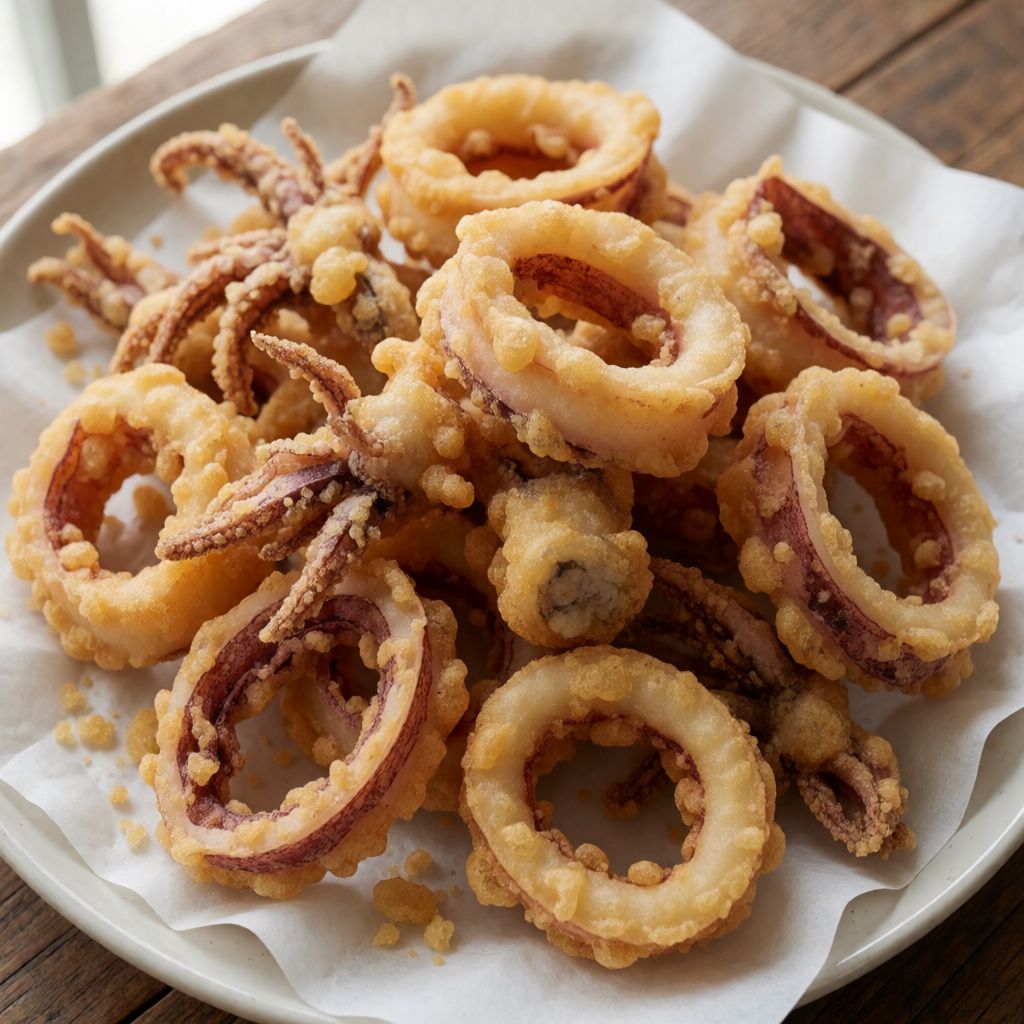
Crispy deep-fried squid rings coated in flour and fried until golden - a simple seafood favourite.
Labels are worked out automatically from the ingredients and can be wrong. Check the packaging if it matters to you.
Ingredients
- 1 kg Squid
- 300 g Plain flour
- Salt to taste
- Peanut oil for frying




Steps
Rinse the squid under running water and carefully detach the head.
Feel inside the mantle, locate the hard quill and pull it out.
Clean out the innards, then peel off the skin with a sharp knife.
Cut off the fins and rinse thoroughly once more.
Slice the mantle crosswise into rings about 0.5 cm thick.
Remove the hard beak-like part from the tentacles.
Place the squid in a sieve to drain off any excess moisture.
Pour the flour into a bowl or onto a tray.
Coat the squid in the flour so it evenly covers each piece.
Transfer the squid to a sieve and shake gently to remove excess flour.
Heat the peanut oil to 170°C.
Fry the squid in small batches for 3-4 minutes until golden. It is ready when the thickest part reaches 63°C inside.
4 minPlace on paper towels to absorb excess oil, then season with salt to taste.
This is squid rings in a dry flour dust, dropped into hot oil for less time than it takes to read this sentence twice. Not battered, not beer-battered, not tempura — just flour, so what you taste is squid, not crust. That's the whole idea, and it's also the whole risk: there's nowhere for a flour coating to hide bad timing.
What decides whether it works is heat and speed, not minutes. Squid is almost pure muscle with very little fat and very little connective tissue to break down slowly, the way you'd break down a shin of beef. There's nothing in there that gets more tender the longer you cook it. The opposite happens: protein tightens the moment it hits heat, and it keeps tightening for as long as the heat keeps coming. Four minutes in oil hot enough to crust flour is already generous. Go longer because it "doesn't look cooked enough" and you'll get rubber bands with a nice golden coat.
Some say squid needs a long fry to cook through properly, the way chicken does. No — because chicken has raw muscle fibre and bacteria risk that genuinely need time and core temperature to deal with. Squid rings half a centimetre thick are through in seconds once the oil is hot; the 63°C core and the golden crust arrive together, almost by accident, not because you waited for one and the other followed. The entire craft here is restraint: pull it before your instinct tells you to.
Start with the squid itself, because this is a one-ingredient dish wearing a flour coat, and a bad squid can't be rescued by technique. Fresh is good if you trust the fishmonger and the smell is of sea, not of fish. But most squid sold in the UK, fresh or otherwise, has already been frozen once at sea — that's normal, not a defect, and it doesn't hurt this dish, since you're slicing it into rings anyway and texture differences at that scale are small. What you want to avoid is squid that's been frozen, thawed, and refrozen at the shop or in your own freezer — that's when the muscle fibres really do go mushy, because ice crystals form twice and tear the structure both times. If buying frozen rings ready-cut, that's a fair shortcut; just thaw them slowly in the fridge, not in warm water, so they don't weep out their moisture before they ever see the pan — and drain them properly afterwards, same as fresh.
That draining step — the sieve, the wait — isn't fussiness, it's physics. Water and hot oil don't mix; a wet piece of squid dropped into oil spits and splatters because the water flashes to steam the instant it meets heat, and a wet piece also turns your dry flour coating into a paste that won't crisp. Patience here is an ingredient: give the squid a few minutes to actually drip dry before it meets flour, and give it again once it's floured, so what goes into the oil is coated, not pasted.
The flour: plain flour, nothing seasoned, nothing self-raising. You're not trying to build a thick batter, you're dusting — a layer thin enough to crisp in the time the squid itself needs, which is almost no time at all. That's why you shake off the excess in a sieve: too much flour and the coating needs longer in the oil to cook through and colour, and that extra time is exactly what toughens the squid underneath. The flour's job is to give you something to see — it goes from raw white to gold, and that colour change is your actual timer, more honest than a clock.
Oil: peanut oil is specified because it has a high smoke point and almost no flavour of its own, so it doesn't fight the squid or burn before the oil's hot enough to crisp flour. The real criterion is just that — any oil that can take real heat without smoking and without smelling of itself. Sunflower oil or plain vegetable oil does the same job and is easier to find in most British kitchens; olive oil isn't right here, it smokes too early and its flavour has no business being in a plate of squid.
On a domestic hob, forget the idea of a deep-fat fryer with its own thermostat — most flats don't have one, and a wide frying pan won't hold enough oil depth to submerge rings properly. Use the deepest, heaviest pot you own, filled with oil to a genuine few centimetres, and if you don't have a thermometer, drop in a small cube of bread: at the right heat it should turn gold and crisp in a matter of seconds, not sit there sizzling slowly. That's your sense-based check when you don't trust the dial.
Fry in small batches, not because the recipe insists on ceremony but because of what a big batch does to the oil: dump in too much cold, wet squid at once and the oil's temperature drops hard — now you're steaming squid in oil rather than frying it, and the flour coating softens instead of setting. Small batches keep the oil hot enough that every ring gets the fast, violent heat it needs. Salt goes on at the very end, off the heat, because salt pulls moisture — salt the squid before frying and you're drawing water back out right when you need it dry, undoing the draining you just did. This is street food economics at heart: squid is cheap, quick, and needs almost no equipment beyond hot oil and a sieve, which is exactly why it turns up at seaside stalls from the Adriatic to the Black Sea rather than in slow-cooked family Sunday dinners — it was built to be fast and sold hot, not to simmer.