
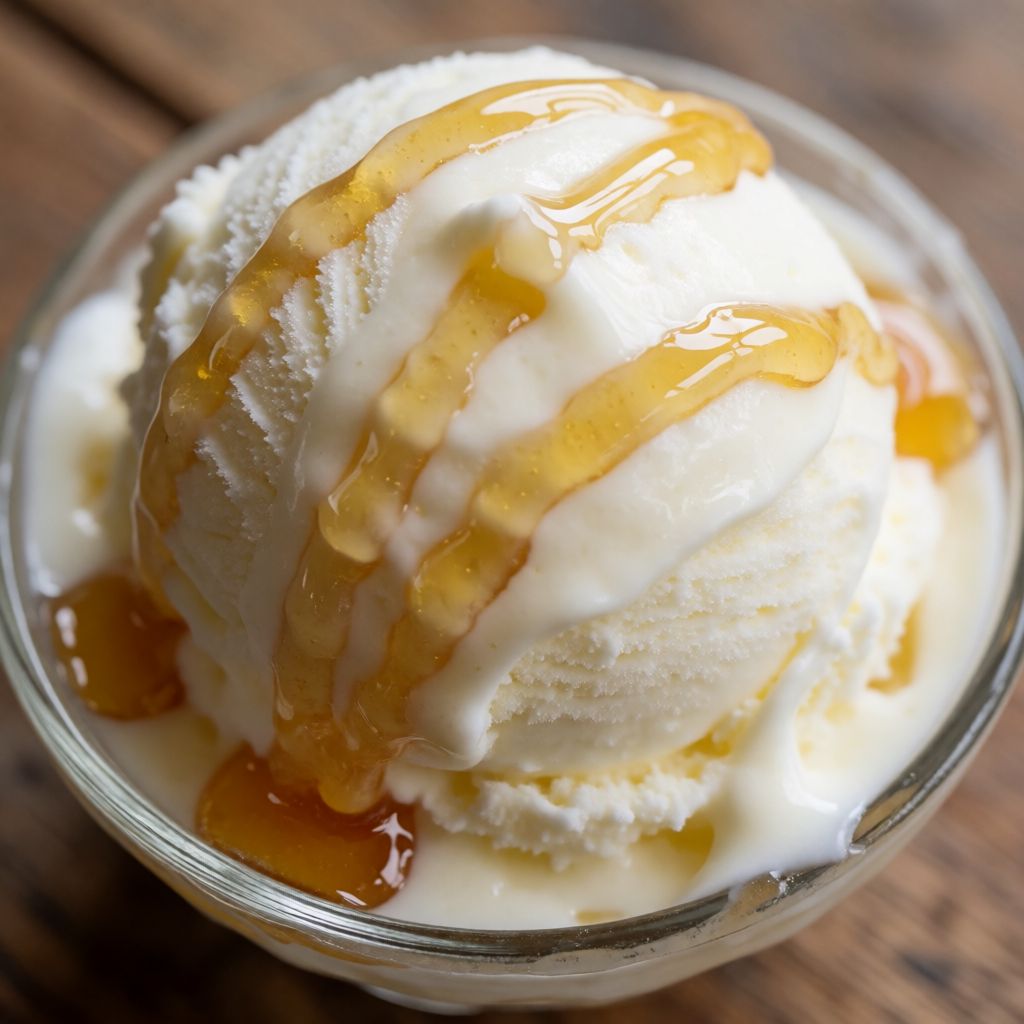
 AI photo
Frozen Yogurt with Honey
A simple frozen yogurt made with honey, perfect for a light dessert.
Labels are worked out automatically from the ingredients and can be wrong. Check the packaging if it matters to you.
Ingredients
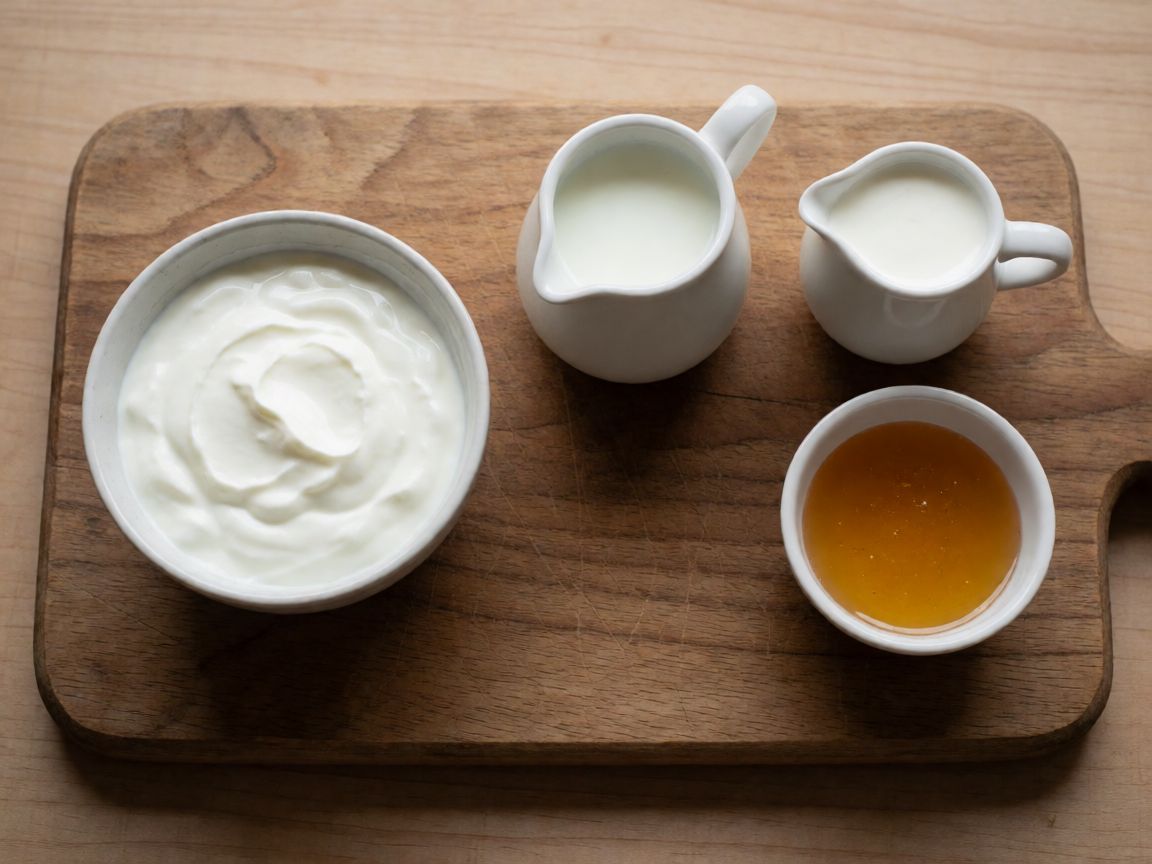
- 500 g Greek yogurt
- 100 ml Milk
- 100 ml Whipping cream
- 60 g Honey




Steps
Whisk all the ingredients together in a bowl, pour into an ice cream maker and let it churn for 25 minutes.
25 minTransfer the finished ice cream to a container and place in the freezer for 1 hour.
60 minSpoon the ice cream into a piping bag fitted with a large star nozzle, pipe into cups and decorate with berries, nuts, seeds or sweets and chocolate.
This is not really ice cream and not really yogurt by the time it's done — it's a frozen custard's lean cousin, made with no eggs, no cooking, no base simmered on the hob. That absence is the whole point and the whole risk: without egg yolks to emulsify fat and water, the job of keeping this smooth falls entirely on the fat you put in and the sugar's fight against ice crystals. Get that balance wrong and you don't get a dessert, you get flavoured ice shavings.
What decides whether this works is three things, and none of them is a stopwatch. First, the fat in the yogurt — thin or fat-free Greek yogurt has nothing to stop water molecules linking up into hard crystals as they freeze, so you'll bite down on something gritty instead of something that gives. Second, movement during freezing: an ice cream maker's paddle is there to tear apart ice crystals the moment they form, which is why churning and freezing happen at once, not one after the other. Third, catching the second freeze at the right moment — firm enough to hold a shape when piped, not so frozen solid that a star nozzle just laughs at you.
Some say frozen yogurt is the "healthy" version of ice cream. No — that's marketing from decades ago, not chemistry. This one has 100ml of whipping cream sitting right next to the yogurt, so whatever virtue you were hoping for is already compromised. The tang of yogurt is a flavour choice, not a diet choice; it cuts the honey's sweetness and stops the whole thing tasting like a candle. That's the actual reason to use yogurt here, and it has nothing to do with calories.
Greek yogurt is the backbone, and the word "Greek" is doing real work here — it means strained, meaning some of the whey (mostly water) has already been drained off before it reaches you. That's why it's thicker than ordinary yogurt straight from the pot and why it costs more: someone paid for the time and the muslin. You want the full-fat version, not the 0% sold next to it on the same shelf under the same brand, because the fat is what interrupts ice crystals from locking together into a solid sheet. If you can't find Greek yogurt, any yogurt strained overnight through a clean tea towel over a sieve will get you there — judge it by whether a spoon stands up in it without toppling.
The milk is a thinner, not a flavour. Its job is to loosen the mixture enough to move freely in the churn — too thick and the paddle just packs it against the sides instead of turning it over. Whole milk earns its place because its own small amount of fat adds to the total; semi-skimmed will work, it just contributes slightly less to the smoothness you're chasing.
Whipping cream is where the real fat budget sits. You need a cream that holds air when beaten — that's what "whipping" means on the carton, roughly a third fat by weight. Single cream is too thin for this; it pours instead of holds, and the whole dessert will freeze harder and icier for the lack of it. If a recipe like this ever asks for double cream instead, that's simply more fat, more smoothness, more richness — not a different mechanism, just more of the same one.
Honey isn't only sweetness, and this is the detail most people miss. Honey is mostly fructose, and fructose resists forming the honeycomb lattice of ice crystals far more stubbornly than ordinary sugar does. That's why honey-sweetened frozen desserts stay scoopable straight from the freezer while a sugar-only version turns into something you need a chisel for. If you swap it for golden syrup or caster sugar, expect a harder set — not a failure, just a different hand on the same lever, and you may need to let it sit out a few minutes before it's workable.
On equipment: an ice cream maker does the churning-while-freezing job properly, because it's cold and moving at the same time. Without one, you're not out of luck, just out of convenience — pour the mix into a shallow container, put it in the freezer, and come back every half hour or so to beat it hard with a fork or whisk, breaking up the crystals as they start to form. It takes longer and the result is slightly coarser, but the mechanism is identical: you're doing by hand what the machine does with a motor.
Six servings from 500g of yogurt means roughly 120g a head once piped out — a modest scoop, not a bowlful, which suits it well as the thing you offer after a Sunday roast when nobody actually has room for a proper pudding but will always find space for something small and cold.