
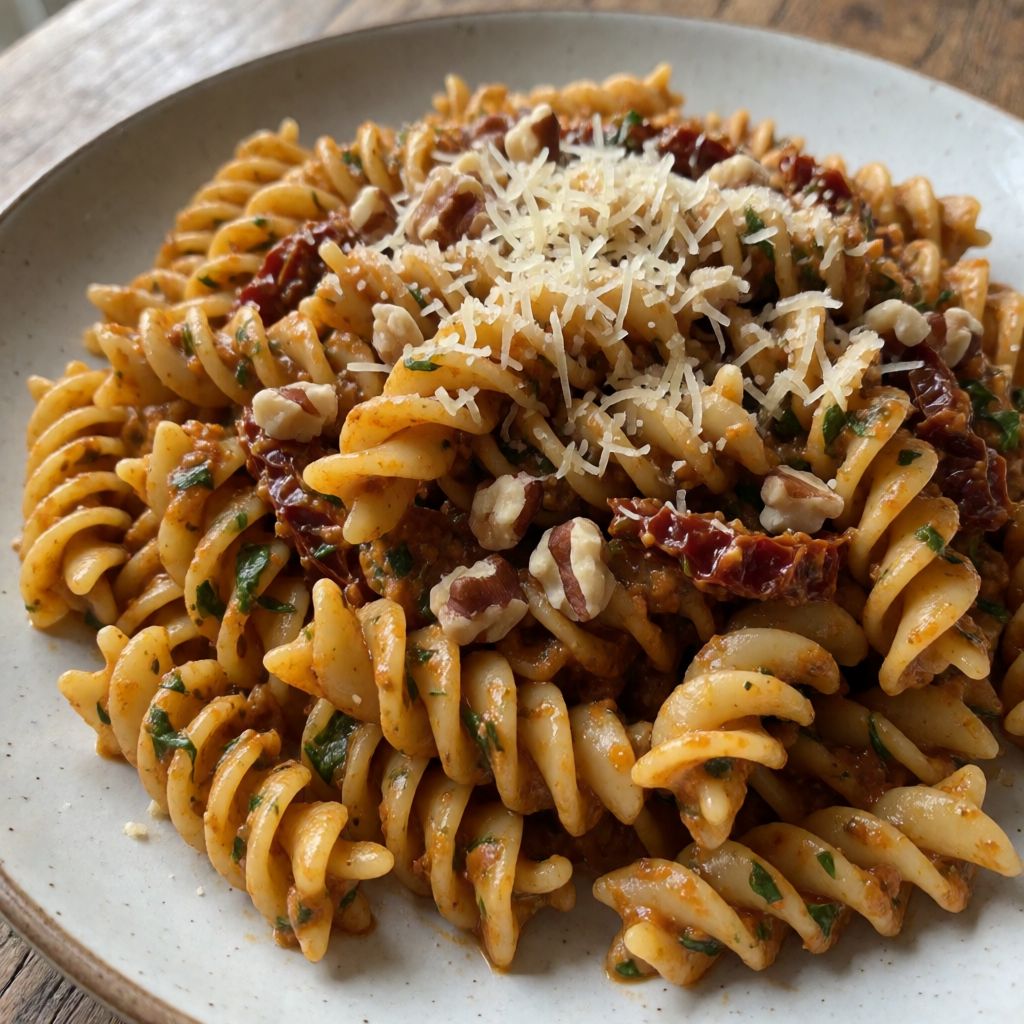
 AI photo
Fusilli with Sun-Dried Tomato and Walnut Pesto
A quick pasta dish with a vibrant walnut and sun-dried tomato pesto, finished with parmesan and fresh basil.
Labels are worked out automatically from the ingredients and can be wrong. Check the packaging if it matters to you.
Ingredients
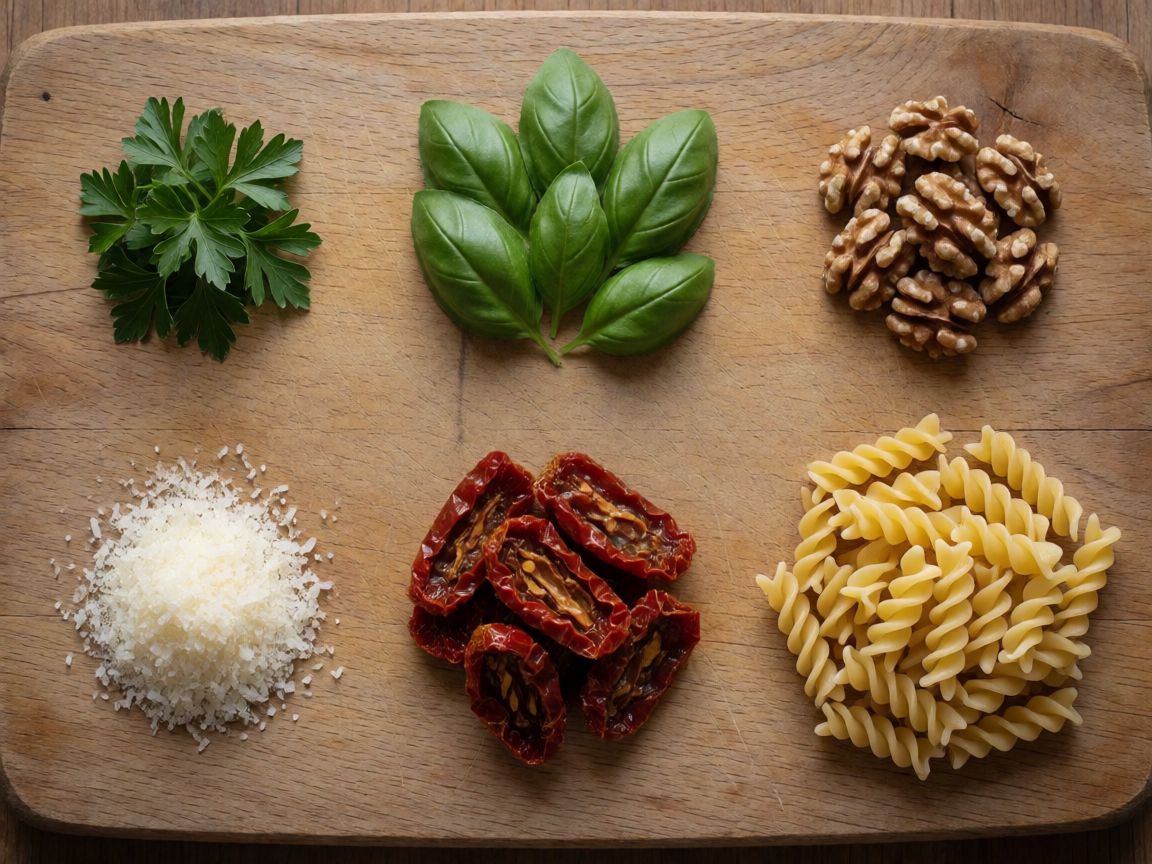
- 1 bunch Parsley
- 10 pcs Basil leaves
- 40 g Walnuts
- Salt to taste
- 2 tbsp Parmesan
- 120 g Sun-dried tomatoes
- 400 g Fusilli
- Olive oil to taste








Steps
While the pasta cooks in a large pot of boiling salted water, put the parsley and basil into a blender with a pinch of salt and blitz.
5 minAdd the sun-dried tomatoes, walnuts, parmesan and enough olive oil, then blend until creamy.
3 minIf needed, add a little of the pasta cooking water to loosen the sauce.
1 minDrain the pasta once it's al dente and divide between plates.
10 minSpoon the pesto over the top and mix well.
2 minGarnish with a few basil leaves and serve immediately.
1 min
This is not a cooked sauce, it's a paste you build in a blender while the pasta works for its own al dente in the next pot — the whole dish lives or dies on that paste staying raw. Heat is the enemy here, not the friend: basil and parsley give up their perfume at the first touch of real heat, so you grind them cold and let the pasta's own warmth, nothing more, carry the smell into the dish.
Fusilli isn't a random choice. A flat noodle would let this paste slide off the plate and sit in a puddle; the spiral grips it, holds it in the groove. That's the whole logic of shape in pasta — the sauce decides the noodle, not the other way round.
Some say pesto only counts if you've bruised it in a stone mortar, that a blender 'kills' it. No — a blender kills it only if you let the motor run hot and long, because the blade's friction heats the basil just enough to start the same oxidation a knife does when it bruises a leaf: chlorophyll breaks down, and the green turns from bright to a tired, bitter grey. Pulse it in short bursts, don't run it like a smoothie, and a blender does the job a mortar does — slower, with more arm work, for people who have the arm work to spare.
The other thing that decides whether this works: a splash of the pasta's own cooking water, stirred into the paste before it meets the noodles. That water is cloudy for a reason — it's full of starch, and starch is what lets oil and water sit together instead of separating. Skip it and the sauce breaks into oily beads and dry clumps the moment it hits a hot plate.
Parsley and basil aren't doing the same job, even though they go into the blender together. Parsley is bulk — cheap, leafy, mild, there to give the paste body without costing you anything. Basil is the perfume, used in a fraction of the quantity because its oils are strong enough that more would just taste soapy. If you can't get good basil — and in a flat with no garden, sometimes you can't — lean harder on parsley and accept a quieter, greener pesto rather than forcing a weak basil to do a job it can't.
Walnuts instead of pine nuts isn't a shortcut, it's economics with a long memory. Pine nuts come from a tree that's slow to fruit and expensive to harvest — pesto's homeland used them because the coast had them. Walnuts are what most of the rest of the world had lying around instead: cheaper, faster-growing, and carrying a slight tannic bitterness that pine nuts don't. That bitterness isn't a flaw here — it's what keeps the sweetness of the sun-dried tomato from turning the whole sauce into jam. Any oily nut will emulsify — almonds, cashews — but you lose that bitter counterweight if you swap them in.
Sun-dried tomatoes are the ingredient doing the heaviest lifting, and they're there because of drying, not flavour fashion: tomatoes used to be dried in the sun purely to survive a surplus harvest past the season, and drying concentrates sugar and umami the way reduction does with a sauce on the stove, just slower and free. That concentration is what lets this pesto skip the usual basil-and-oil-only route — the tomatoes bring acidity and a chewy density that basil alone can't. If you're using the kind packed dry rather than in oil, soak them in warm water first, or they'll grind like leather instead of blending into cream.
Parmesan here is salt and fat and that savoury depth — glutamate, if you want the chemistry — not a dairy flavour you're meant to notice on its own. Any aged, hard, salty cheese does the same work: Grana Padano, pecorino if you want it sharper. Keep the rind off your plate but not off your kitchen — it's worth dropping into stock another day, nothing to do with this dish, just don't waste it.
Olive oil is the one ingredient where the usual substitution rule — any oil with no smell of its own — doesn't apply, because this oil is never heated into neutrality. It's raw in the final dish, so its own flavour is part of the pesto, not a background carrier. Use one you'd be happy to taste off a spoon; a flavourless vegetable oil will just leave the sauce greasy and empty.
There's no garlic in this version, and that's not an oversight — leaving it out lets the tomato's sweetness and the walnut's bitterness sit at the front instead of fighting garlic for attention. And the last ingredient, the one with no weight in grams: patience to taste the pesto before it goes anywhere near the pasta, because sun-dried tomatoes vary wildly in saltiness batch to batch, and salt added after the fact never tastes the same as salt that had time to sit.