
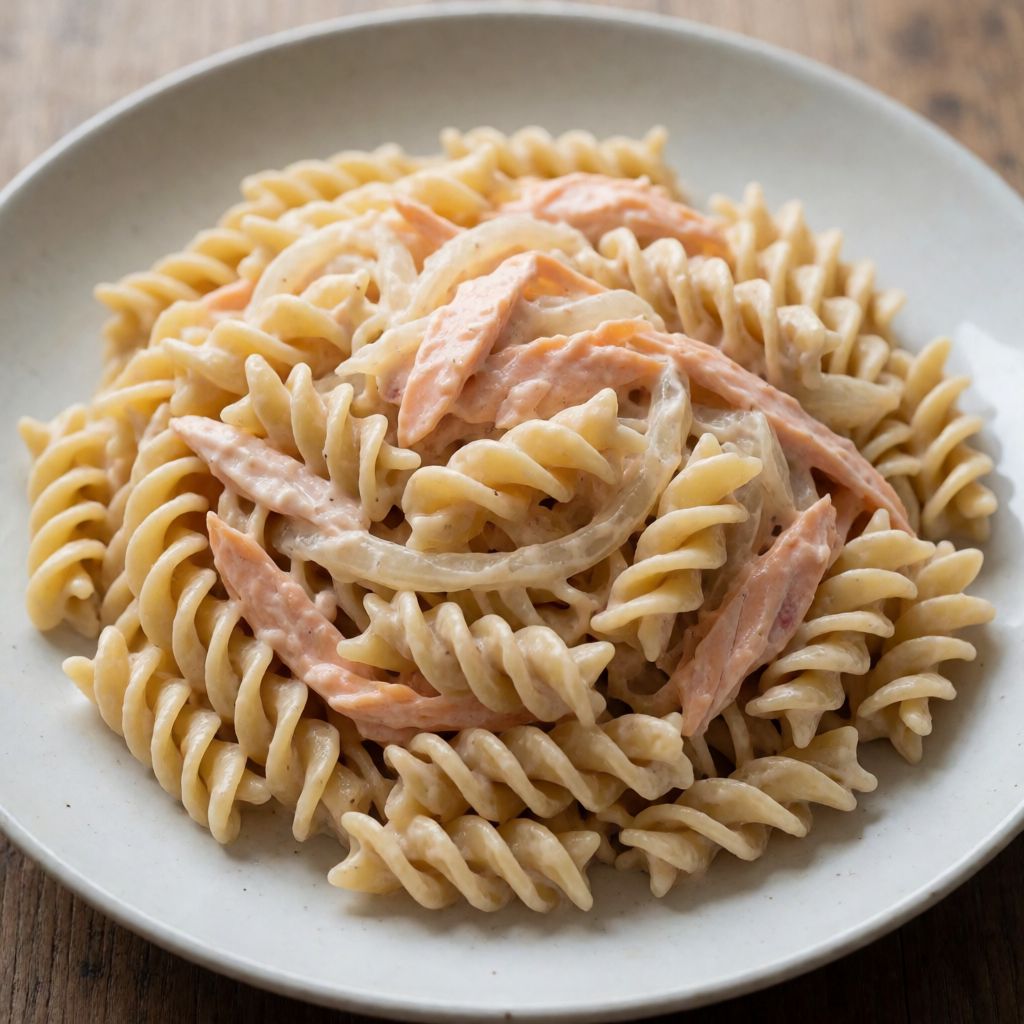
 AI photo
Fusilli with Salmon in Brandy
A quick pasta dish with smoked salmon, brandy and a creamy sauce.
Labels are worked out automatically from the ingredients and can be wrong. Check the packaging if it matters to you.
Ingredients
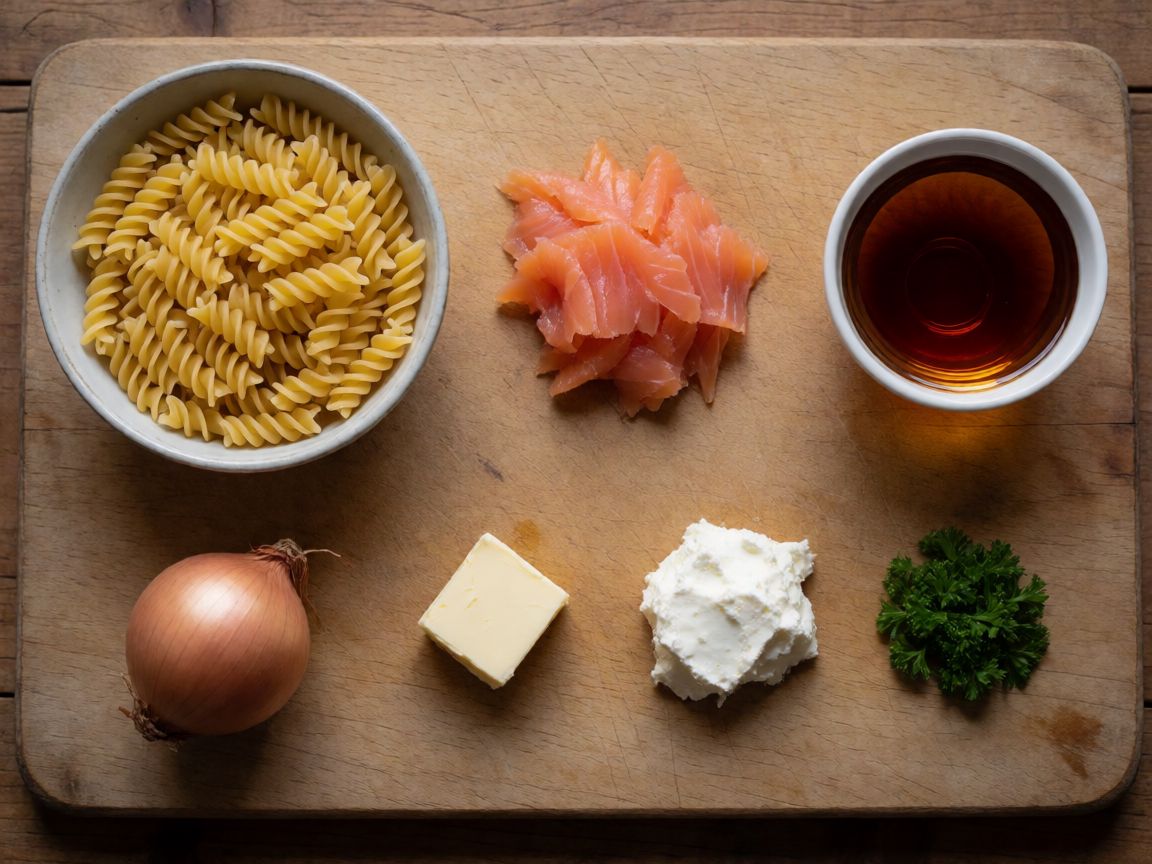
- 400 g Fusilli
- 200 g Smoked salmon
- 1 pcs Brandy a shot
- 1 pcs Onion
- 20 g Butter
- 120 g Cream cheese
- Salt to taste
- Black pepper to taste
- 1 tbsp Parsley









Steps
Melt the butter in a frying pan and sauté the chopped onion until soft, while the fusilli cook in salted boiling water.
Add the chopped smoked salmon and pour in the brandy, letting it bubble and reduce right down.
Cook gently for a few minutes, until the fish reaches an internal temperature of 63°C.
Season with salt, add the cream cheese and let it melt into the sauce.
Season with black pepper, then stir in the drained al dente pasta and toss everything together well.
Sprinkle with parsley, heat through briefly and serve.
This is a weeknight dish wearing a dinner-party coat. Smoked salmon and cream cheese do the work that a proper fish velouté would otherwise demand hours for, and the brandy is there to give the whole thing a lift it hasn't earned the slow way. Feeds four, and it should take you less time to cook than it takes the pasta water to come properly back to the boil after you've dropped the fusilli in.
What decides whether it works is restraint in three places. The onion in butter must go soft and translucent, never coloured — push it to brown and you get a bitterness that fights the cream instead of carrying it, and you'll see the sauce turn a dull khaki instead of staying pale. The brandy needs to actually bubble down to almost nothing, not just get warm — that's not showmanship, that's cooking off the raw alcohol sting so what's left is the aroma without the burn. And the cream cheese wants gentle heat and a patient stir, not a boil — boil it and the proteins seize, and you get oily grains floating in thin water instead of a sauce.
The recipe gives you '63°C' for the salmon, and I'd put that thermometer back in the drawer. Smoked salmon, cold-smoked or hot-smoked, is already cured — salt and smoke did their job before it reached your pan. You are not cooking raw fish to a safe core temperature, you are warming it through until it stops looking glassy and starts looking matte, the pink deepening, the edges curling just slightly. That's the moment. No probe needed, no anxiety about undercooked fish — this isn't chicken.
Fusilli earns its place here for one plain reason: the spiral grips sauce in a way a flat ribbon can't, so every forkful carries its share of cream and fish instead of leaving half the sauce behind in the pan. Any short pasta with a twist, a groove, a hollow — penne, rotini, conchiglie — will do the same job. A smooth tube or a long strand won't hold on as well, and you'll end up chasing sauce round the bowl.
For the salmon, know what you're buying. Cold-smoked is silky and barely firmed by the smoke, which is why it turns from translucent to opaque so visibly in the pan — that's your doneness cue doing its work in real time. Hot-smoked is already cooked through and flakier; it'll heat through faster and fall apart more readily, which is fine, just stir more gently. Offcuts and trimmings, sold cheaper than whole fillets, are perfect here since you're chopping it anyway — no reason to pay fillet prices for something going into a sauce. If salmon isn't to hand, smoked trout behaves almost the same way; smoked mackerel works too, though it's a stronger, oilier flavour and you may want less of it.
The brandy isn't about getting a buzz into the sauce — it's a deglazing agent and an aromatic one at once. Poured in hot, its alcohol lifts the stuck-on bits of onion and fat off the base of the pan, and as it reduces, the sharp solvent smell burns away and what's left is a rounded, slightly sweet depth you can't get from stock alone. Any dry brandy will do — nobody's going to taste the difference between a decent cognac and a cheap cooking one once it's reduced. No brandy in the house? A dry white wine does the same deglazing job, just with a different accent; skip the alcohol altogether and a squeeze of lemon at the end will give you acidity without the depth, which is a fair trade if that's what you've got.
Butter, not oil, for the onion — at this gentle a heat you don't need oil's higher smoke point, and butter's milk solids add a faint nuttiness that oil can't. Use unsalted if you can, so you're the one deciding how salty the dish ends up, not the dairy. The cream cheese stands in for cream itself: it's more stable at low heat, it won't split the way thin cream can if you look away for a minute, and a half-tub keeps in the fridge far longer than an open carton of cream — which is really the whole economic logic of this dish. It was built to use things that sit in a fridge waiting, not things you buy specially. Mascarpone or a thick crème fraîche will substitute if cream cheese isn't in, though crème fraîche brings its own tang, which isn't unwelcome.
Parsley goes in at the very end, off the heat or close to it, chopped fine — any longer in the pan and it wilts to a dull khaki and loses the fresh, grassy note it's there for. And give the whole thing the patience it's actually asking for: let the onion truly soften rather than rushing it translucent, let the brandy truly reduce rather than pulling it off bubbling, let the cheese truly melt in rather than cranking the heat to speed it along. None of these steps take long, but each one has a point past which hurrying costs you the texture you're after.