
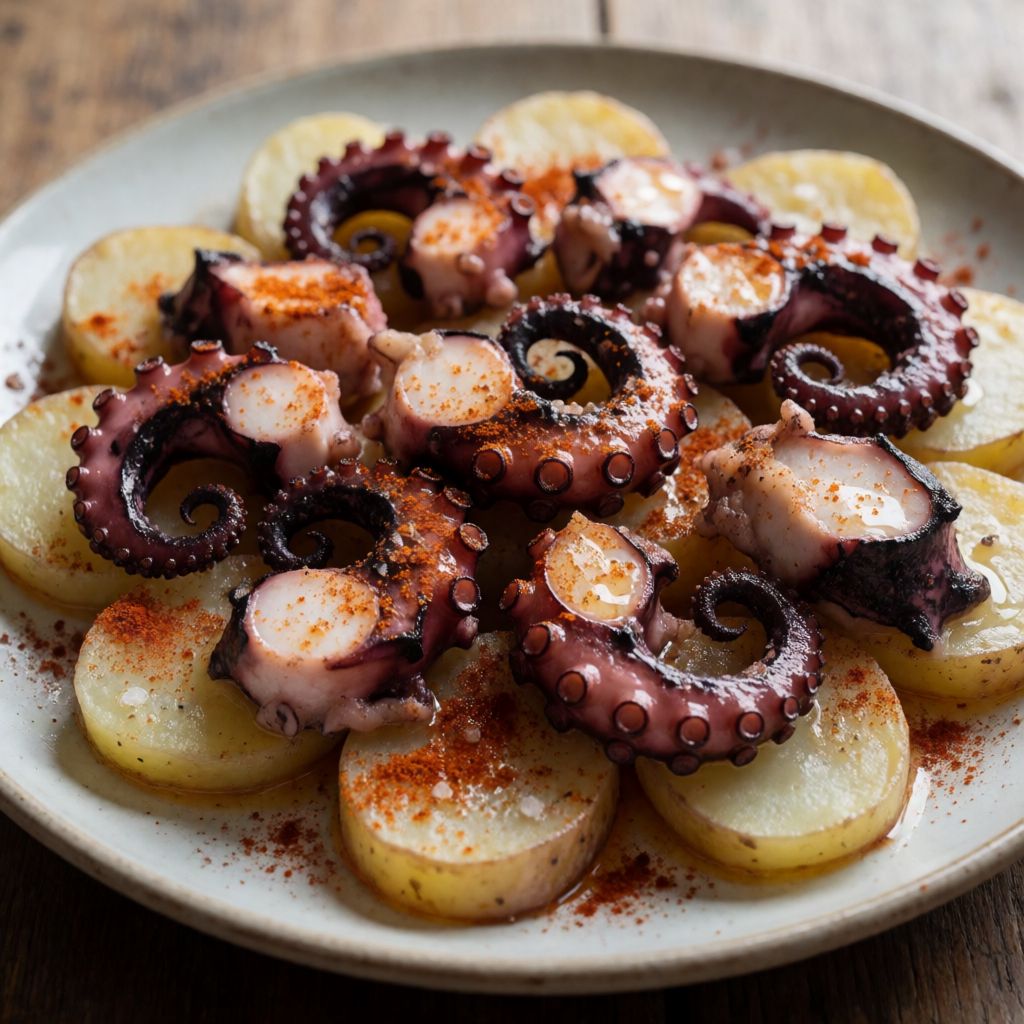
 AI photo
Galician-Style Octopus
A classic Galician-style octopus, gently poached until tender and served over paprika-dusted potatoes.
Labels are worked out automatically from the ingredients and can be wrong. Check the packaging if it matters to you.
Ingredients
- 500 g Potatoes
- 1.5 kg Octopus
- Coarse salt to taste
- 0.5 pcs Onion
- Sweet paprika to taste
- Hot paprika to taste
- Olive oil to taste






Steps
Fill a pot with one litre of water, add half the onion and a handful of coarse salt, then bring to a boil.
Submerge the octopus in the water, tentacles included, and cook for 50 minutes until tender. It is done when the thickest part reaches 63°C.
50 minDrain, reserving the cooking water, and let the octopus cool.
Peel the potatoes and slice them.
Pour the reserved octopus cooking water back into the pot, add the potatoes and simmer for 15-20 minutes until tender.
18 minSlice the octopus into rounds or thick pieces.
Drain the potatoes and let them cool.
Arrange the potato slices on a platter and top with the octopus pieces.
Drizzle with olive oil and sprinkle with a mix of sweet and hot paprika.
Chill in the refrigerator for 1 hour before serving.
60 min
This is pulpo á feira — octopus cooked plain in salted water, laid over sliced potato, finished cold with oil and two paprikas. No sauce, no stock reduction, nothing hiding behind a pan lid. It's fairground food from the Galician coast: a dish built entirely around what a boiling cauldron and a cheap fish could do for a crowd standing at a market stall, eaten off a wooden plate with a toothpick because that's what the stallholders (the pulpeiras) had to hand. Nothing mystical in that — just poverty and good sense meeting in a pot.
What decides whether this works is not the octopus itself but what you do to the water it sits in. Octopus is mostly collagen-rich connective tissue wrapped round muscle fibre, and those two things want opposite treatment: the collagen needs a long, gentle simmer to melt into gelatine, while a hard, rolling boil just shocks the muscle fibre into clamping down and squeezing out its own moisture — that's the rubber-band bite everyone blames on 'cheap octopus' when really it's blamed on an impatient cook. A bare simmer, water barely trembling, for the better part of an hour, is what turns a creature built like a knot of elastic bands into something a fork slides through.
Buy the octopus by looking at where it's been, not by whether it says 'fresh' on the label. A lot of what UK fishmongers sell as fresh octopus was frozen on the boat anyway, and that's not a downgrade — ice crystals forming inside the muscle physically tear the fibre apart, which is exactly what you're trying to achieve with heat and time. If your octopus was never frozen, fresh off a boat, it can actually be tougher to cook tender, because the fibre is still intact. So the old rule 'always buy fresh' gets it backwards here: a well-frozen-and-thawed octopus is often the kinder choice for a home cook with no kazan and no fairground cauldron, just a stock pot on an electric ring.
For the water: coarse salt, not table salt, because you want it to dissolve slowly and season the flesh through a long cook rather than hit it all at once. Half an onion is there for a faint sweetness in the broth, nothing more — don't go hunting for a specific variety, any onion you'd put in a stew will do. Some cooks drop a wine cork into the pot, convinced it tenderises the octopus. It doesn't — cork has no enzyme, no acid, nothing that touches protein. What actually tenderises it is the forty-odd minutes at a gentle simmer that follow. The cork is a good story, not a mechanism.
Potatoes: choose a waxy one — Charlotte, Jersey Royal if they're in season, anything that keeps its shape when boiled — rather than a floury Maris Piper that wants to fall apart into mash. You're slicing these and standing them on a plate; they need structural integrity, not fluffiness. Cook them in the same water the octopus came out of, not fresh water — that water is carrying dissolved gelatine and salt, and throwing it away would mean cooking the potato in flavour you already paid for.
Paprika does two different jobs here and that's why the recipe wants two kinds. Sweet paprika (pimentón dulce) gives colour and a round, slightly fruity smell; hot paprika (pimentón picante) gives a thin edge of heat without the bulk of a fresh chilli, which would be wrong texturally sitting on cold potato. If you can't get Spanish paprika, any smoked paprika will do for the sweet one, and a pinch of cayenne stands in for the hot — just use less, cayenne is sharper and has no smoke.
The oil needs to taste of something, because it's the only thing in this dish that isn't cooked — a decent olive oil, not an everyday one bought for frying. If you only have a flavourless oil in the cupboard, this isn't the dish to use it in; borrow a good olive oil rather than substitute, because there's nothing else here to carry its job.
Last point, and it's the one people skip because it looks like nothing is happening: the hour in the fridge before serving. That's not for safety, it's for the dish to settle — the paprika oil soaks a little into the potato, the octopus firms up enough to slice cleanly instead of tearing. Patience here isn't a virtue you're performing, it's doing actual work. Serve it straight from the fridge, or close to it; this was never meant to be a hot dish.