
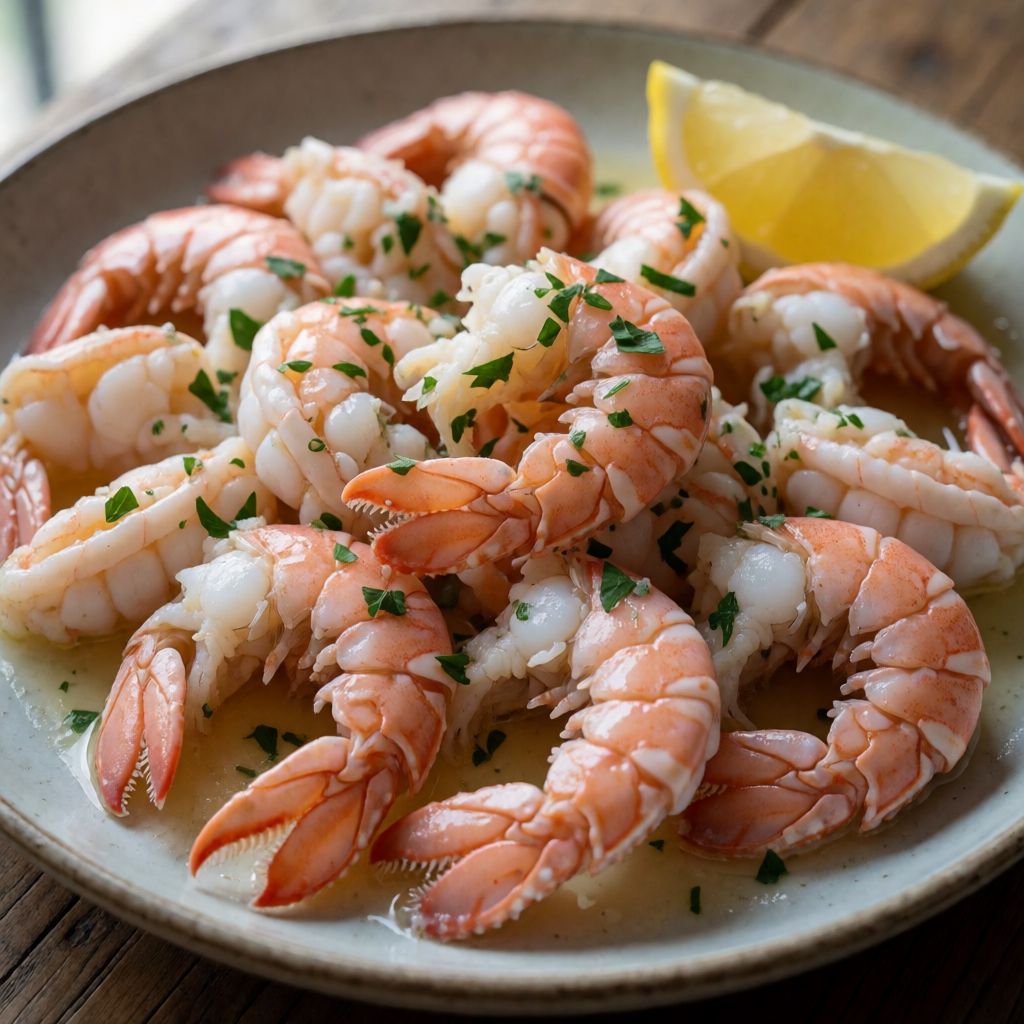
 AI photo
Langoustine Tails with Garlic
Buttery baked langoustine tails with garlic, parsley and lemon zest, served with baguette.
Labels are worked out automatically from the ingredients and can be wrong. Check the packaging if it matters to you.
Ingredients





Steps
Using kitchen scissors, cut the langoustine tails along the back and remove the black intestinal vein.
Place them on a baking tray lined with baking paper, cut side up.
Make the garlic butter by mixing softened butter with the garlic, finely chopped parsley, grated lemon zest and salt.
Spread a small piece of the butter over each tail.
Bake in a preheated fan oven at 220°C for about 5 minutes.
5 min
This is scampi with its collar straightened — the French way of saying it, because that's exactly where the garlic-butter-and-shellfish idea comes from, by way of every seaside bistro that ever had a grill and five spare minutes before service. What decides whether it works isn't the oven dial. It's two things: how cleanly you split the tail, and how fast you get it out again.
Cutting along the back with scissors isn't tidying up. A langoustine tail is a curved tube of flesh of uneven thickness — thicker at the top, tapering at the tail fan. Left whole, the thick end stays underdone while the thin end turns to rubber before you've noticed. Split and laid flat, cut side up, the whole thing cooks at roughly the same rate, and the butter has somewhere to sit instead of running off a curved shell.
The dark vein you're pulling out is the intestinal tract — not decorative grit, actual digestive matter. Leave it and you get a gritty, faintly bitter note in an otherwise clean dish, and no amount of garlic butter disguises sand. People sometimes skip this step on small tails thinking it isn't worth the bother. It is. It takes seconds and it's the difference between clean and merely edible.
Langoustine tails, in a British kitchen, usually means Dublin Bay prawns — the same creature that ends up breaded and fried as 'scampi' in half the pubs doing a Sunday carvery. Fresh ones are a coastal luxury; most of what you'll buy anywhere inland is frozen, and that's fine, because freezing barely bothers these — but thaw them properly in the fridge, not under a tap, and pat them dry before you touch the scissors. Water sitting on the flesh means the pan or tray steams instead of searing, and the butter never gets hot enough to sizzle — it just poaches everything into blandness.
Butter does two separate jobs here and that's why the recipe asks for it twice. The 50g goes into the flavoured butter — softened, not melted, so it holds the garlic, parsley and zest in suspension rather than letting them sink or float off. The plain 25g is there for the baguette, because a dish built around garlic butter produces a tray of garlic butter you are not allowed to waste — that's not greed, that's arithmetic; the butter is doing a lot of the flavour work for a fairly plain protein, so mopping it up with bread is practically part of the method. If you're out of butter and reaching for oil instead: the criterion is a fat that can hold aromatics in a soft paste and melt gradually rather than instantly pool and run — butter does this because it's partly solid fat and partly water at room temperature. Oil won't behave the same way; it'll slide off the tail before it's done its job.
Crush the garlic rather than mince it, and stir it into the butter rather than laying it bare on the flesh. Raw garlic directly exposed to 220°C for even a few minutes turns bitter and acrid — it scorches before the shellfish is cooked. Buried in butter, it's insulated: the butter melts first, carries the garlic gently into the flesh, and the garlic never sees direct dry heat at all. That's the whole reason this dish calls for garlic butter and not garlic oil or garlic rubbed straight on.
Parsley and lemon zest aren't garnish, they're correction. Butter and garlic together are rich and a little flat on their own; parsley brings green bitterness and lemon zest brings aromatic acidity without the wetness of juice, which would thin the butter and stop it clinging. This is also, frankly, why the dish has so few ingredients: langoustine is expensive enough that nobody in a kitchen economising on anything else is going to bury it under a spice list. The whole point, historically, of a dish like this is that the shellfish pays for itself — you don't need six more ingredients competing for attention.
Salt goes into the butter, not directly onto the raw flesh beforehand. Salt pulls moisture out by osmosis, and if it sits on raw shellfish for any length of time before cooking, you lose some of the natural juice that should stay inside and baste the flesh from within. Mixed into the butter, the salt arrives with the fat, at the moment of cooking, not before it.
As for the tray and the oven: a fan oven at full throttle is standing in for what a grill does in a restaurant kitchen — fast, even, surrounding heat rather than heat from one direction only. If your oven doesn't have a fan setting, go a touch hotter and keep an even closer eye on the flesh colour, because a conventional oven's heat is less even and will cook one side of the tray faster than the other. There's no fixing that with more minutes — only with watching.