
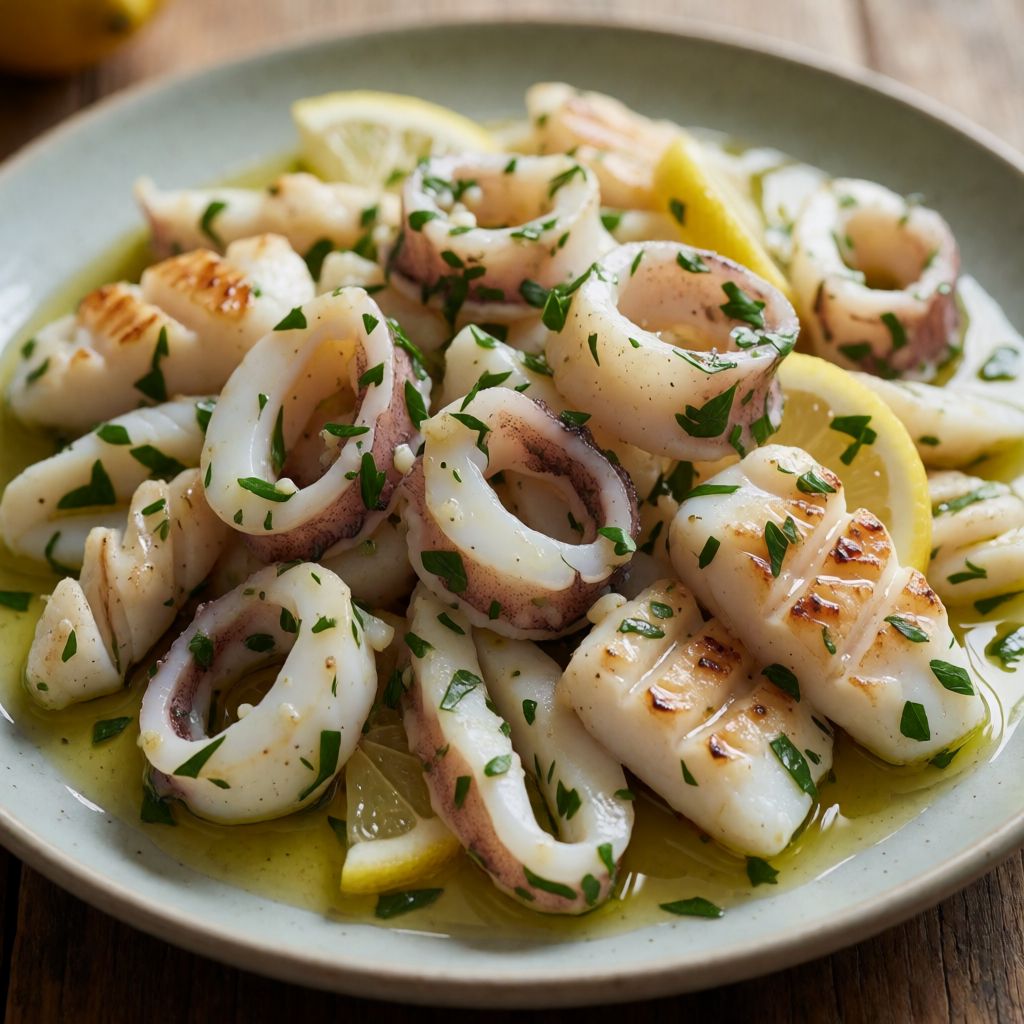
 AI photo
Grilled Cuttlefish Salad
A simple, zesty salad of grilled cuttlefish with garlic, parsley and lemon.
Labels are worked out automatically from the ingredients and can be wrong. Check the packaging if it matters to you.
Ingredients
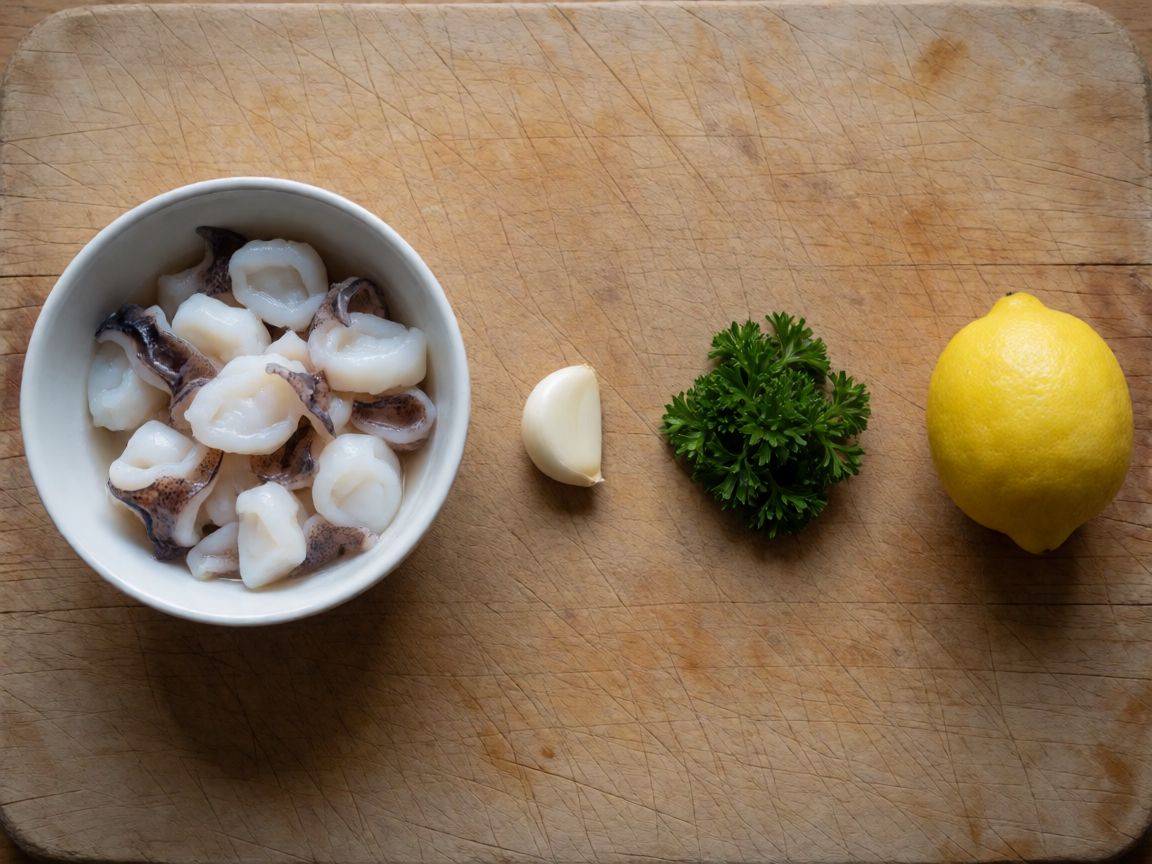







Steps
Heat a griddle pan or non-stick frying pan.
Fry the cuttlefish on both sides until golden. It's ready when the thickest part reaches 63°C.
20 minPlace the cuttlefish on a plate and sprinkle with garlic and parsley.
Season with salt and black pepper to taste.
Drizzle with olive oil and lemon juice, toss and serve.
5 min
This is a hot-plate dish, not a stew: a quick sear, then everything else happens cold, poured over the top. Cuttlefish hits a ridged pan or a non-stick frying pan hard and fast, comes off, and only then meets garlic, parsley, lemon and oil. Nothing simmers here. The dressing is raw on purpose — it's there to cut through the char, not to cook alongside it.
What decides whether it works is speed and dryness. Cuttlefish flesh is mostly muscle wall with almost no connective tissue to break down, so there's no long-cook route to tenderness the way there is with, say, a shin of beef or an octopus tentacle. You have one short window where the proteins set without squeezing out all the moisture. Miss it on the low side and the flesh stays slimy and translucent. Miss it on the high side — leave it on the heat past that point — and it tightens into rubber, because that's what happens to thin muscle with no fat and no collagen cushion: it has nowhere to go but tough.
Some say you should cook squid and cuttlefish a long time to "soften" them, the way you'd braise a tough cut. No — that logic belongs to octopus, whose tentacles are dense with collagen and genuinely need long slow heat to turn to gel. Cuttlefish's mantle has almost none of that. Long heat on cuttlefish doesn't soften anything; it just drives water out until you're chewing on string.
Cuttlefish itself: fresh is nicer to handle because it hasn't lost structure to ice crystals, but frozen is entirely sound — it's sold frozen for a reason, cephalopods hold up to freezing better than most seafood because their flesh is dense and low in fat (fat is what usually goes rancid and grainy in the freezer). If you're thawing it, do it slowly in the fridge, not under a hot tap, and pat it properly dry with paper before it goes near the pan. That drying step isn't fussiness — a wet surface on a hot pan steams instead of sears, and steaming is exactly how you end up with pale, water-logged, slightly rubbery cuttlefish instead of browned, firm cuttlefish. If you have no cuttlefish, squid works on the same logic — thin muscle wall, same short hot window — just watch it even more closely, because squid is thinner and crosses from tender to rubber faster.
The pan: a ridged griddle is the honest substitute for live fire here, and it earns its keep because the ridges hold the flesh up off any released liquid, so you get drier contact and real colour instead of a poach in its own juice. A flat non-stick pan does the same job less dramatically — no stripes, same principle, just make sure it's properly hot before the cuttlefish goes in, hot enough that it hisses the second it touches. No kazan, no open flame needed; this dish was never built around either.
Garlic: raw, chopped fine, scattered over hot flesh rather than cooked in oil first. That's deliberate — a few seconds of ambient heat from the seafood softens its edge without cooking it into paste, so you still get bite, not background. If raw garlic is too sharp for your table, a smaller amount or a clove crushed with a little salt (which breaks it down and mellows it faster) does the same job with less aggression.
Parsley: here for green freshness and a bit of bitterness against the richness of olive oil — any soft-leaved herb with a clean, grassy character can stand in; coriander would change the dish's accent but not its mechanics.
Lemon and olive oil together are the whole dressing, and that's not a shortcut, it's the actual tradition: coastal kitchens built their sauces from what grew nearby — citrus and olives, not cream or butter, because that's what was cheap and abundant on that coastline, not because acid-and-fat is some sacred combination. The oil should have little character of its own so it carries the lemon and garlic rather than arguing with them — any neutral oil, sunflower included, will do if good olive oil isn't to hand, though you lose a little of the grassy background note.
Salt and pepper go on after the sear, not before, because salt drawn out early pulls moisture to the surface — the same water-release problem as a wet pan, just caused by you instead of a careless thaw. Season once the cuttlefish is already off the heat and the risk has passed.
Last thing, and it's not really an ingredient but it should be treated like one: give the dressed cuttlefish a minute or two before it goes on plates. Patience here isn't about tenderising — the sear already did what tenderising there is to do — it's about letting the lemon and garlic actually permeate the warm flesh instead of just sitting on its surface. A dish eaten the second it's dressed tastes like two things placed near each other; a dish given that short rest tastes like one thing.