
 AI photo
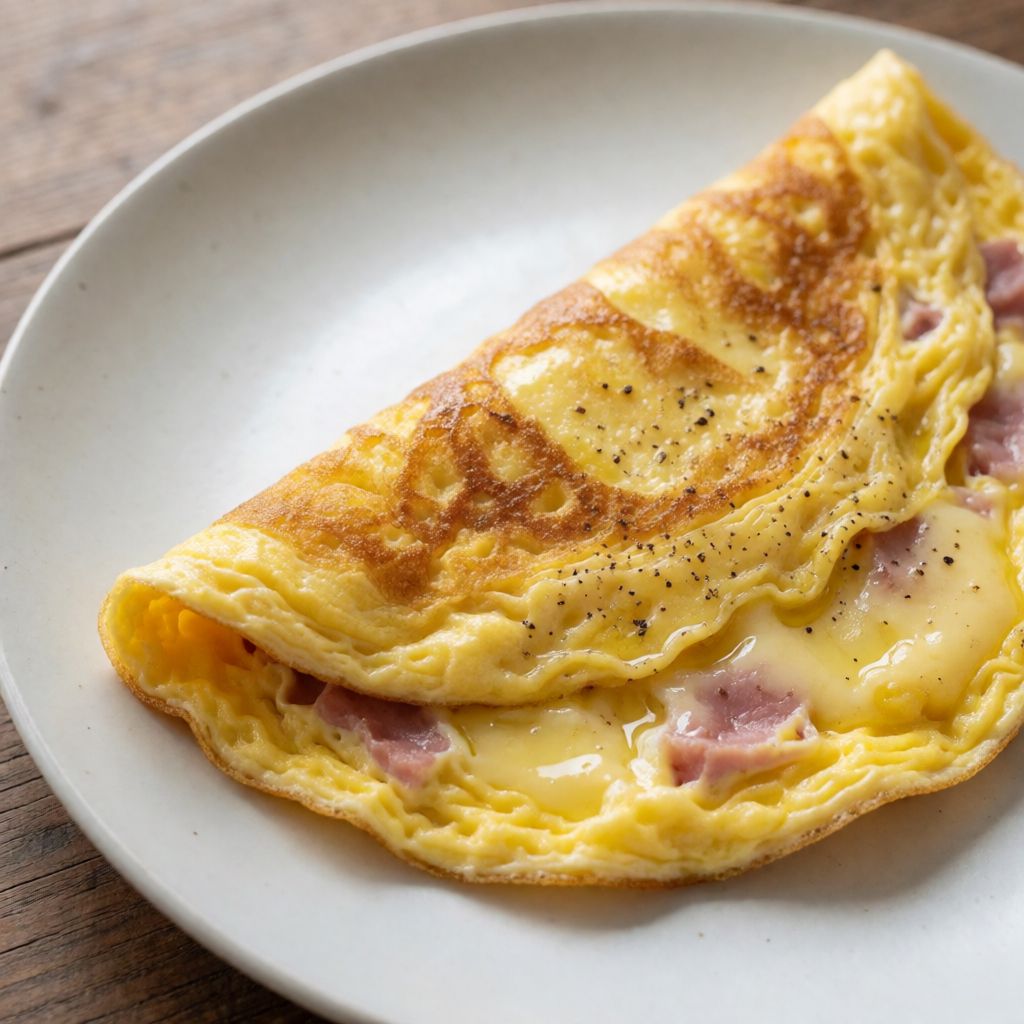
Ham and Cheese Omelette
A classic French-style omelette filled with melted Comté cheese and ham cut into strips, finished with fresh chives.
Labels are worked out automatically from the ingredients and can be wrong. Check the packaging if it matters to you.
Ingredients








Steps
Crack the eggs into a sieve and press them through until all the egg mixture has passed.
2 minAdd salt and freshly ground pepper and whisk the eggs until smooth.
1 minHeat a pan with the olive oil, add the butter and let it melt and sizzle.
2 minPour the egg mixture into the pan and stir with a spatula for 15-20 seconds.
Place the grated Comté cheese and the ham strips in the centre while the eggs are still soft inside, then fold the omelette towards the middle.
2 minLet the omelette rest in the hot pan for 5-10 seconds before turning it onto a plate.
Serve on a plate, sprinkled with finely chopped chives and freshly ground pepper.
1 min
A folded omelette is really two timings pretending to be one: the egg has to set just enough to hold a shape, and the filling has to warm through without the egg turning into a rubber mat. Everything in this recipe is built around keeping that balance — not around how many minutes you stand at the hob.
Start with the sieve. Pulling raw egg through a strainer isn't fussiness — it catches the chalazae, those little white cords anchoring the yolk, and any shell fragment that slipped in. Skip it and you get flecks of toughness in an otherwise silky omelette; that's the real cause of the odd rubbery bite people blame on "overcooking" when the eggs were never the problem.
Some say a proper omelette needs a hard whisking with a fork to get it fluffy. No — because what makes an omelette light is heat and speed, not air beaten in. Over-whisking just breaks the egg down and makes it weep later in the pan. Whisk only until yolk and white are one colour, nothing more.
The fold, not the flip, is the whole trick. You're not cooking the omelette through before adding cheese and ham — you add them while the centre is still wet and shiny, then fold the sides over. The outside has set enough to hold; the inside finishes in the fold, carried by residual heat, melting the Comté without ever hitting a flame again. That short rest in the hot pan afterwards — five, ten seconds — is doing the last of the cooking for you. Pull it too early and the middle stays raw and cold against warm cheese; wait too long in that fold and you've made scrambled eggs with a hinge.
Butter alone, in a pan hot enough to actually cook an omelette fast, will often brown and bitter before you've poured the egg in — that's why there's a spoon of oil underneath it. Oil raises the point at which the fat starts to break down, buying you the window to melt butter to a sizzle without blackening it. Use any oil that has no smell of its own — a light olive oil, sunflower, grapeseed — so it doesn't fight the butter for flavour. This isn't a dish that wants extra-virgin green olive taste shouting over the eggs.
Three eggs is one person's portion, and that's not arbitrary — it's roughly what a French bistro cook reaches for because it's the smallest amount that still folds cleanly without the whole thing collapsing thin and dry in the pan. Eggs at room temperature slide through the sieve faster and set more evenly than fridge-cold ones, which shock on contact with hot fat and set unevenly at the edges first.
Comté is chosen for how it behaves in heat, not just taste: it melts into itself rather than weeping water the way a very fresh soft cheese would, so it stays a pocket of melted cheese instead of thinning your egg. The criterion for a substitute is exactly that — a firm cheese that melts smooth without releasing liquid. Gruyère, a mature Cheddar, even a good Emmental will all do the job; a young, wet cheese won't.
Ham here should be a dry-cured slice, not a wet gammon-style one straight from a packet swimming in brine — the drier the ham, the less water it dumps into the fold to dilute the egg around it. If all you've got is a thicker Sunday-roast-leftover ham, cut it thinner; strips, not chunks, so it warms through in the few seconds it spends folded in rather than sitting as a cold core.
Salt and pepper go into the raw egg, not on at the table only — salt dissolves and seasons evenly through the mixture while it's still liquid, which you can't do once it's set. Freshly ground pepper at the end, over the chives, is there for smell as much as bite — pre-ground pepper has mostly lost its oils by the time it reaches your shaker.
None of this needs a kazan or a lid you don't own — a plate balanced over the pan, if you ever need to trap a little steam, does the job of a lid in most British kitchens perfectly well. What this dish actually asks of you is patience in a very short window: resist folding before the centre is ready, resist leaving it a beat too long after. That's the whole skill, and it fits in about fifteen minutes — quicker than boiling the kettle twice for tea, and a far smaller commitment than Sunday's roast.