
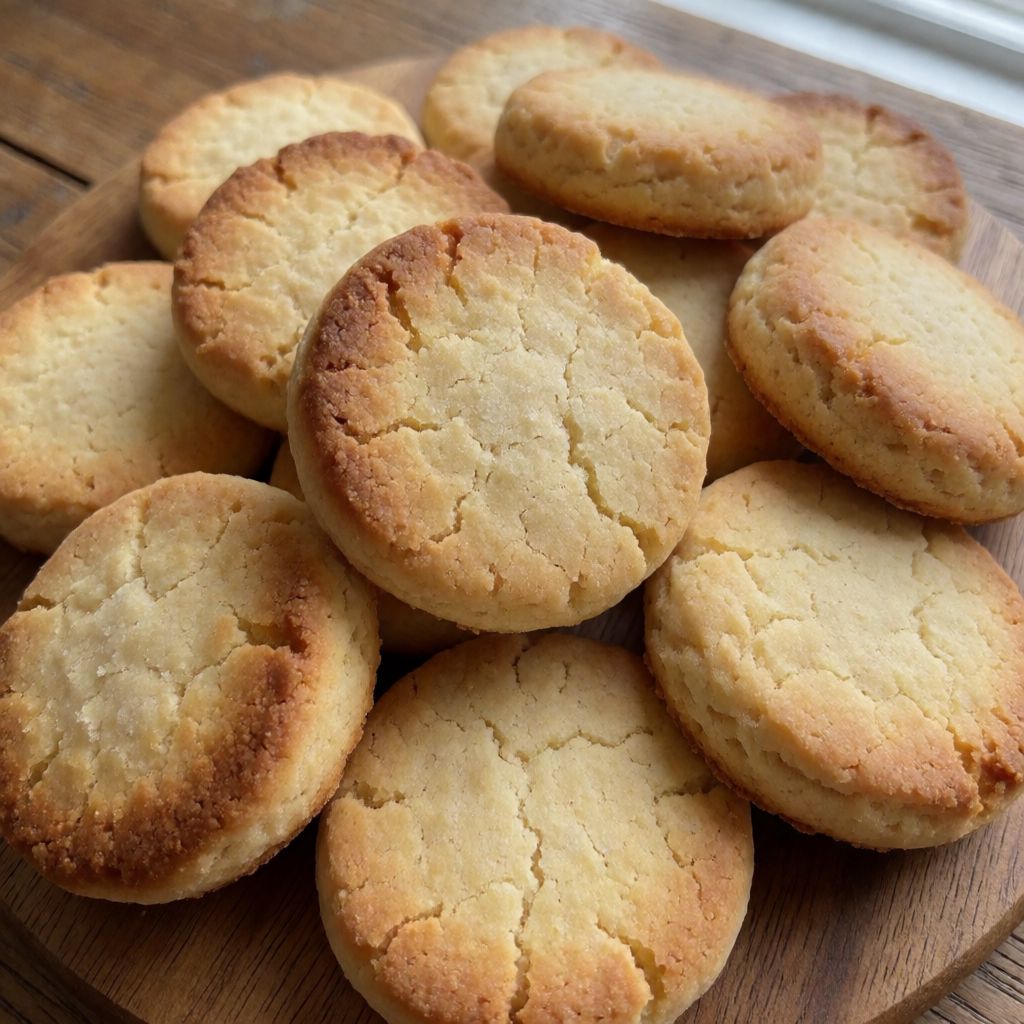
 AI photo
Kamut Flour Biscuits
Simple home-style biscuits made with kamut flour, lemon zest and a dusting of icing sugar.
Labels are worked out automatically from the ingredients and can be wrong. Check the packaging if it matters to you.
Ingredients
- 400 g kamut flour
- 2 pcs egg yolks
- 200 g sugar
- 200 g butter
- 1 package baking powder
- 1 tbsp bicarbonate of soda
- 1 pcs lemon zest; or orange
- milk as needed
- 1 pinch icing sugar for dusting









Steps
Cut the butter into cubes and soften it in the microwave on medium power.
Pile the kamut flour into a bowl, make a well in the centre and add the lemon zest, baking powder, bicarbonate of soda, butter, sugar and egg yolks.
Mix all the ingredients well, then knead energetically into a smooth, elastic dough.
If the dough is too firm, add a little milk as needed.
Shape the dough into a ball, wrap it in cling film and leave it in the fridge.
30 minUsing a rolling pin, roll out the dough to a thickness of about 5 mm.
Using cutters or freehand, cut the biscuits into the desired shapes.
Place the biscuits on a baking tray lined with baking paper and bake in an oven preheated to 180°C.
14 minWatch the baking closely so the biscuits do not burn.
After baking, let the biscuits cool at room temperature.
If you like, dust with icing sugar, cocoa powder or chopped nuts.
These are shortbread-type biscuits built on kamut flour instead of wheat — an ancient grain, higher in protein than ordinary flour, which gives the dough a slightly nuttier flavour and a bit more backbone. What decides whether they work isn't the oven, it's the fat: butter has to be soft, not melted, so it coats the flour particles rather than drowning them. Melt it and you get a greasy puddle that spreads flat and crisps up tough, not short.
The double leavening — baking powder and bicarbonate of soda both — looks like a belt-and-braces habit, but it has a reason. Bicarb needs an acid to react properly and give off its gas early; baking powder carries its own acid and works again in the oven's heat. Together they give you lift at two different moments, which matters more with kamut flour because it's heavier and denser than plain flour and needs the extra push to stay light rather than squat.
Resting the dough in the fridge isn't decoration, it's the step that separates a biscuit that holds its shape from one that slumps into a blob on the tray. Cold butter firms back up, the gluten in the kamut flour relaxes after the rough handling of kneading, and the whole thing becomes easier to roll without tearing or springing back. Skip this and you'll fight the dough with every stroke of the rolling pin.
Kamut flour, if you haven't met it, is just milled khorasan wheat — an older variety than the modern bread wheat in your usual bag of flour, sold mostly through health-food shops here rather than the baking aisle at the supermarket. It has more protein and a faint buttery-sweet taste of its own, which is why the lemon or orange zest matters: it's there to lift that heaviness, not just for scent. If you can't find it, strong plain flour or even a wholemeal-plain blend will get you a biscuit in the same family, just lighter and blander — add a touch more zest to compensate.
Butter is the one ingredient with no real substitute here if you want shortbread texture — it's what gives "short", meaning it coats the flour and blocks long gluten strands from forming, so the biscuit snaps rather than chews. Margarine or any spread with added water will behave differently in the oven and spread thinner. Some say you can swap in oil for a lighter biscuit — no, because oil has no structure at room temperature, and these need to hold a cut shape until they bake, not slump on the tray.
Egg yolks, not whole eggs, go in for a reason: the yolk carries the fat and the richness, the white carries water and protein that would toughen the dough and fight the shortbread texture you're after. If you've got leftover whites, that's a meringue problem for another day, not this one.
Sugar is doing double duty — sweetness, yes, but also colour. It's what caramelises at the edges and tells you the biscuit is ready, which is why you watch the tray rather than trust a timer alone; every domestic oven runs a little differently from the one the recipe was tested in, and 180°C on your dial might run hotter or cooler in practice.
Bicarbonate of soda is the strong, fast-acting leavener and needs an acid partner to do its job cleanly — here that's partly the zest, partly the baking powder's own acid salts. If you only had one or the other you'd still get a biscuit, just denser and slower to rise, so don't treat the pairing as fussiness; it's the mechanism.
The milk at the end is a rescue, not a rule — kamut flour absorbs moisture differently batch to batch, so some doughs will need a splash and some won't. Add it a spoonful at a time; you're looking for a dough that holds together smoothly without cracking at the edges when you knead it, not a particular number of tablespoons. And give the fridge rest its full half hour at least — rushing it is the single most common reason homemade shortbread ends up thin, hard and spread out rather than short and clean-edged.