
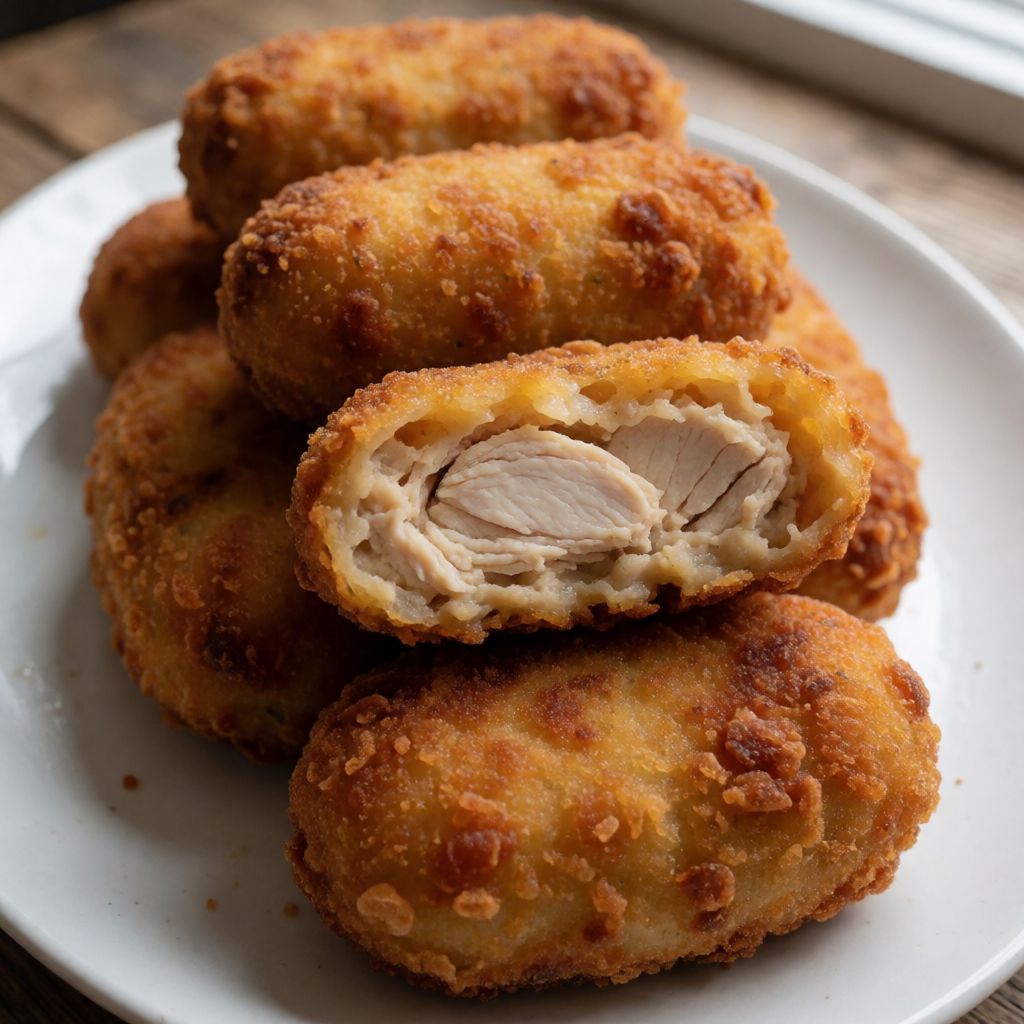
 AI photo
Chicken Croquettes
Crispy breaded chicken nuggets, dipped in a light batter and fried until golden.
Labels are worked out automatically from the ingredients and can be wrong. Check the packaging if it matters to you.
Ingredients
- 500 g Chicken breast
- 1 pcs Eggs
- 80 g Plain flour
- 250 ml Milk
- 0.5 tsp Baking powder for savoury baking
- 1 tsp Olive oil
- 200 g Breadcrumbs dried
- 150 g Cornflakes
- 2 tsp Salt
- Peanut oil for deep-frying









Steps
Rinse the chicken breast, remove any bones and small tendons, and cut into 30 pieces about 2 cm thick, 4 cm wide and 6 cm long.
Blend the breadcrumbs and cornflakes together, add a teaspoon of salt and mix well.
Crack the egg into a bowl, sift in the flour and mix well. Add the milk, olive oil, baking powder and salt, and whisk vigorously for a few minutes.
Dip the chicken pieces into the batter, then coat them on all sides in the crumb mixture. Place on a tray.
Heat the peanut oil in a frying pan over high heat, then reduce to medium and lower in the nuggets.
Fry the nuggets until golden on both sides; the chicken should reach an internal temperature of 74°C.
20 minPlace the cooked nuggets on a paper towel to drain excess oil, and season with a little salt.
Serve hot.
This is chicken breast cut into fingers, run through a thin batter instead of flour-egg-crumb, then rolled in a cornflake-crumb mix and fried. The cornflakes are the whole trick — they fry up harder and craggier than breadcrumbs alone, so you get a shell that stays crisp even after it cools on the plate, which plain breadcrumbs rarely manage once steam from the chicken starts softening them from inside.
What decides whether this works is the thickness of the batter and the size of the pieces. Thirty pieces out of 500 g means each one is small — thin enough that the inside cooks through before the crust burns. Cut them bigger and you're choosing between raw centre and black crust, because breast meat this lean has almost no fat to buy you extra minutes of leeway.
Some say you can skip the batter and just do egg then crumb — no, because the batter (egg, flour, milk, a little baking powder) is thin enough to cling in a film, not a paste, and the baking powder gives it a slight lift so the crust blisters rather than sitting flat and dense. Egg alone is stickier but gives you a tighter, chewier shell with none of that crackle.
Doneness here isn't really a colour you chase — "golden on both sides" is the outside talking, and the outside lies, because crumb browns fast and meat doesn't care. The 74°C is the only honest number in the recipe; everything else is a guide for your eyes while you wait for that number to be true.
Chicken breast is the right cut here precisely because it's bland and low-fat — it needs a jacket to carry flavour and moisture, and that's what the crumb-and-batter system is for. If you only have thigh, use it: it's more forgiving of a few extra minutes in the oil and won't dry out the way breast does if you overshoot 74°C by much. Breast punishes carelessness; thigh forgives it. That's the trade.
The batter wants flour with no extra protein strength to it — plain flour, not bread flour — because you're not building gluten, you're making a coating that clings and sets. The baking powder is a small amount for a reason: too much and the batter puffs into something bready and separates from the meat in the fryer; half a teaspoon is enough to rough up the surface so the crumb has something to grip.
Milk and egg together loosen the batter to a dippable consistency rather than a paste. If you're out of milk, water works, though you lose a little browning — milk's sugars caramelise, water's don't. The olive oil in the batter isn't for flavour at this quantity; it's there to stop the batter drying tight and cracking before frying, acting as a small lubricant inside the mix.
The crumb coat is cornflakes blended with dried breadcrumbs, not cornflakes alone — pure cornflakes shatter too fine and burn before the chicken's done; pure breadcrumbs go soft under steam. Together you get structure from the cornflakes and an even base layer from the crumbs that helps the batter underneath actually stick instead of sliding off in the oil.
Peanut oil is chosen for one reason only: it tolerates high heat without smoking or tasting of itself, which matters because you want the crust to crisp fast before the chicken inside overcooks. Any oil with a high smoke point and no flavour of its own does the same job — sunflower oil, or rapeseed, which is the more common choice in a British kitchen and cheaper to buy in bulk for deep-frying than peanut oil tends to be.
On a domestic hob, "high heat then reduce to medium" is really about recovery, not about hitting a number — a wide pan with a few centimetres of oil loses heat fast once you drop cold nuggets in, so you start hot to compensate for that drop, then back off so the crust doesn't scorch while you wait out the centre. A thermometer in the oil, if you have one, tells you more than "medium" ever will; if you don't, drop in a cube of bread — it should colour steadily, not instantly blacken.
Patience here is the resting on paper towel afterwards. Pull them straight from oil to plate and the crust goes soggy from trapped steam within a minute, because there's nowhere for that steam to go. A minute on paper, uncovered, lets it escape before you salt and serve — small thing, but it's the difference between crisp and merely fried.