
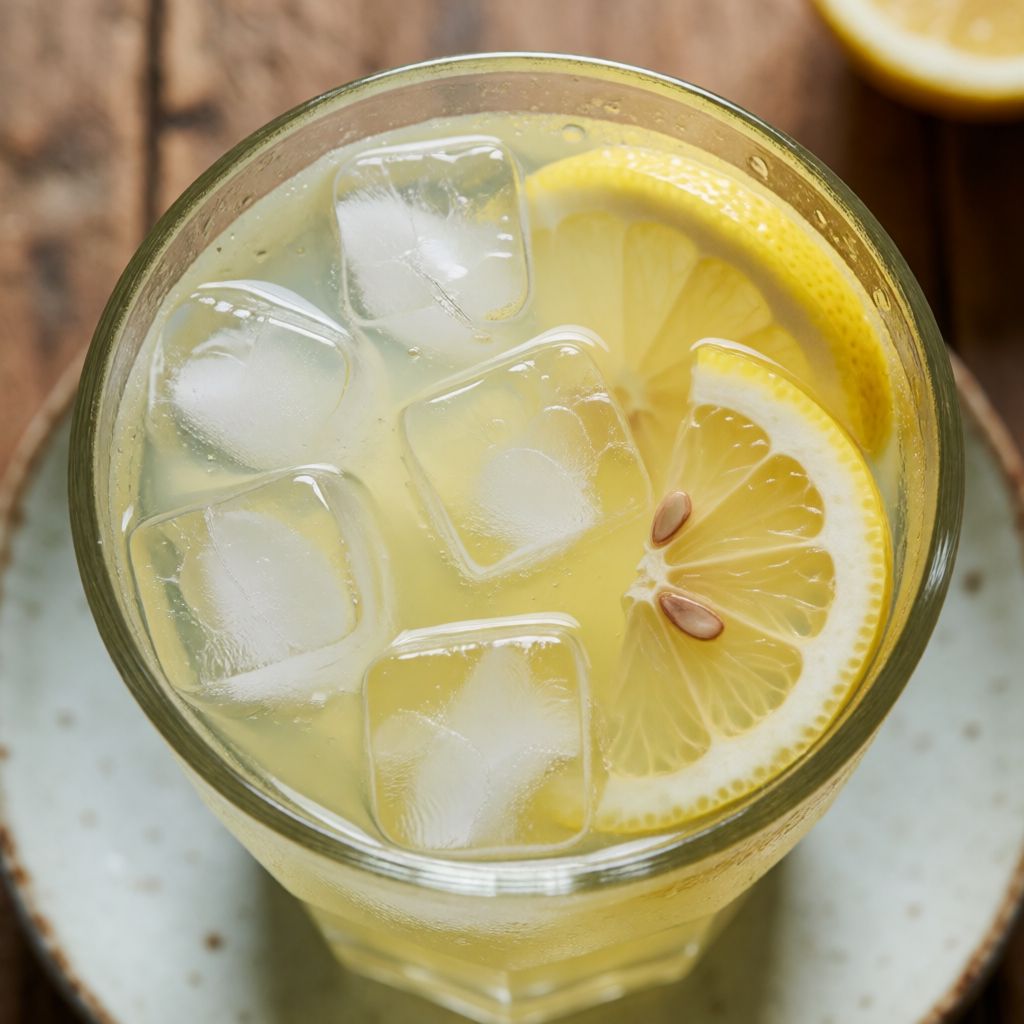
 AI photo
Lemonade
A refreshing homemade lemonade made with fresh lemon juice, sugar and mint.
Labels are worked out automatically from the ingredients and can be wrong. Check the packaging if it matters to you.
Ingredients





Steps
Put the sugar and water in a saucepan.
Bring to a boil and cook until the sugar has completely dissolved.
10 minRemove from heat and add freshly squeezed lemon juice.
Pour into a jug, then add ice and cold water to taste and desired strength.
If you like, garnish with lemon slices and mint leaves.
This isn't lemonade in the squash sense — it's a syrup that you dilute to order. That's the whole trick: you make one small, stable, intensely sweet-sour base, and you decide the strength glass by glass with ice and water. Once you see it that way, every step makes sense.
What decides whether it works is dissolving. Cold water will only hold so much sugar before it sits on the bottom of the jug as grit — that's why the sugar goes into water and onto heat first, not straight into the jug. Heat raises how much sugar the water can carry, and it does it fast. The tell isn't a clock, it's your eye: the liquid stops looking cloudy with suspended crystal and goes properly clear. Ten minutes is roughly how long that takes in a small saucepan — treat it as the floor, not the finish line.
The second thing that decides it is when the lemon goes in. Off the heat, after the syrup comes away from the stove — not boiled with the sugar. Boil citrus juice and you drive off the volatile aromatics that make it smell like lemon rather than just taste sour; what's left is flatter, slightly cooked, a bit bitter at the edges. You want the acid raw and loud against a sweetness that's already been tamed by heat.
On that last point: the card calls this one serving, but five lemons' worth of syrup, properly let down with ice and water, will comfortably fill a jug for three or four. That's not a contradiction, it's how syrup-based drinks are meant to work — you make a concentrate once, then stretch it to the table as needed. It's also why street vendors and cafés have made lemonade this way for as long as there's been sugar and citrus to sell: one batch of syrup, made ahead, served to twenty different thirsts at twenty different strengths, with no extra cooking per glass. Economical, not magical.
Sugar: ordinary white granulated is fine — the job is to dissolve cleanly and add sweetness with no flavour of its own. Caster sugar will dissolve a touch faster because the crystals are finer, but it's not worth going out of your way for. Avoid anything with molasses left in it (demerara, muscovado) unless you actually want that flavour fighting the lemon.
Water for the syrup: whatever comes out of your tap. In parts of the UK that's quite hard water, and very hard water can leave a faint mineral edge — not enough to worry about here, since the sugar and lemon dominate completely.
Lemons, juiced: five for 100g of sugar is a deliberately strong ratio, because this juice is going to be diluted later — weak juice would vanish under the ice and water. Squeeze them yourself rather than relying on bottled juice; bottled juice has usually lost the top note of aroma you're relying on precisely because you added it cold, off the heat.
The garnish lemon, specified organic: that one matters for a different reason than the juicing lemons. You're eating that peel in effect — it floats in the glass, touches lips, sometimes gets bitten into — so wax coating and pesticide residue on the skin aren't something you want to shrug off. If you can't get organic, at least give it a proper scrub in warm water before slicing, which gets rid of most surface wax even if it can't touch what's inside the skin.
Ice and cold water: this is your only control knob, so don't think of it as an afterthought. More ice and less water gives you a drink that stays strong as it slowly dilutes from the ice melting — useful if people are going to nurse their glass. More water up front gives a lighter, more even drink straight away. Mint is just scent sitting on top of the glass; crush a leaf or two lightly between your fingers before you drop it in, so it has to work for its place rather than just floating there looking decorative. And patience, here, is really just one ingredient in disguise: let the syrup go properly clear before you take it off the heat, don't rush the lemon in while it's still hot enough to cook, and the rest of the drink looks after itself.