
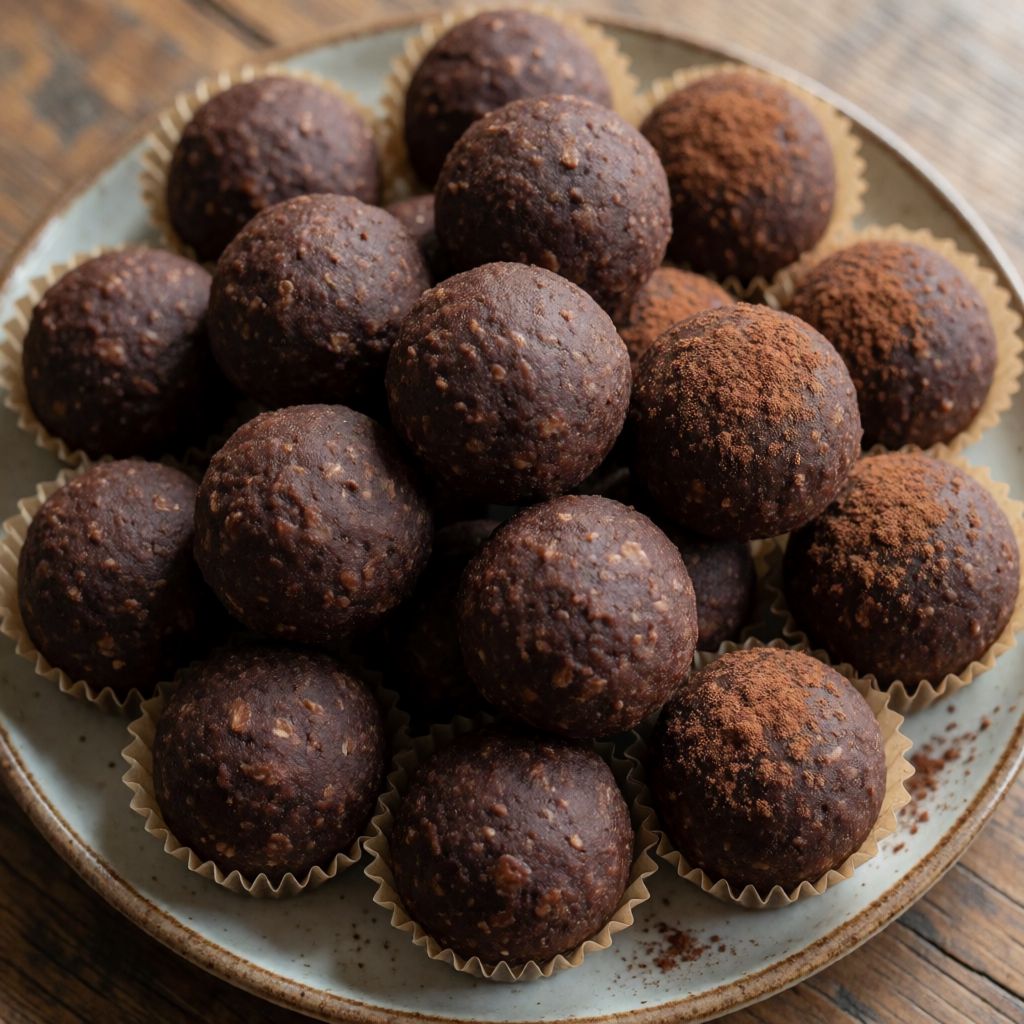
 AI photo
Liquorice Chocolate Oat Balls
Soft no-bake oat and cocoa balls flavoured with liquorice syrup and rolled in liquorice powder.
Labels are worked out automatically from the ingredients and can be wrong. Check the packaging if it matters to you.
Ingredients
- 125 g Porridge Oats
- 75 g Butter softened
- 75 g Sugar
- 20 g Cocoa Powder
- 50 ml Espresso
- 1 tbsp Liquorice Syrup
- 1 tbsp Liquorice Powder for coating



Steps
In a bowl, mix the sugar, cocoa and porridge oats, then stir in the espresso and liquorice syrup.
Add the softened butter and combine thoroughly.
Shape into small balls and roll them in the liquorice powder.
This is a no-bake sweet: the "cook: 0 min" in the recipe isn't a mistake, it's the whole point. Nothing here needs heat to become safe or to set — the oats don't cook, they drink. What holds a ball like this together is not egg, not flour, not an oven doing its slow work on starch. It's butter, soft enough to spread but not so warm it runs, binding sugar and cocoa and oat flake into a paste that firms up again once it's cold.
So the thing that decides whether this works isn't really a step at all — it's the state of two ingredients before you even start mixing: how soft your butter is, and how long you let the oats sit in that bitter-sweet liquid before you try to shape anything. Rush either one and you get a crumbly handful that won't hold together, or a greasy one that slicks your palms and slides apart on the plate. This quantity makes about twenty small balls — a plateful for a tea tray alongside the usual milky cup, not something you bake into a tin.
Liquorice is doing two separate jobs here, not one. The syrup goes into the mass itself, carrying its flavour all the way through. The powder stays on the outside, a dry dusting that hits your tongue a half-second before the chocolate does. Keep that distinction in your head and you'll understand why both forms are in the list and neither can simply stand in for the other.
Start with the oats. Porridge oats means the ordinary rolled kind, flattened and steamed once already at the mill — not quick-cook instant flakes, which have been rolled thinner and will turn to paste before you've finished mixing, leaving you with something closer to wet sand than a ball. And not steel-cut, which stay too toothy and would need far longer than this recipe gives to soften. Rolled oats sit in the middle: enough surface to drink up the espresso and syrup, enough body left to still feel like oats once they have.
Butter has one job here: glue. "Softened" means it gives under a fingertip the way soft clay does — press and it yields, but it doesn't run off your hand. Butter that's been melted has already lost the structure that lets it set hard again in the fridge; mix that in warm and your balls will sweat fat at room temperature instead of holding their shape. If your kitchen is cold, give it an hour out on the counter rather than ten seconds in the microwave — a shortcut there is the single most common reason these fall apart.
Sugar does more than sweeten. Undissolved granules give a slight grit against the smoothness of cocoa and butter, so there's no need to hunt down caster sugar specifically — ordinary granulated does the job, and here that texture is part of the point, not a flaw to iron out.
Cocoa powder needs to be the plain, unsweetened kind. Drinking chocolate already has sugar and milk powder folded in, and it will throw off the balance you're building with the espresso's bitterness. The espresso itself is there as the liquid that lets the cocoa bloom into real flavour instead of sitting on the tongue as dust — any strongly brewed, unsweetened coffee does the same work, so a very strong cafetière brew, or a spoon of instant granules dissolved in a little hot water, stands in perfectly well if you don't have a machine for espresso.
Liquorice syrup is the one ingredient most kitchens in Britain won't have in the cupboard already, oddly enough, given the Pontefract connection — look for it where Scandinavian or Dutch imports sit, or make a rough version by reducing a strong liquorice root tea with a spoon of sugar until it thickens slightly. For the coating, you want something aromatic and dry rather than wet — pure liquorice root powder is the traditional choice, but if you can't find it, a dusting of cocoa on the outside will at least stop the ball sticking to your hand, even though you'll lose that particular bittersweet hit on the first bite.
And then: give it time. Once shaped, the balls want the fridge — not because anything in them is unsafe left out, but because that's the moment the softened butter remembers it's solid and locks the whole thing together. Roll them too soon, before the oats have properly drunk their liquid, and you're just pressing dry crumbs into a shape that falls apart at the first bite. Patience isn't a virtue here — it's a step, and skipping it shows on the plate.