
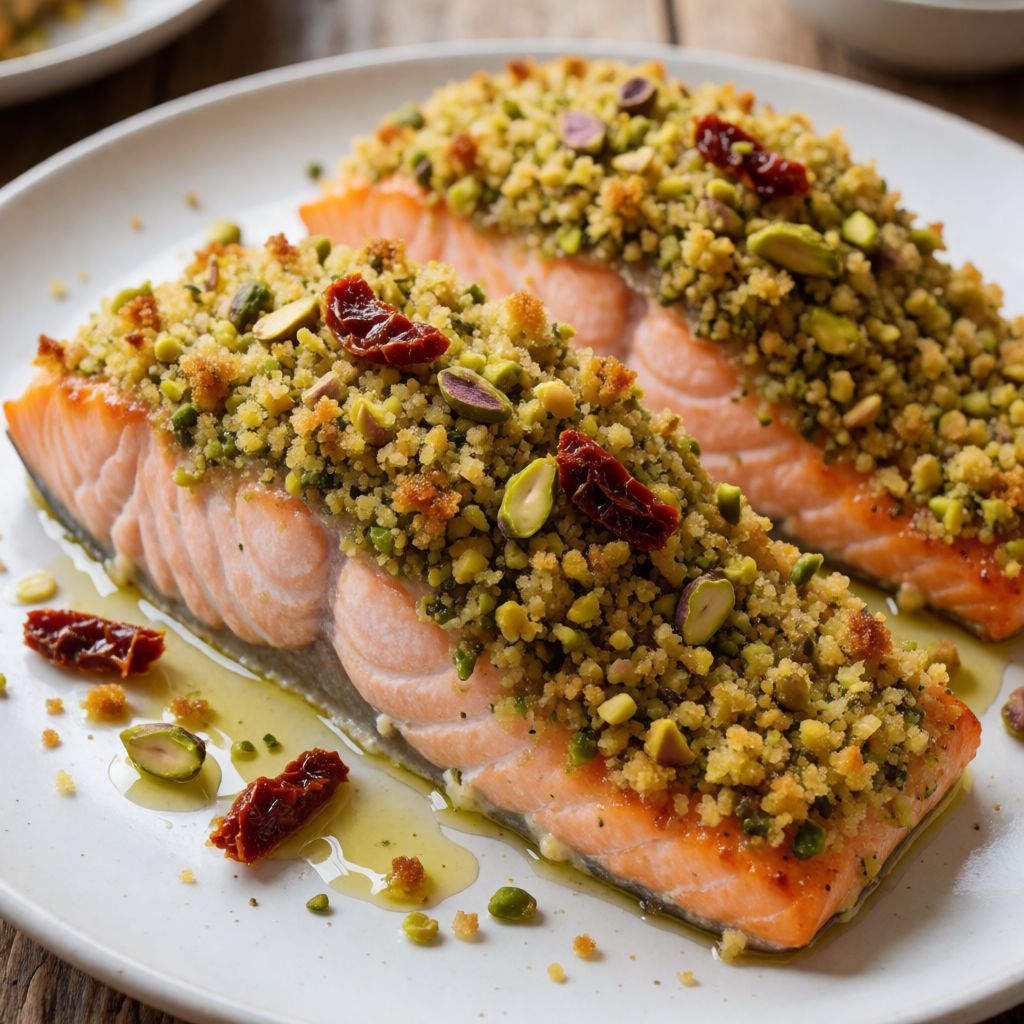
 AI photo
Salmon in Pistachio Crust
Salmon fillets coated in a pistachio and breadcrumb crust, baked until golden.
Labels are worked out automatically from the ingredients and can be wrong. Check the packaging if it matters to you.
Ingredients
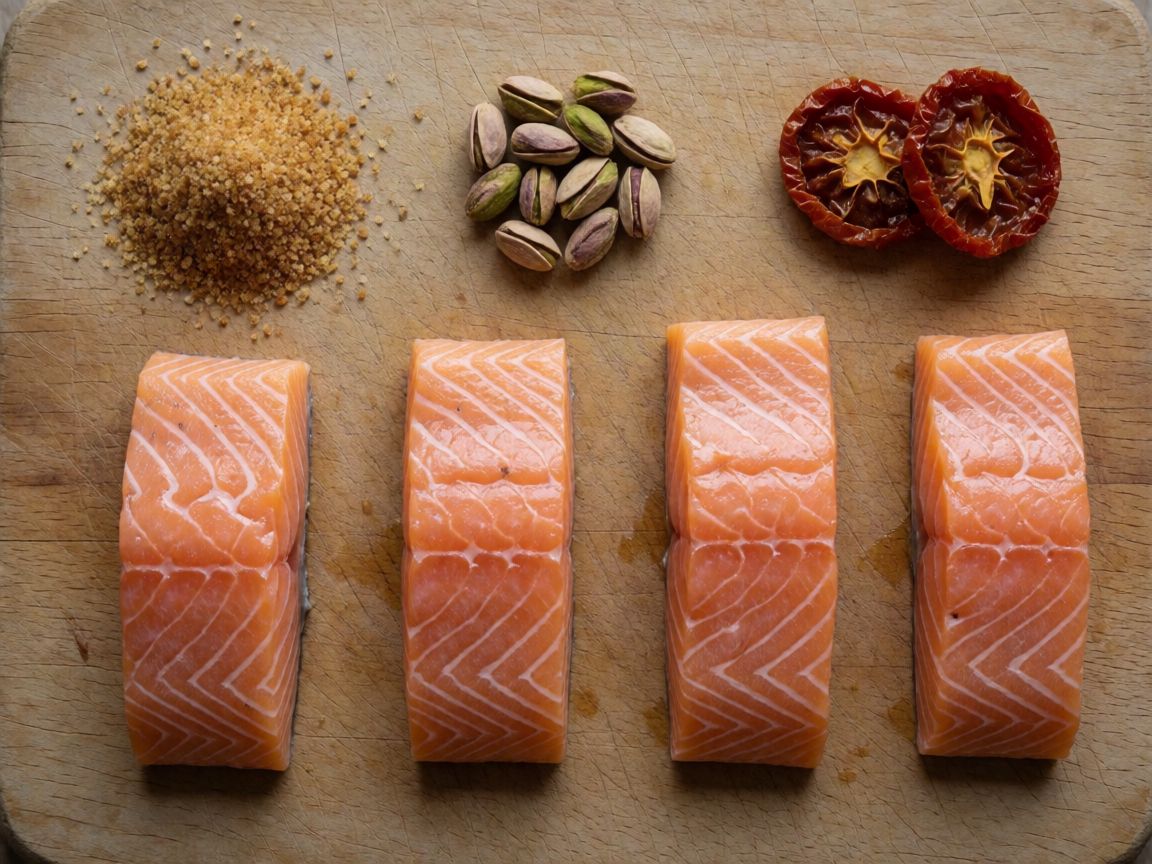
- 4 pcs Salmon
- 2.5 tbsp Olive oil
- 40 g Dried breadcrumbs
- 100 g Pistachios
- 2 pcs Sun-dried tomatoes
- Salt to taste
- Black pepper to taste







Steps
Prepare the salmon: remove the skin and any bones, rinse the fillets under running water and pat dry with paper towel.
Peel the pistachios: blanch them in boiling water for a few minutes, drain in a colander and rub off the skins.
Dry the pistachios in the oven for a few minutes, or leave them to air-dry for 30 minutes.
30 minBlend the pistachios into coarse crumbs, mix with the breadcrumbs and season with salt and black pepper.
Lay the salmon fillets on a plate, brush with olive oil, coat on all sides in the pistachio mixture and transfer to a baking tray.
Rinse the sun-dried tomatoes to remove excess salt, chop finely and scatter evenly over the fish, then drizzle with olive oil.
Bake at 180°C for about 20 minutes, until lightly golden on top. Doneness: 63°C at the thickest part.
20 minRemove the salmon, place on a serving plate and serve hot.
This is a salmon fillet in a jacket — ground pistachio and dried breadcrumb bonded on with oil, baked once in a hot oven. Nothing is fried first, nothing is sauced after. What decides whether it works is a timing conflict: the crust needs enough heat to crisp, and the fish underneath needs almost none, because salmon goes from silk to sawdust in about the time it takes you to answer the phone.
Some say bake fish until it flakes easily and turns pale all the way through. No — by then it's already dry, the proteins have squeezed out their moisture and there's no getting it back. The real marker is temperature at the thickest point, somewhere around 60–63°C, with the centre still faintly translucent. The trouble is you can't peek — the crust hides it — so you're not cooking by eye here, you're cooking by probe. A thermometer costs less than the salmon.
The crust itself is not decoration, it's a shield. It sits between a fierce dry oven and a fish that wants gentle, even heat, and it buys you a margin where the outside can brown while the inside barely gets there. That's the whole trick of the dish — one temperature, two different jobs happening on either side of a few millimetres of crumb.
Salmon: buy it skinned and boned, or do that yourself with a sharp thin knife run flat along the skin — the point is fillets of roughly even thickness, four of them, so they all cross 63°C at the same moment instead of one piece finishing while another's still raw in the middle. Salmon's own fat is what makes this crust-and-bake method sensible for it in the first place: under the crumb jacket it self-bastes. Try the same trick on a lean white fish like cod and you'll need less time and a sharper eye, because there's no fat reserve to cover a mistake.
Pistachios: raw, unsalted, shelled. Blanching lifts the thin skin, which is both bitter and tough — leave it on and you taste it as grit and astringency under the crumb. Don't reach for roasted salted ones to save a step; they've already been through heat once, they'll scorch before the fish is near done, and the salt stacks awkwardly on top of the tomatoes and the seasoning later. If pistachios aren't to be had, almonds or hazelnuts will bind and crunch the same way — you lose the pistachio's green and its faint sweetness, but the mechanism holds.
Breadcrumbs: dried, not fresh. Fresh crumb carries moisture and steams under heat instead of toasting; dried crumb is already most of the way to crisp before it goes in the oven. Its job here is to lighten the pistachio, which on its own is too dense and too oily to form a crust that shatters rather than just sits there. Stale bread ground fine, or panko, does the same job.
Olive oil, used twice, doing two different things: brushed onto the fish it's glue — fat and the fish's own surface moisture are what make the crumb stick, not pressing harder. Drizzled over the finished crust it's a heat-carrier, letting the top brown instead of just drying out under dry oven air. Any oil with no strong character of its own will do the gluing — sunflower, a neutral vegetable oil — but it won't add anything, and here the olive oil belongs with the pistachio and tomato as one Mediterranean-leaning set of flavours, so I'd keep it unless you've none in the cupboard.
Sun-dried tomatoes: rinse them, because they're salted twice over by the time they reach you — once in the drying itself, a preservation trick from before anyone had a fridge, salt pulling water out so the tomato dries faster and keeps longer, and often again in the oil or brine they're sold in. Rinsing hands the salt decision back to you instead of leaving it to whoever packed the jar.
Salt and pepper, genuinely to taste — but taste the crust mixture itself before it goes anywhere near the fish, not after it's baked on. Breadcrumbs, pistachio, and tomato are each already carrying some salt; adding blind at the end is how crusts end up oversalted while the fish underneath stays bland. On an ordinary UK oven, don't trust the number on the dial — home ovens routinely run ten or fifteen degrees off what they claim, and a middle shelf position evens out hot spots better than guessing. A sheet of baking parchment instead of greasing the tray saves you scrubbing off tomato sugars that have caught and gone dark. One fillet per person is the portion as given — four fish, four people, nothing more exotic needed alongside than new potatoes, in the same unfussy spirit as a Sunday roast.