
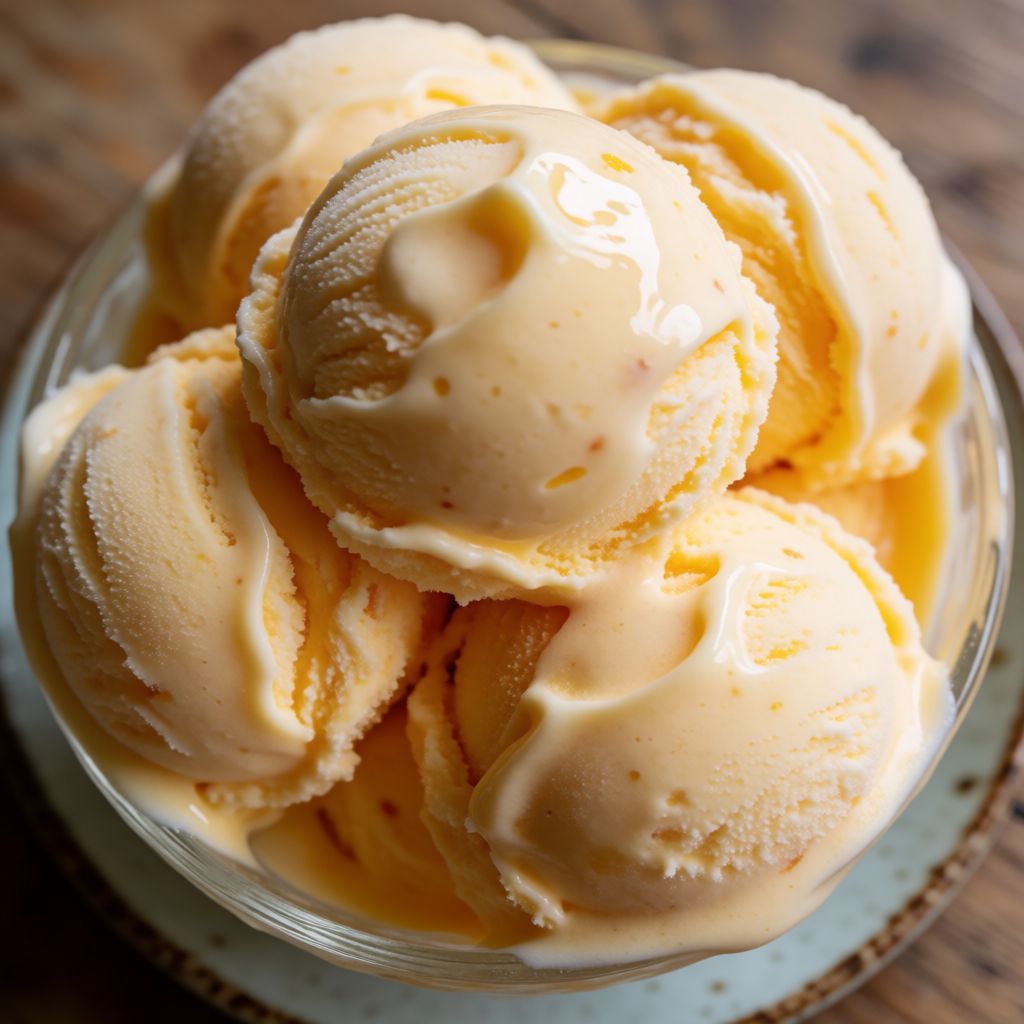
 AI photo
Mango Ice Cream
A creamy no-churn mango ice cream, thickened with milk and butter, folded with whipped cream and frozen until firm.
Labels are worked out automatically from the ingredients and can be wrong. Check the packaging if it matters to you.
Ingredients
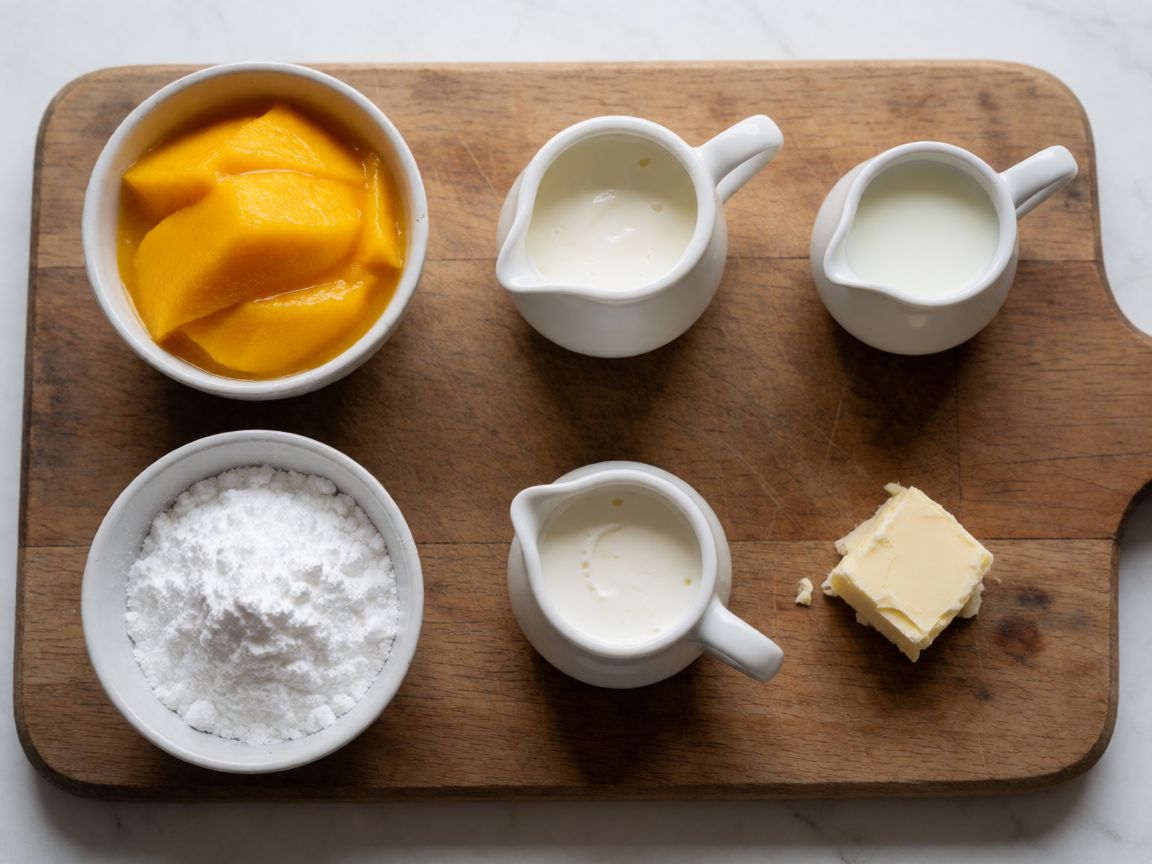
- 300 g Mango Flesh
- 210 g Icing Sugar
- 250 ml Whipping Cream
- 200 ml Milk
- 30 g Butter





Steps
Pour the milk into a small saucepan, add a portion of the icing sugar and set over low heat, stirring constantly.
When the milk is about to come to the boil, add the butter and keep whisking, cooking for about 20 minutes until it turns a creamy colour.
20 minPour the mixture into a bowl and let it cool completely.
Peel the mango, cut it into pieces and blend until smooth.
Combine the mango purée with the cooled, thickened milk mixture and stir together.
Whip the whipping cream with the remaining icing sugar until it forms a thick foam.
Gently fold the whipped cream into the mango mixture, stirring carefully from bottom to top with a spatula.
Transfer the ice cream into a freezer container, cover and freeze for 6–8 hours.
This is not really a fruit ice cream with mango bolted on — it's two separate little engineering jobs stitched together. One job is a sweet, thickened milk base, built without a single egg. The other is whipped cream, carrying air. Mango turns up late, as flavour and colour, after both jobs are already done. Get that order wrong and you get mango-flavoured ice, not ice cream.
The milk base is the part people underestimate. Milk, icing sugar and butter, simmered low and stirred the whole time, aren't making a custard — there's no egg to set anything. What's happening is slower: water is driven off, sugar and milk proteins concentrate, and the butter's fat gets worked all through it. The 'creamy colour' you're told to watch for isn't decoration, it's your only proof the water has actually gone and the mixture has body — thick enough to coat a spoon rather than run off it. Low heat isn't caution for its own sake: milk with sugar in it catches on the bottom of a pan within seconds on anything hotter, and once it's caught, you taste it in every spoonful.
Milk is doing structural work here, not just flavour — it's the thing that gets reduced and thickened into the base. Whole milk, nothing skimmed, because the little extra fat in it helps the thickening and keeps the final texture from turning grainy with ice crystals once frozen. If all you've got is semi-skimmed, it'll still work, just with a slightly thinner base — compensate by trusting the colour cue more than the clock.
Icing sugar appears twice, and that's not laziness in the ingredient list — it's deliberate. Icing sugar dissolves without a trace of grit, in hot milk or in cold whipped cream alike, and dissolved sugar also lowers the freezing point a touch, which is part of why this ice cream scoops rather than snaps. Granulated sugar in the milk pan would dissolve fine with the heat, but whipped raw into cream it stays sandy under your tongue. If icing sugar isn't in the cupboard, blitz ordinary sugar fine in a processor before you use it in the cream stage — in the milk, plain sugar is forgivable since heat does the dissolving for you.
Butter's job is fat, full stop — it's there to round out the milk base and help it coat rather than freeze into sharp crystals. Any unsalted butter does this; salted will just mean you taste salt faintly through the mango, which nobody's after in a dessert. There's no substitute that does quite the same thing without bringing its own flavour along, so don't reach for margarine here — you'll taste the difference and not fondly.
Whipping cream, not double cream and not single — it needs enough fat to hold a whip and enough looseness to actually take air in without seizing into something closer to butter. Whip it to a thick foam that holds its shape loosely on the whisk, not stiff peaks you could stand a spoon in — overwhipped cream has already lost its stretch and folds in badly, trapping less air, not more.
Mango flesh should be ripe enough to give gently under a thumb and smell like mango even through the skin — unripe fruit here just means more sugar fighting less flavour, and you end up correcting with the icing sugar rather than tasting fruit. If mango's out of season or disappointing at the shop, a ripe peach or a very ripe banana purée will take the same role — the mechanism doesn't care which fruit carries the flavour, only that the fruit is soft, sweet on its own, and blended smooth with nothing left in fibres.
The freezing time is a floor, not a target — six to eight hours assumes a proper freezer running at freezer temperature, not the top shelf of an old fridge-freezer that struggles in summer. Test it by pressing a spoon into the centre: it should resist a little before giving, not fight you and not slump. And don't rush the cooling of the milk base before you meet it with the mango — pour it in warm and you'll partly cook the raw fruit's flavour flat, and later when the whipped cream goes in, warmth is exactly what collapses the air you worked to get into it. Patience there isn't an aside, it's the ingredient doing the quiet work the recipe never mentions by name.