
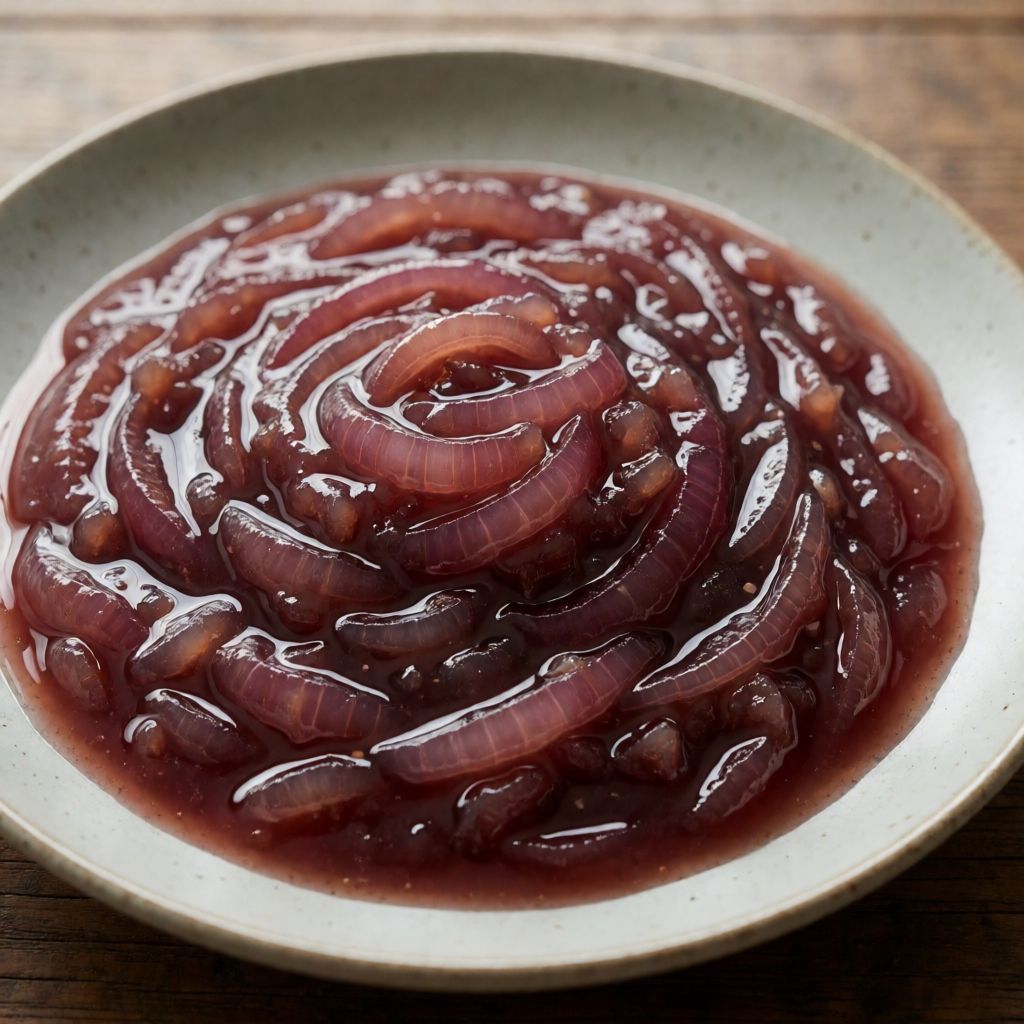
 AI photo
Red Onion Marmalade
A sweet and tangy red onion marmalade, slow-cooked with brown sugar and balsamic vinegar.
Labels are worked out automatically from the ingredients and can be wrong. Check the packaging if it matters to you.
Ingredients
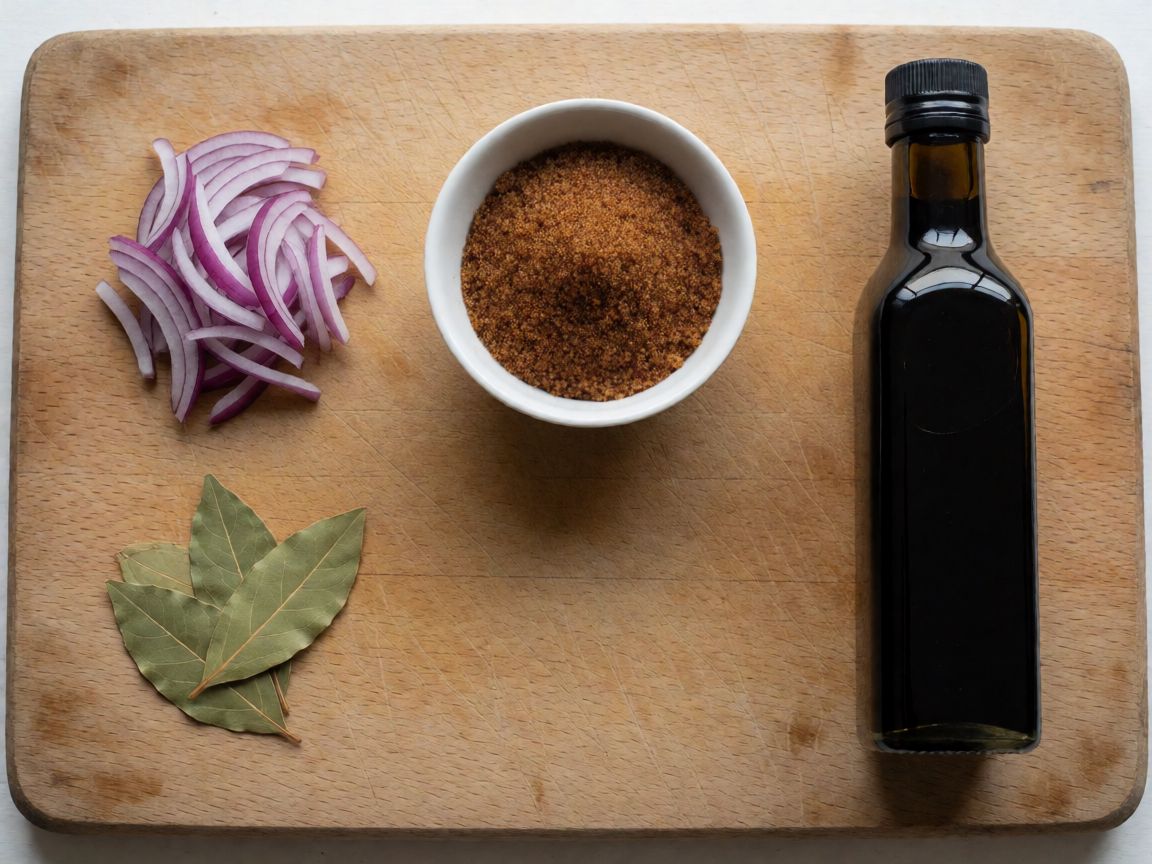
- 1 kg Red onion
- 400 g Brown sugar
- 100 ml Balsamic vinegar
- 3 pcs Bay leaves
- Salt to taste



Steps
Peel the onions thoroughly and slice them thinly.
Place the onions in a large bowl, add the brown sugar, balsamic vinegar and bay leaves. Mix and cover with cling film.
Leave the onions to marinate for at least 3 hours, stirring occasionally.
180 minRemove the bay leaves and transfer the onion mixture to a large saucepan. Add the salt.
Cook over a gentle heat for at least 45 minutes, stirring frequently.
45 minSterilise airtight jars.
Pour the hot marmalade into the jars and seal immediately while still hot.
Let the jars cool at room temperature.
This isn't jam in the citrus sense — there's no pectin doing the work, no setting point from a fruit's own gelling sugars. What you're making is a reduction: a kilo of sliced red onion losing its water to sugar and vinegar until what's left behind is dark, sticky, and holds a spoon shape for a second before it slumps. Good on a cheese board, better than you'd expect spooned next to cold Sunday-roast beef the next day, or stirred into a sandwich that needs waking up.
Two things decide whether this works, and neither of them is a clock. First, the three-hour sit before any heat touches the pan. The sugar and vinegar don't flavour the onion so much as pull water out of it — osmosis, plain and simple, the same mechanism that makes a salted cabbage weep in an hour. That water loss does two jobs: it softens the onion's cell walls before cooking even starts, and it dissolves the sugar into a syrup that coats every slice evenly, instead of the sugar sitting dry at the bottom of the bowl doing nothing. Skip the sit, or cut it short, and you're asking the pan to do all the softening and dissolving at once — which is exactly when the bottom layer scorches before the middle's given up its moisture.
On choosing the onion: red, specifically, and not for drama — the anthocyanin pigment that makes it purple when raw is what turns the whole pot that deep burgundy-near-black colour once acid and heat get to work on it. Use yellow onion and you'll still get a perfectly good spread, just amber rather than wine-coloured, and a shade sweeter without the slight mineral edge red onion carries. Pick onions that are firm with dry, unbroken skin — a soft spot means rot's already started inside, and rot doesn't cook away, it just spreads flavour you don't want.
Brown sugar isn't just 'sugar, but brown' — the molasses still in it gives a toffee note that white sugar can't, and it also holds a touch more moisture, which matters when you're trying to build a syrup rather than a dry caramel. White sugar works if that's what's in the cupboard; you'll lose some depth, that's all, not the dish.
Balsamic vinegar earns its place for two reasons: acidity to stop a kilo of sugar tasting like a kilo of sugar, and a lower pH that helps the finished jar keep longer once sealed — sugar and acid together are an old, cheap way of holding a glut of something past its season, long before anyone had a fridge, which is really the whole economic reason preserves like this exist at all. If you haven't got balsamic, reach for something with body of its own — sherry vinegar, a decent red wine vinegar — rather than a thin, purely sharp vinegar with nothing behind it; you want backbone here, not just acid.
Bay leaf goes in to marinate, not to cook — it gives what it has to give over those three hours in the cold bowl, and pulling it out before the pot touches the heat avoids it turning bitter and woody under prolonged simmering. Salt, in a small amount, isn't there to season in the way it seasons a stew — it's there to stop the sweetness tipping into one flat note, the way a pinch of salt sharpens a pudding.
On the kitchen itself: use the widest pan you own, not your deepest saucepan. Width is surface area, and surface area is what drives the water off on an ordinary hob that can't deliver the blast of a restaurant burner. A deep narrow pot just means a longer wait for the same result, and more risk that the bottom overcooks before the top's caught up. For the jars, the mechanism worth knowing is this: hot filling plus immediate sealing creates a vacuum as the jar cools — that vacuum, not the lid itself, is what's doing the preserving. Sterilise properly or that vacuum never forms cleanly, and you've made a lovely spread that won't keep.
And build in the patience before you start, not as a virtue but as an ingredient you have to budget for — three hours sitting, then the better part of an hour at the pot, stirring more than you'd like. There's no shortcut through either stage that doesn't show up later as scorched onion or a jar that spoils before its time.