
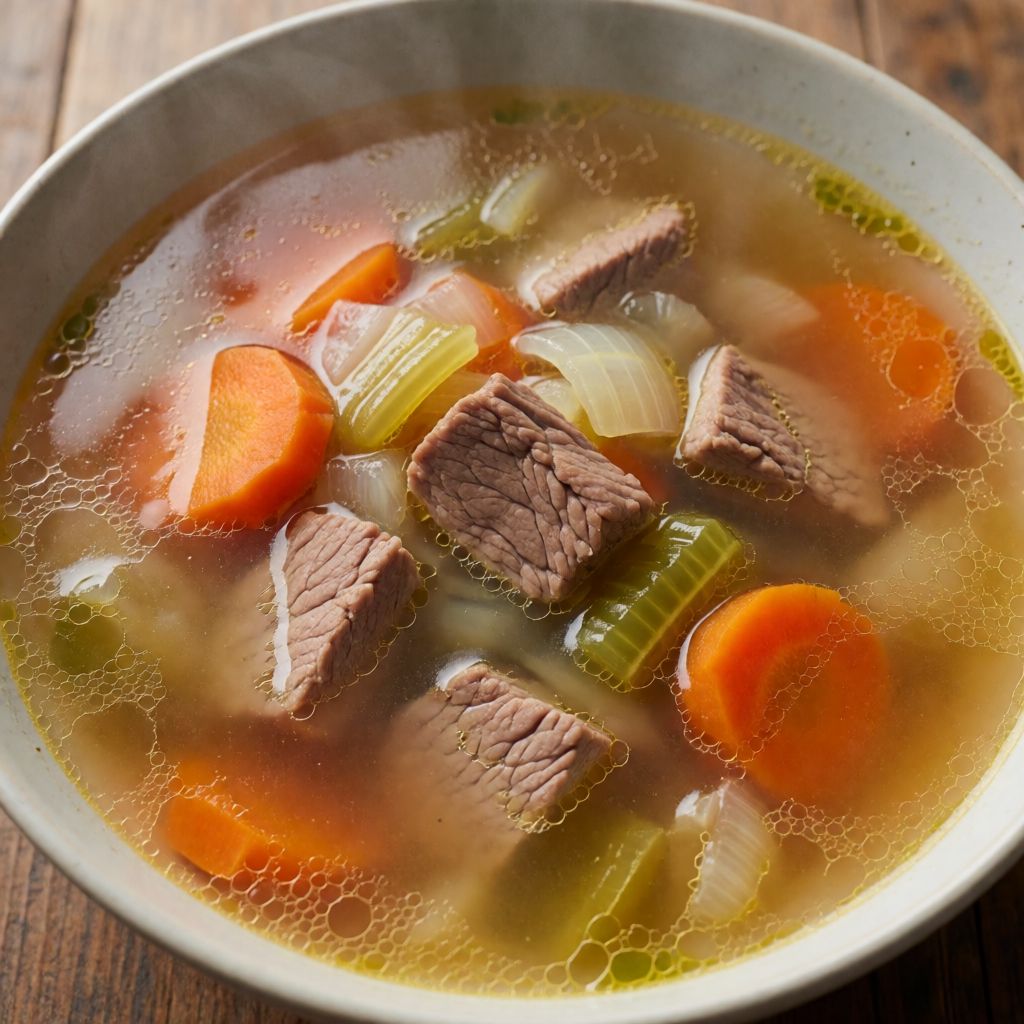
 AI photo
Beef Broth
A comforting homemade beef broth, gently simmered with vegetables.
Ingredients
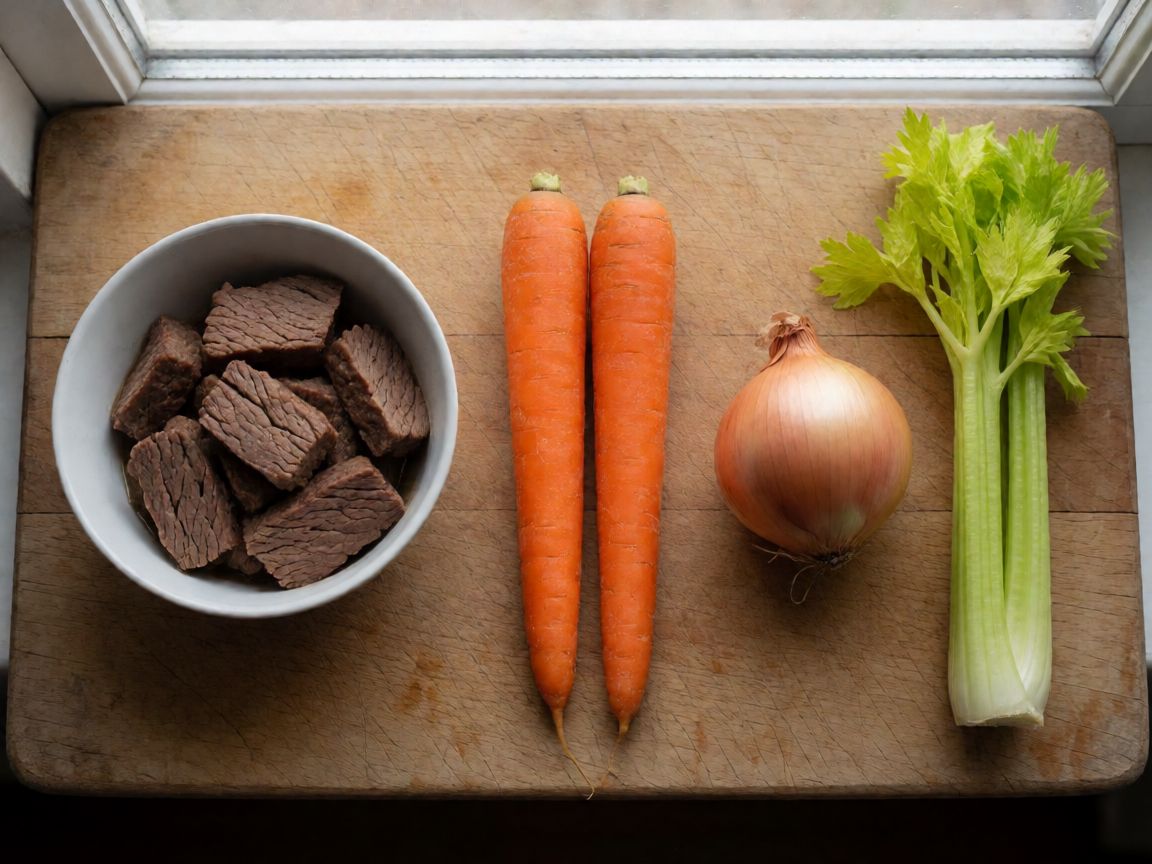






Steps
Thoroughly wash and clean the vegetables.
Put the vegetables into a pot and add the beef.
Cover everything with water and bring to the boil.
Simmer for at least 2 hours, seasoning with salt to taste.
120 minTaste the broth and add more salt if needed.
Strain the broth, separating out the vegetables, and use as needed.
This isn't "boil beef and vegetables." This is turning water into something with a spine — body, a bit of shine, a flavour that sits in the back of your throat long after the spoon's gone down. What decides whether it works isn't the ingredient list, it's what you do to the heat for two hours straight.
Some say: bring it to a hard boil first, to "seal" the meat and cook it through quicker. No — because a hard boil is exactly what wrecks a broth. The violent bubbling smashes the proteins coming off the meat into clumps before they've had time to settle, and those clumps trap fat and scum and drag them right through the liquid instead of letting you skim them off the top. Once a broth goes cloudy this way, it stays cloudy. There is no fixing it later, only straining it harder and pretending.
After the first boil, the whole two hours should look almost lazy. The surface should barely tremble — a bubble breaking here and there at the edge of the pot, nothing rolling in the middle. That gentle heat lets the fat render out cleanly instead of being churned into the water, and it gives the connective tissue in the beef time to melt into gelatin rather than just toughen and seize. This is also why "120 minutes" in the recipe is a floor, not a target: the carrot should bend when you press it, not snap, and the broth itself should look like it's lit from inside — gold, not grey. If it isn't there yet, it isn't done yet, whatever the clock says.
The beef matters more for what's inside it than for taste. You want a cut with bone and connective tissue — shin, brisket, short rib, oxtail, the kind of thing that's cheap precisely because it's tough. That toughness is collagen, and collagen is what becomes gelatin under slow heat, which is what gives the broth body instead of leaving you with flavoured water. If Sunday's roast left you with bones and trim, that's the right material, not a waste product — using it in broth is exactly how this dish earned its place in frugal kitchens everywhere, not through any mystique. A good steak would actually make a thinner, less interesting broth; save it for the pan, not the pot.
Carrot, onion, celery are not there to be eaten later — they're there to give the water something to carry besides meat. Onion brings sweetness that mellows as it cooks; celery brings a green, slightly bitter top note that stops the whole thing tasting flat and one-dimensional; carrot does double duty — sweetness, and a built-in doneness test, since it softens on roughly the same timeline as the meat releasing its gelatin. Scrub them well rather than peel everything away — the skins and ends hold flavour too, and this is a dish built on using what you have, not on trimming for looks.
Salt goes in late, and that's not fussiness — add it early and in quantity before you know how much the liquid will reduce, and you'll either under- or oversalt it, with no way to fix the second one short of diluting out the flavour you just spent two hours building. Taste near the end, when the broth has mostly given up what it has to give, and salt to that.
Water: two litres to six hundred grams of beef means you start generous, because two hours of gentle simmering will still cook some of it off as steam, slowly, even at that low a bubble. Keep it topped up only if it drops below the meat — don't keep adding water throughout, or you'll dilute everything you've extracted so far.
If you've no beef, the same mechanism runs on chicken — bony, skin-on pieces, same gentle heat — just for less time, because chicken's connective tissue gives up its gelatin faster. The method doesn't change; only the clock's lower bound does.
For straining, you don't need muslin and a stand. A fine sieve over a bowl, maybe a paper napkin laid in the sieve if you want it properly clear, does the job in a flat with no special kit. Press the vegetables a little as you strain if you want every drop, but don't force them through — that's what pushes grit and cloudiness back into a broth you've just spent two hours clarifying.