
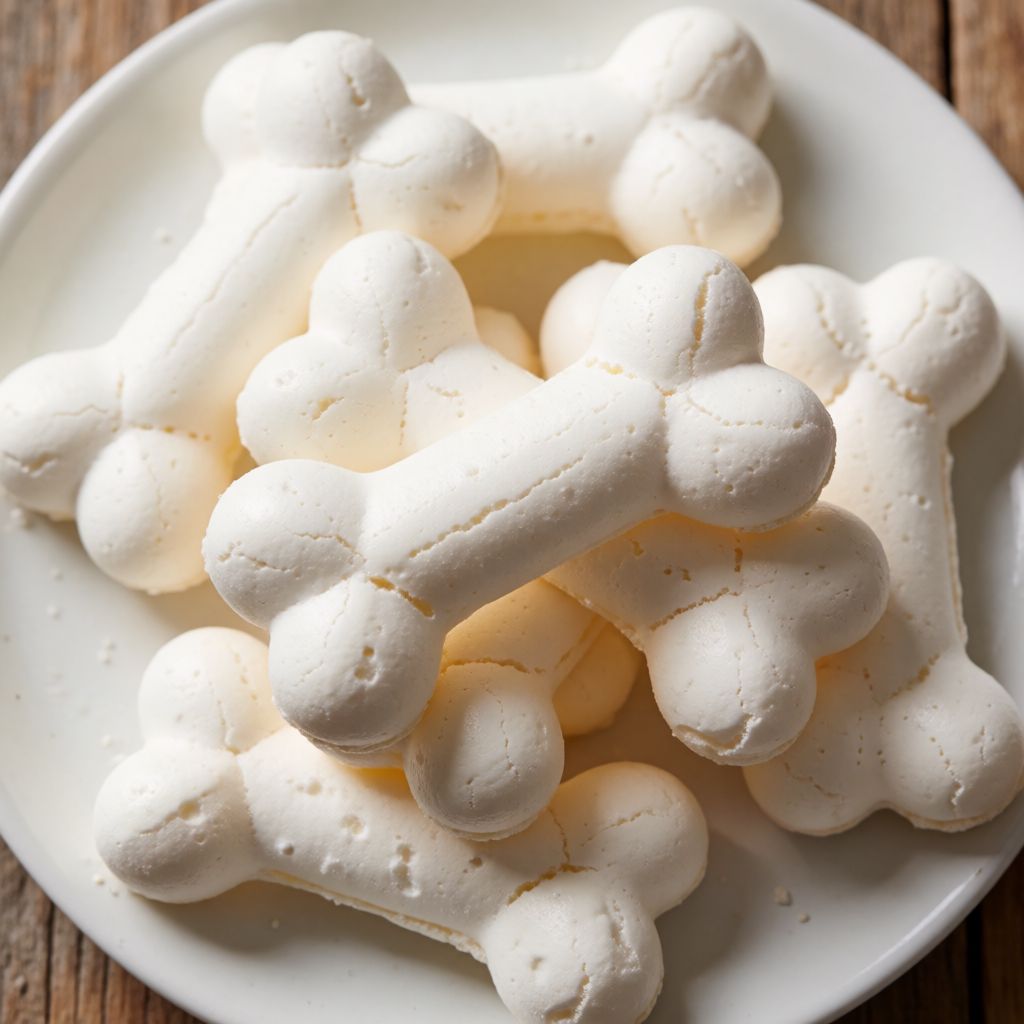
 AI photo
Halloween Bone-Shaped Meringues
Crisp, crunchy meringue bones made for a spooky Halloween treat.
Labels are worked out automatically from the ingredients and can be wrong. Check the packaging if it matters to you.
Ingredients
- 3 pcs Egg whites
- 1 pinch Salt
- 1 tsp Vanilla extract
- 200 g Icing sugar




Steps
Pour the egg whites into a bowl with a pinch of salt and whisk into a thick, stiff foam.
Gradually add the vanilla extract and icing sugar, continuing to whisk until glossy and stiff.
Line a baking tray with parchment paper and spoon the mixture into a piping bag.
Bake at 90°C for 120 minutes.
120 minLeave the meringues to cool inside the switched-off oven.
What was changed
Swapped in Vanilla extract, as it is not commonly sold in UK shops.
This isn't a cake, it's dried sugar held up by egg-white scaffolding. You whip air into albumen until the protein unfolds and links arm to arm, trapping thousands of tiny bubbles. Then you feed those bubbles sugar, which dissolves into syrup and sets around them once the water's gone. Bake is the wrong word for what the oven does here — at 90°C nothing browns, nothing cooks in the usual sense. You're pulling moisture out, slowly, so the structure dries solid instead of collapsing. That's the whole mechanism, and everything that can go wrong with meringue goes wrong at one of those three points: the whip, the sugar, the dry.
What decides success is cleanliness and patience, in that order. One speck of yolk fat on your whisk or bowl and the whites will not foam properly — fat coats the protein strands before they can bond to each other, so you get sad little bubbles instead of a thick, standing peak. No special bowl material fixes a greasy one; what matters is that it's actually clean. Patience is the second half: whisking takes longer than you think it should, sugar needs to go in gradually so it has time to dissolve rather than sit as grit, and the oven needs its full stretch with the door shut, because 120 minutes at low heat is a lower bound, not a clock you can beat.
Egg whites are the one ingredient with no real substitute here, because nothing else unfolds and re-links into a stable foam the way albumen does. Three whites from medium eggs give you roughly 100g of protein-and-water, which is the right amount to hold 200g of sugar in suspension — that near 1:2 ratio by weight is why these meringues end up sweet and firm rather than soft and marshmallowy. If you're out of fresh eggs, carton whites work, aquafaba (the liquid from a tin of chickpeas) will foam too, though it behaves more delicately and needs a longer, gentler whisk — fine for a trial batch, not something to bet Halloween on.
Salt does two small jobs: it nudges the proteins to loosen and link slightly faster, cutting a little time off the whisking, and it rounds off the sweetness so the finished bone doesn't taste like straight sugar. You could leave it out and still get meringue — just slower and flatter in flavour.
Vanilla extract goes in after the whites are already thick, not before, because any liquid added too early just dilutes the foam you've built. Use real extract if you can — it's alcohol carrying flavour compounds pulled from the pod, so it mixes in cleanly. Essence is a cheaper synthetic copy and will taste thinner and more one-note; it still works, it's just not the same voice.
Icing sugar is chosen over caster or granulated for one plain reason: it's already ground fine, almost powder, so it dissolves into the foam fast. Coarser sugar takes longer to melt into syrup, and any crystals left undissolved when the meringue goes in the oven will sit there as grit, and later pull moisture back in from the air, making sticky, weeping spots. Any sugar fine enough to vanish on your tongue without a grainy feel will do the same job — icing sugar is just the easiest way to guarantee that.
The oven stage is where a flat kitchen tells on you. Ninety degrees for two hours is not cooking, it's a slow evaporation, and most domestic ovens — especially fan ovens common in UK kitchens — don't sit still at a low setting; they drift, overshoot, cycle. An oven thermometer on the shelf is worth more than trust in the dial. Humidity matters too — a damp British evening with the kettle going for tea slows the drying further, so if your kitchen feels muggy, give it extra time rather than more heat. You'll know they're actually done not by the clock but by handling one: it should lift cleanly off the parchment, feel light rather than tacky, and sound faintly hollow when tapped, like a dry shell rather than a dense sweet.
Leaving them in the switched-off oven afterwards isn't superstition, it's thermal courtesy — cold kitchen air hitting a hot, brittle, mostly-water-free shell makes it crack and can let it reabsorb a little moisture from condensation. Letting the oven cool with the door shut lets the meringue follow the temperature down slowly, so it stays whole. As for feeding four — that's a loose figure for a Halloween plateful of small piped bones; pipe them larger and fewer, smaller and you'll get a tray full for trick-or-treaters, same mixture either way.