
 AI photo
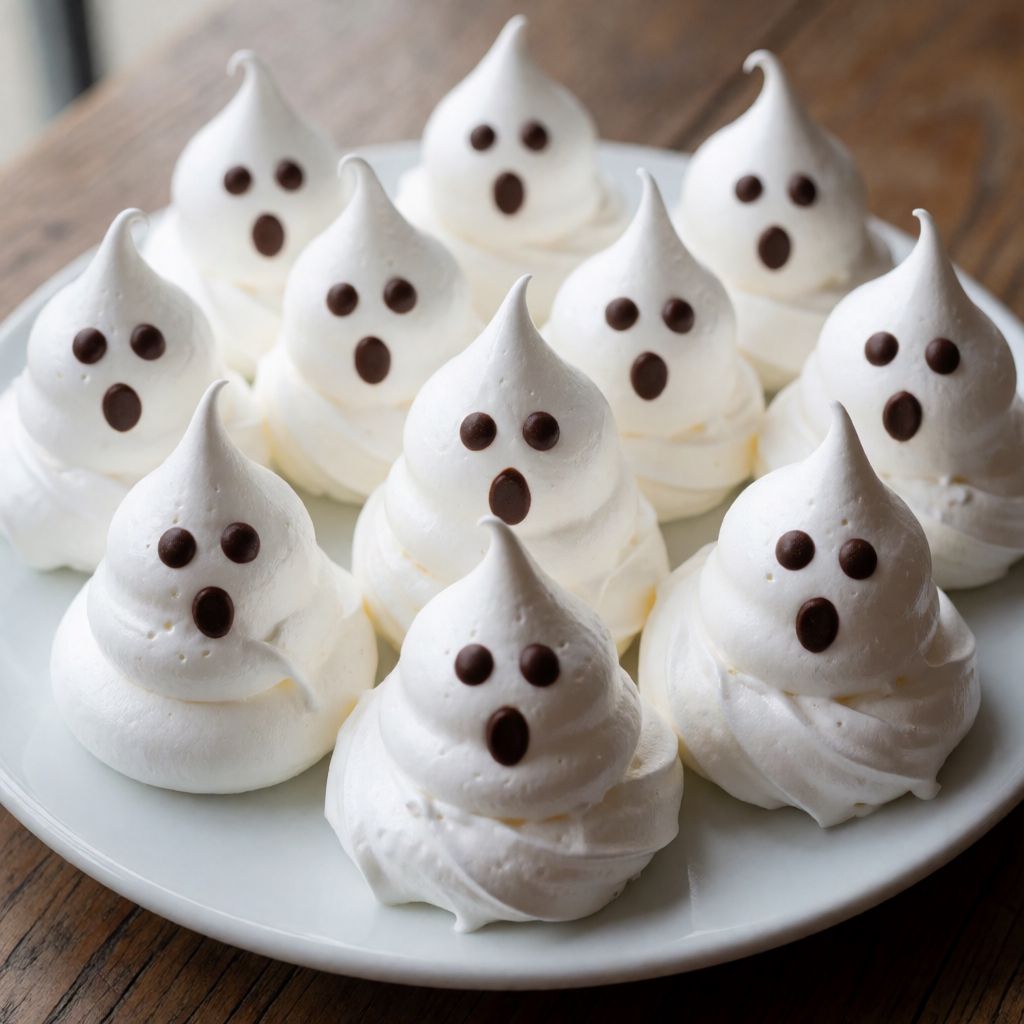
Meringue Ghosts
Light, crisp meringue ghosts piped with a chocolate pen and baked low and slow for a spooky treat.
Labels are worked out automatically from the ingredients and can be wrong. Check the packaging if it matters to you.
Ingredients
- 4 pcs egg whites
- 240 g icing sugar twice the weight of the egg whites
- 40 g dark chocolate



Steps
Carefully separate the egg whites from the yolks and weigh them; you will need twice that weight in icing sugar.
Take a large glass or metal bowl and start whisking the egg whites with a mixer on low speed.
Once a light foam forms, increase the mixer speed.
Gradually add the icing sugar and continue whisking until you get a thick, glossy mixture.
Transfer the mixture to a piping bag fitted with a large round nozzle.
Pipe tall ghost-shaped mounds onto a baking tray lined with parchment paper.
Preheat the oven to 80°C and bake the meringues using the fan setting.
180 minReduce the temperature to 75°C and continue baking, occasionally opening the oven door.
60 minRemove the finished ghost meringues from the oven and let them cool.
Melt the dark chocolate in a bain-marie.
Pour the melted chocolate into a piping bag with a fine nozzle and draw on eyes and a mouth.
Let the chocolate set.
Meringue ghosts are just meringue, shaped into tall peaked cones and given a face with chocolate — the dessert does most of its charming through the piping bag and the calendar (Halloween), not through anything exotic in the bowl. Four egg whites, their weight doubled in icing sugar, pipe out as about eight little ghosts, one each for a table of guests.
The whole dish stands on one number: twice the weight of sugar to egg white, by weight, not volume. Weigh the whites once you've separated them — eggs vary, that's why you weigh rather than count — and double that figure in icing sugar. Too little sugar and the foam weeps syrup and sags before it ever sees the oven; too much and you get a gritty, over-sweet shell that never quite dries through to the centre.
What decides whether this works isn't the whisking, it's the drying. You are not baking these — you're pushing water out of a protein-and-sugar foam slowly enough that it sets into a shell before it collapses. That's why the oven starts at 80°C and drops further: hot enough to drive off moisture, cool enough that the outside doesn't seal and harden before the inside has had its say. Push this with a hotter oven and you get a meringue that looks finished, sounds hollow when tapped, and goes to glue the moment you bite into it — the shell set before the centre had finished drying.
Patience is the main ingredient here, more than egg white or sugar. Four hours for something you could pipe in fifteen minutes. There is no shortcut through that stretch that doesn't come back as a crack, a weep, or a sticky middle.
Egg whites are pure protein and water — nothing else is meant to be in there. No fleck of yolk, no trace of grease on the bowl. Fat coats the protein strands and stops them unfolding to trap air, which is the one thing that can ruin your foam before the mixer's even properly started. Use glass or metal, properly washed — plastic tends to hold a thin film of old grease in its scratches even after a wash, which is reason enough to leave it in the cupboard for this job.
Some say only the very freshest eggs make good meringue. No — if anything, the opposite helps a little. Whites that are a few days old have thinned slightly and whip up higher and more stable than whites straight from a hen that laid this morning. Don't go hunting for the freshest box in the shop for this one; whatever's sitting in the fridge from last week is fine, arguably better.
Icing sugar goes in gradually, once the whites are already foaming — not tipped in all at once. Dump it in too fast and its weight crushes the air bubbles before the protein network has had time to set around them, and your glossy foam goes flat and starts weeping. Added slowly, it dissolves into the thin liquid between the bubbles and turns it into a syrup that holds the whole structure up, rather than a dead weight sitting on top of it. That's also why icing sugar specifically — it's fine enough to dissolve quickly into a cold foam. If all you have is caster sugar, it will work, but whisk longer and rub a little of the mixture between two fingers before you stop: if you can feel grit, it isn't ready yet.
Low mixer speed at the start, then higher, builds small and even bubbles first. Go straight to full speed on raw whites and you get big, uneven bubbles that merge and pop — more dramatic in the bowl, weaker once it's in the oven.
Dark chocolate here is decoration, not structure, so the one real rule is bain-marie, never a direct flame or a dry pan. Water meeting melting chocolate — even a splash of condensation off a too-hot lid — makes it seize into a grainy paste that won't pipe. Any dark chocolate you like the taste of will do; milk or white chocolate works for the faces too, it just melts faster and scorches faster, so keep the water under the bowl at a bare shiver, never a boil. Let it cool a touch past fully runny before you draw — too thin and your eyes spread past the line you meant to draw.
On the oven itself: 80°C dropping to 75°C isn't baking in any sense your Sunday roast would recognise, it's dehydrating, and the drop near the end is because by that point the easy moisture is gone and what's left needs gentleness rather than more heat, or the sugar on the surface starts to colour and scorch. The fan matters more here than in most recipes — still air around a meringue just sits there getting saturated with the moisture it's meant to be carrying away. If your oven has no fan setting, open the door more often than written, to let that wet air out by hand; that's not fussing, it's doing the fan's job yourself.
One more thing worth knowing, since it explains the whole method rather than just this recipe: meringues were originally a way of using up egg whites left over from dishes that only wanted the yolks — custards, mayonnaise, fresh pasta. And the long, low, dry-don't-bake approach is older than any oven dial: bakers used to slide trays of meringue into the bread oven after the loaves came out, using the dying residual heat for hours because there was no other way to hold a low, steady temperature. Your dial at 80°C is just doing on purpose what they were doing out of necessity.