
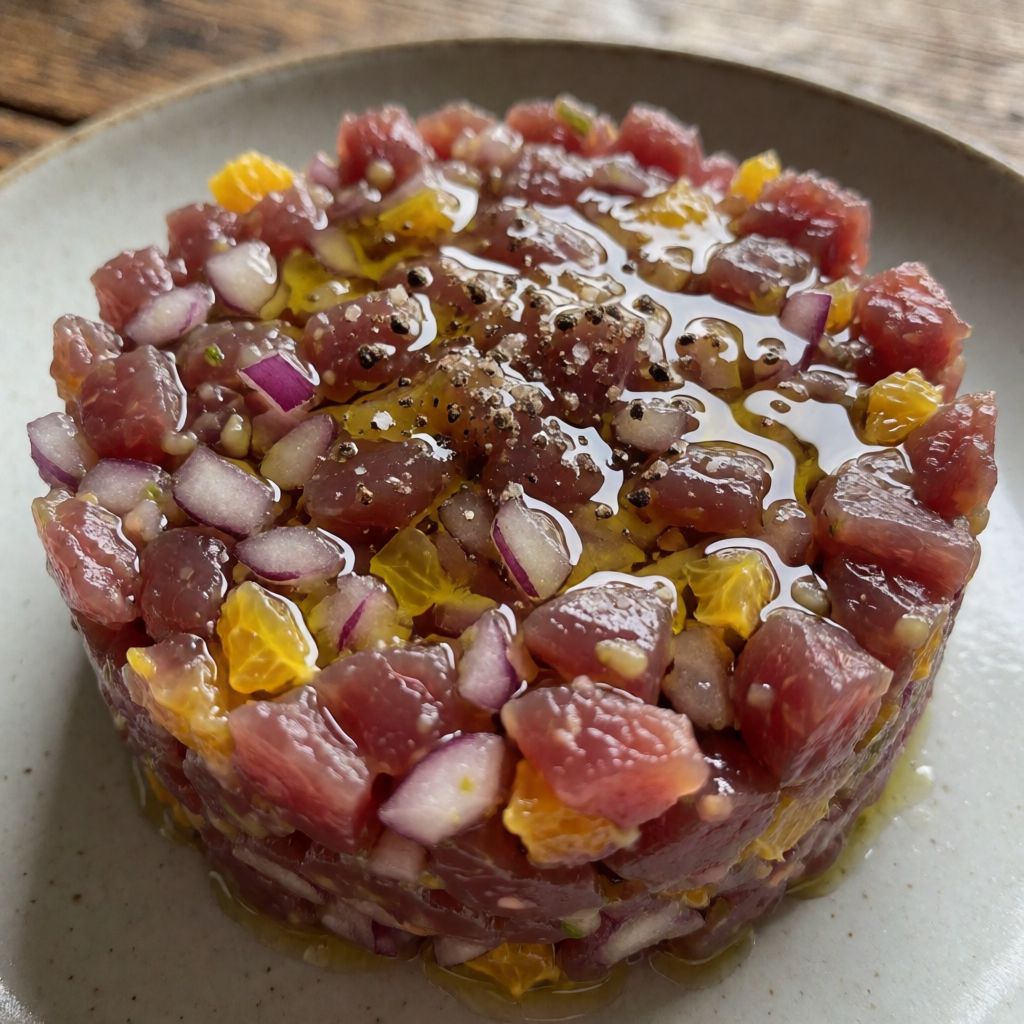
 AI photo
Mini Orange Beef Tartare
A delicate beef tartare paired with sweet orange, red onion and black olives.
Ingredients
- 200 g Beef steak fillet, sirloin or rump, finely chopped
- 1 pcs Red onion
- 2 pcs Orange
- Olive oil to taste
- Salt to taste
- Black pepper to taste
- Black olives, pitted to taste






Steps
Finely chop the beef steak by hand, season with grated orange zest, salt and black pepper, and mix well.
Shape into small timbale-style portions and place them on orange slices.
Top with thin rings of red onion and pitted black olives, then drizzle with olive oil.
What was changed
Beef steak was used so the beef tartare is made from a cut of meat suitable for eating raw, rather than pre-ground mince.
This isn't tartare in the French sense — no egg yolk, no capers, no mustard holding it together. It's raw beef dressed with orange zest and oil, built on orange slices, so the whole thing lives or dies on two things: how fresh that beef is, and how you cut it.
Some say raw beef is inherently risky, full stop — no. Cooking isn't what makes meat safe, freshness and handling are. A fillet bought that morning from someone who trims to order is safer raw than a three-day-old supermarket pack seared hard. Ask your butcher what came in today, not what's on special.
The knife matters more than the cut. You chop by hand, not run it through a mincer, because a mincer's blades generate friction, and friction makes heat, and heat is the enemy of raw meat — it starts the proteins breaking down before anyone's eaten anything, and the texture goes from tartare to paste. A knife, used with a light rocking motion, keeps the meat cool and keeps it in pieces, not mush.
Timing here isn't about minutes on a stove, because there's no stove. It's about sequence: zest and season right before you shape it, not an hour before, because salt pulls water out of meat the moment it touches it. Salt too early and you get a puddle of pink liquid and grey meat sitting in it — not appetising, and not what you paid for.
The beef: fillet, sirloin or rump, finely chopped by hand — all three work because they're lean and tender enough to eat raw without connective tissue getting in the way. Rump is cheaper and has slightly more character, fillet is softer and blander, sirloin sits between. Whatever you choose, it needs to come from a cut you trust enough to eat uncooked, bought the same day if you can manage it, kept cold in the fridge right up until you start chopping. There's no substitute here that doesn't change the dish into something else — this only works with beef you'd be happy to see pink in the middle of a steak.
The orange does two jobs, not one. Zested, it gives sharp citrus oil straight onto the meat — this is where the flavour actually lives, so use a fine grater and stop before you hit the white pith, which is bitter and does nothing for you. Sliced, it's the plate the tartare sits on, and here you want an orange that's firm enough to hold a slice without falling apart — a navel orange does this better than a very juicy, soft-skinned variety that collapses under a knife.
Red onion, cut into thin rings — thin matters, because raw onion in a thick ring is a mouthful of onion, and thin is a note of sharpness against the meat and citrus. If red onion is too much for you, a milder shallot does the same job with less bite. Black olives, pitted, bring salt and a little bitterness that cuts through the richness of raw beef and oil — any good black olive works, kalamata if you want more depth, but don't reach for the bright green brined kind, they're a different flavour altogether and too assertive here.
Olive oil should have no character of its own strong enough to fight the orange — a light, fruity oil rather than a heavily peppery one. If you don't have olive oil, any neutral oil with a clean taste will carry the seasoning without arguing with it, though you lose a little of the roundness olive oil gives.
Shaping it into a neat timbale needs no special kit — a small ramekin or even a cookie cutter pressed into the meat and lifted away gives you the same clean round shape a chef's mould would. Don't rush this part. Patience here isn't about waiting for something to cook, it's about handling the meat gently enough that it keeps its shape and doesn't turn gluey under your hands — press it together just enough to hold, then leave it alone.
Serve it the moment it's plated. This isn't a dish that improves sitting in the fridge under clingfilm for later — the citrus starts working on the meat's surface the second it touches it, and what's pleasant after five minutes turns tired after fifty.