
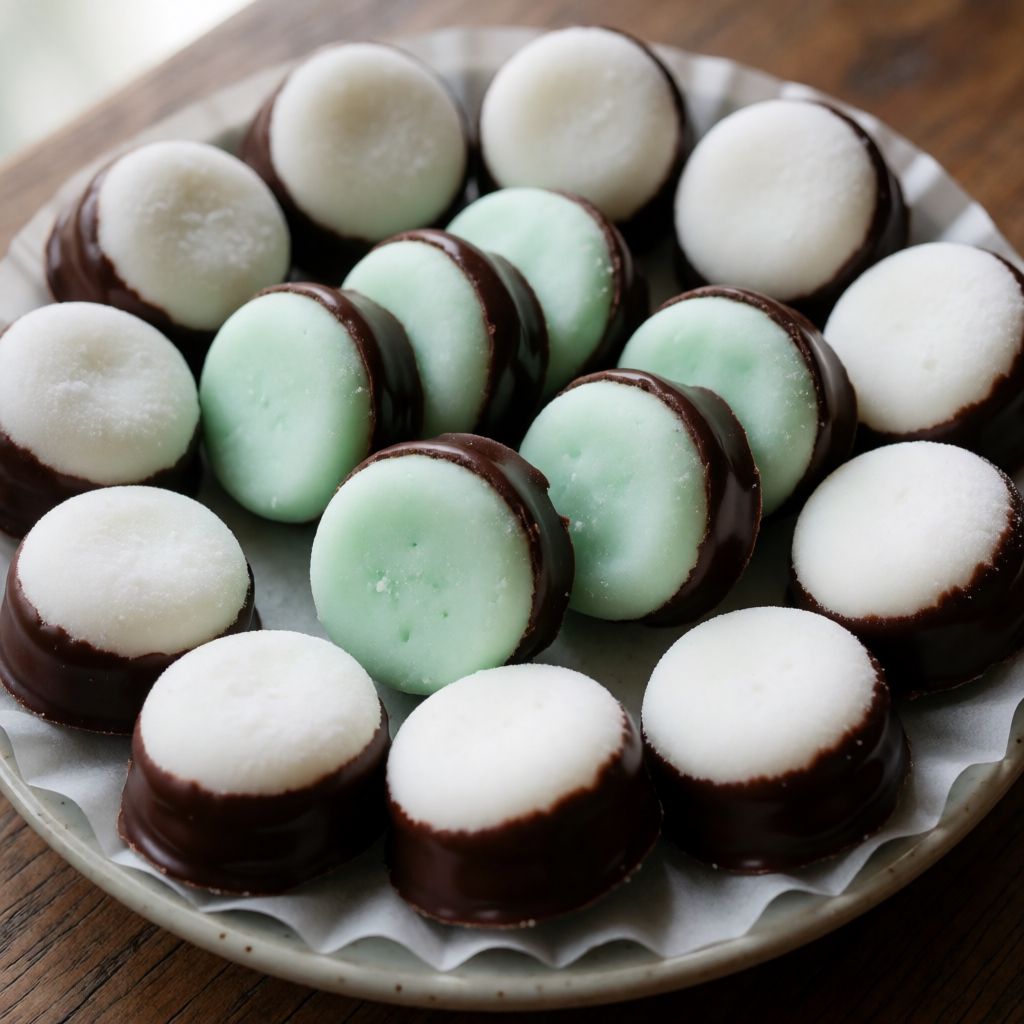
 AI photo
Peppermint Creams
A classic no-bake sweet of whipped egg white and icing sugar, flavoured with peppermint and topped with dark chocolate.
Labels are worked out automatically from the ingredients and can be wrong. Check the packaging if it matters to you.
Ingredients
- 1 pcs egg white
- 200 g icing sugar
- 10 pcs peppermint extract drops, or to taste
- 100 pcs dark chocolate buttons




Steps
Whisk the egg white with the icing sugar until thick and glossy, then add the peppermint extract to taste.
5 minSpoon the mixture into a piping bag fitted with a star nozzle and pipe small, neat rounds onto a sheet of baking parchment.
10 minPlace a little melted chocolate or a few chocolate buttons in the centre of each round.
5 minLeave the sweets to dry on the kitchen worktop until the next day.
720 minIf you like, cover with a wire rack and then a clean tea towel to let air circulate.
2 minThe sweets are ready when they turn crisp and lift easily off the paper.
Peppermint creams are not baked, they're dried. That's the whole mechanism: egg white whipped with icing sugar makes a stiff, glossy paste — the albumen wraps round the sugar crystals and traps air, which is what lets you pipe a shape and have it hold. There's no cooking of the egg here at all. The work that makes these "set" happens afterwards, in the open air, as water slowly leaves the paste and it turns from soft and tacky to crisp and firm.
What decides whether it works is two things: how stiff the paste is before you pipe it, and how dry the air is while it sits. Under-whisk and you get a mix with too much water locked in and not enough sugar to bind it — the rounds slump, and stay damp at the base no matter how long you leave them, because there's nothing for that water to do but sit there. Over-whisk, or get any grease in the bowl from a stray fleck of yolk, and the egg white won't hold air at all, and you're back to syrup.
Some say put them in the fridge to set faster — no, the opposite happens. Cold air holds more moisture close to a surface than warm air does, so a fridge slows evaporation rather than speeding it, and the moment you bring a cold cream back out, it fogs with condensation and undoes whatever drying it had managed. These want a warm, dry, still spot on the worktop — away from the kettle, away from a steamy hob — not a chilled one.
The egg white is doing a job, not providing flavour — it's the net that traps air and sets the sugar's structure. Use it at room temperature; cold straight from the fridge it whips slower and never quite fills with as much air. The one thing that will sink you is grease — a smear of yolk, a bowl that still has a trace of butter in it — because fat collapses the air bubbles as fast as you beat them in. A wipe of the bowl with a bit of vinegar or lemon juice if you're not sure it's clean costs nothing and saves the whole batch.
Icing sugar is chosen for its grain, not its sweetness — it's already ground fine enough to dissolve smoothly into the egg white with no grit. Caster sugar in its place would leave you with a gritty paste that never fully turns glossy, because the crystals are too coarse to dissolve on a cold whisk. Most UK icing sugar also carries a trace of cornflour, which happens to help the mix stay smooth rather than clumping — a small bit of luck built into the bag you buy at the supermarket, not a trick you need to engineer yourself.
The mint is the one ingredient where "to taste" actually means something, because mint flavourings vary wildly in strength. Peppermint essence (alcohol-based) is mild enough that you can be generous; peppermint oil is many times stronger, and one drop too many tips the whole batch from fresh to medicinal — menthol numbs the tongue past a point, so more drops don't buy you more mint, they buy you soap. Add a few, taste the raw paste off the spoon, add more only if it's genuinely flat.
Dark chocolate isn't there for looks — it's there to argue with the sugar. A pure sugar-and-egg-white paste is sweet with nothing to push back against it, and dark chocolate's bitterness and lower sugar content does that job. Milk chocolate in its place isn't a failure, just a different, sweeter sweet, with the mint pushed further into the background. Any chocolate with a decent hit of cocoa solids will do the same work as the buttons — a broken-up bar of plain chocolate, melted or left in pieces, behaves the same way.
The star nozzle earns its keep by giving the cream ridges, which means more surface area exposed to air, which means faster, more even drying. A food bag with a corner snipped off will pipe a smooth round instead — nothing wrong with that, it'll just take a touch longer to crisp, because there's less surface doing the work. Don't go by the clock here either; go by the lift test.
This is a sweet-shop sweet, not a plated dessert, and the scale — a hundred tiny ones from one egg white — tells you that: it's a tin-for-Christmas, plate-at-the-fete kind of batch, a way of using up a spare egg white left over from a custard or a cake, which is exactly how it earned its place in English kitchens in the first place, long before anyone thought of it as nostalgic. The patience it asks for — a full night, sometimes more — isn't a gap in the recipe. It's the ingredient doing the actual work, and there's no oven setting that replaces it without risking a melted centre or a cooked egg white.